 English
 Español
 Français
 日本語
 한국어
 Deutsch
 Português
 Русский
 中文 (中国)

- I. Root Cause: Structural Defects of Perforated Pipes and Strainers
- II. Technical Solution: The “Narrow Outside, Wide Inside” Logic of V-Shaped Slots
- III. Application Scenarios: From Resin Retention to Distribution Optimization
- IV. Engineering Validation: Quantifiable Improvement Effects
- V. Industry Trend: From “Component” to “System Solution”
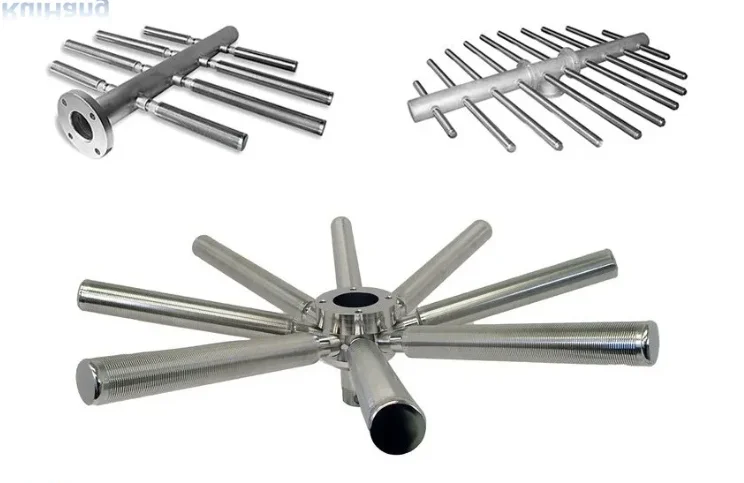
In ion exchangers, high-speed mixed beds, sand filters, and other water treatment equipment, uneven water distribution and filter media loss have long coexisted and reinforced each other: high flow velocities in preferential flow zones scour the filter bed, and filter media is carried downstream and lost; once media is lost, the uneven bed thickness further aggravates preferential flow. The wedge wire header is emerging as a key technical solution that cuts this vicious cycle at its root.
I. Root Cause: Structural Defects of Perforated Pipes and Strainers
Conventional distribution/collection devices mostly use perforated pipes or strainers (water caps). Whether the outflow from each hole on a perforated pipe is uniform depends on the ratio of orifice resistance to pipe friction resistance. When pipe friction resistance approaches or exceeds orifice resistance, holes near the inlet discharge too much and distal holes too little, producing preferential flow. The open area ratio of perforated pipes is typically only 1%–3%, so orifice resistance is insufficient to “overpower” pipe friction, and distribution uniformity cannot be guaranteed.
Filter media loss is another predicament. The hole diameter of a perforated pipe is determined by machining precision. When media particle size is small, any hole larger than the smallest particle causes continuous media loss. Industry data show that common causes of filter media washout include excessive backwash intensity, improper media gradation, uneven backwash water distribution, and displacement of support layers. The Qinhuangdao Tanghe Water Plant once conducted a systematic investigation into media washout and found that corrosion, rupture, and blockage of distribution mains and branches, together with air entrainment during emptying of the backwash water tank causing rupture of the media bed, were the main causes of quartz sand loss—in 2005 alone, 53 tons of quartz sand were lost, 100,000 tons of backwash water were wasted, equivalent to RMB 297,000.
II. Technical Solution: The “Narrow Outside, Wide Inside” Logic of V-Shaped Slots
The core structure of a wedge wire header consists of wedge-shaped metal wires and support rods welded together to form continuous slots. Its key design lies in three aspects.
Geometric advantage of the V-shaped cross-section. The wedge wire cross-section is trapezoidal, with the smallest opening on the outside, gradually expanding inward. This structure simultaneously satisfies two functions: the outer narrow slot is smaller than the smallest filter media particle, achieving precise retention; if a particle侥幸 enters the slot, the expanding internal space prevents it from becoming “wedged,” making it easier to flush out during backwashing. Product literature states that the V-shaped zone “provides an appropriate release angle, facilitating smooth removal of impurities during backwashing.”
Continuous slots and high open area ratio. Unlike the discrete holes of perforated pipes, wedge wires form continuous linear slots with an open area ratio of 10%–40%, far higher than perforated pipes of the same diameter. The high open area ratio makes slot discharge resistance significantly dominate pipe friction resistance, thereby satisfying the hydrodynamic conditions for uniform distribution. Industry selection guidelines indicate that slot size is typically selected as 2/3 of the media particle size—for example, a 0.3 mm slot corresponds to approximately 0.45 mm media.
Fully welded integral structure. The wedge wires and support rods form a stable triangular support, capable of withstanding media loads and backwash water impact. Materials can be 304/316L stainless steel, with a design life of 15–30 years and essentially maintenance-free. Resin trap product specifications show that wedge wire slot tolerance can be controlled within 0.05 mm, with filtration accuracy ranging from 0.02 mm to 1.0 mm.
III. Application Scenarios: From Resin Retention to Distribution Optimization
The application of wedge wire headers has expanded from simple resin retention to systematic distribution optimization.
Ion exchange and mixed bed systems. Resin traps are installed in the outlet piping of water treatment equipment as safety devices to prevent accidental resin loss. Their slot size is customized according to resin particle size; continuous slots provide high open area to minimize pressure loss, and the V-shaped surface facilitates backwash cleaning. In mixed bed intermediate drainage scenarios, wire-wound intermediate drainage headers perform four functions: regeneration drainage, uniform liquid distribution, resin retention, and pressure stabilization/flow equalization, with commonly used slot sizes of 0.2–0.5 mm.
Industrial wastewater pretreatment. Zhejiang Petroleum & Chemical Co., Ltd.’s industrial wastewater contains oil, slag, and high suspended solids, causing frequent clogging of conventional screens. After adopting 316 stainless steel wedge wire screen plates, with 1 mm filtration accuracy and 35 m³/h single-unit capacity, suspended solids removal rate stabilized above 96%, with two years of continuous trouble-free operation and maintenance costs reduced by nearly 40%.
IV. Engineering Validation: Quantifiable Improvement Effects
The effectiveness of wedge wire technical solutions has been validated in actual projects, although systematic public disclosure of quantitative data remains insufficient.
Based on known industry cases, the effects are concentrated in three dimensions: zero resin loss—after replacing original distribution devices with stainless steel wire-wound headers in ion exchanger retrofits, resin leakage was effectively controlled; significant reduction in O&M costs—the Zhejiang Petrochemical hydraulic screen project reduced maintenance costs by nearly 40%, saving over RMB 500,000 annually in energy and labor; improved system stability—two years of continuous trouble-free operation validated the durability of the wedge wire structure in industrial wastewater environments.
It should be noted that publicly available data on quantitative distribution uniformity of wedge wire headers (such as uniformity coefficients and multi-point flow deviation rates) remain relatively scarce, with most product descriptions remaining at qualitative levels such as “extremely uniform distribution” and “no dead zones.” This suggests that when promoting this technology, the industry needs to address the credibility gap in engineering data.
V. Industry Trend: From “Component” to “System Solution”
Wedge wire headers are undergoing a positioning shift from a single component to a systematic solution. In petrochemical, power, and municipal sectors, wedge wire hydraulic screens have been used as pretreatment units to replace or supplement fine screens, with wedge wire slot accuracy reaching 0.1 mm. The application scenarios of Resin trap screens have also expanded from product water pipelines to backwash pipelines—since temperature-related flow variations may cause expensive resin to be discharged into drains, adding wedge wire traps in backwash lines has become an industry convention.
This trend is driven by two factors: increasingly stringent environmental regulations forcing companies to reduce wastewater discharge from resin and media loss, and growing awareness of full life-cycle cost accounting. The “invest once, benefit for years” characteristic of wedge wire headers gives them stronger competitiveness than traditional solutions in cost-sensitive industrial scenarios.
Please login to write a comment after