 English
 Español
 Français
 日本語
 한국어
 Deutsch
 Português
 Русский
 中文 (中国)

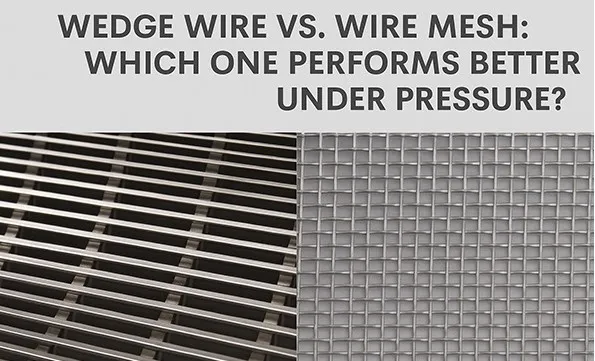
In the field of industrial filtration, selecting the proper Filter Media is a critical decision that directly impacts process efficiency and operating costs. Among the wide array of options available, two common types of metallic Filter Media—wedge wire screens (also known as Vee-Wire® screens, Johnson screens) and Woven Wire Mesh—often leave purchasers and engineers in a dilemma. They may appear similar at first glance, but differ vastly in structural principles, performance characteristics, and suitable applications.
This article provides an in-depth analysis of the core differences between these two screen types, along with a clear Selection Guide to help you make the most informed decision.
I. Structural Principles: A Fundamental Difference from the Start
To understand their respective strengths and weaknesses, we must begin with their “origin”—the manufacturing process.
-
Wedge Wire Screen: This is not a woven product but rather a welded structure. Its core consists of a series of V-shaped or wedge-shaped profile wires (Vee-Wire) evenly wound around a set of longitudinal support rods, welded at each intersection. This forms a continuous, precise slot that is an integral, rigid unit in itself.
-
Woven Wire Mesh: This is the more familiar “mesh,” formed by interweaving warp and weft wires in various patterns such as plain weave, twill weave, or Dutch weave. Its aperture size is described by mesh count (the number of openings per linear inch), and the structure is relatively flexible.
II. Performance Comparison: Key Differences Across Six Dimensions
These fundamentally different “genetic codes” result in significantly different performance characteristics in industrial applications.
| Performance Dimension | Wedge Wire Screen (Vee-Wire® Screen) | Woven Wire Mesh |
|---|---|---|
| Mechanical Strength | Extremely high. The welded structure is self-supporting and highly resistant to compression and deformation, making it ideal for high-pressure and high-solids-load applications. | Relatively weaker. Under high pressure and high flow rates, single-layer mesh is prone to deformation, leading to inaccurate filtration ratings. Often requires backing supports or sintered multi-layer construction for reinforcement. |
| Filtration Precision | Excels in coarse to medium precision filtration (above 50 microns). Special manufacturing can achieve slots below 20 microns, but at a higher cost. | Offers a wider and finer precision range, easily achieving 20-micron, 10-micron, or even 1-micron precise filtration. |
| Open Area & Pressure Drop | Higher open area. The V-shaped wire profile ensures that fluid flow (from outside to inside) encounters a gradually widening gap, resulting in lower resistance, less clogging, and consequently, lower pressure drop and energy consumption. | Pursuing higher precision often requires fine wires and/or multi-layer weaves, which reduce open area and lead to greater pressure drop losses. |
| Clogging Resistance & Cleanability | Resistant to clogging and easy to clean. Fluid contacts the smooth surface of the V-shaped wire, making it difficult for solids to become lodged. The smooth profile also ensures excellent backwashing efficiency. | The cross-over points of the weave structure, particularly in multi-layer composites, can trap and lodge particles, making cleaning relatively more difficult. |
| Typical Applications | Solid-liquid separation, sizing, dewatering. Ideal for water wells, geothermal, mining, chemical processing, food (sugar, starch), and brewing (wort filtration) where strength, anti-clogging, and low energy consumption are critical. | Precise filtration. Suitable for fine chemicals, pharmaceuticals, oil purification, and other applications requiring extremely high precision for liquid or gas filtration. |
| Customization Flexibility | Slot size, number of support rods, and materials (stainless steel, duplex steel, Hastelloy, etc.) can all be customized as needed. | Offers an extremely wide range of mesh counts, weave patterns, and materials, particularly excelling in specialty metals (titanium, nickel, etc.). |
III. How to Choose: A Simple Decision-Making Guide
With a clear understanding of the differences, you can make your choice based on the following key questions:
-
Is your operating condition severe? Does it involve high pressure, high flow velocity, or significant solids abrasion? If yes, the superior strength of a wedge wire screen is your top priority.
-
Is energy saving and pressure drop reduction your primary goal? If your process is sensitive to pressure drops and you aim to reduce pumping energy costs, the high open area and low resistance of a wedge wire screen provide a distinct advantage.
-
How high is your filtration precision requirement? If the requirement is above 50 microns, either type can work, but a wedge wire screen offers superior longevity and anti-clogging performance. If you need below 20 microns or even finer filtration, a Woven Wire Mesh is typically a more mature and cost-effective choice.
-
Does your system rely heavily on online backwashing? If your system requires frequent online backwashing to maintain continuous operation, the smooth surface and V-shaped slot design of a wedge wire screen make its cleaning efficiency far superior to that of woven mesh.
Conclusion
There is no single “better” screen—only the one that is “better suited” for your specific process.
-
If your application involves water wells, mining, primary food processing, chemical coarse filtration, etc., where you prioritize high strength, long service life, low energy consumption, and anti-clogging, then the wedge wire screen (Vee-Wire® Screen) is your ideal choice.
-
If your process demands ultra-high-precision clarification filtration, then a Woven Wire Mesh may be the more appropriate solution.
As an experienced industrial filtration solution provider with decades of expertise, Jinjue offers a comprehensive product range—from wedge wire screens to various woven meshes—alongside professional technical support. Whether you need standard products or custom-engineered solutions, we are committed to helping you find the most precise and efficient filtration solution for your application. Please feel free to contact our technical team for tailored selection recommendations based on your specific operating conditions.
Please login to write a comment after