 English
 Español
 Français
 日本語
 한국어
 Deutsch
 Português
 Русский
 中文 (中国)

- 1. Why Softening Systems Need Resin Traps
- 2. Structural Advantages and Material Selection of Wedge Wire Elements
- 3. Slot Selection: Matching the Element to the Resin
- 4. Pressure Drop and Hydraulic Design
- 5. Installation and Operational Maintenance
- 6. Selection Decision Framework: 304 vs 316L
- 7. Wedge Wire vs. Woven Mesh and Perforated Plate
- 8. Conclusion
1. Why Softening Systems Need Resin Traps
Ion exchange water softening relies on sodium-form cation resin to exchange calcium and magnesium ions in water. The most widely used softening resin, 001×7 strong acid cation exchange resin, has a specified particle size range of 0.315–1.25 mm, with an effective diameter of 0.40–0.70 mm and a lower limit particle size (below which particles constitute ≤1%) of less than 0.315 mm . This means that under normal conditions, intact resin beads are larger than 0.3 mm. However, over long-term operation, resin particles can fracture and escape due to osmotic shock during regeneration, oxidative degradation, or mechanical damage to upstream distribution systems.
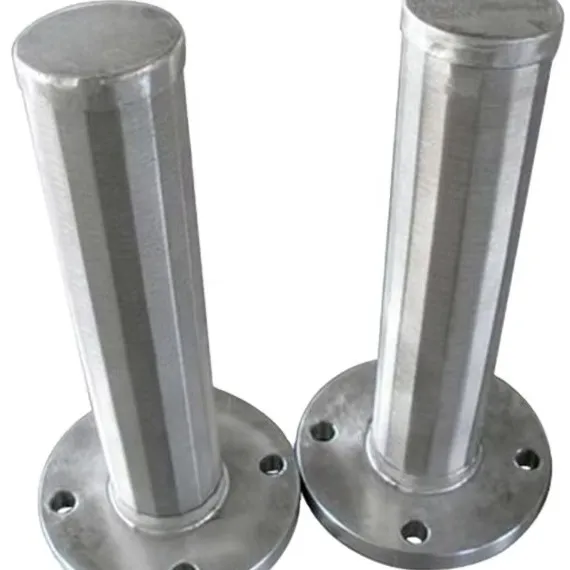
Once resin enters downstream piping, the consequences are costly. Particles can block valves and nozzles, accelerate wear on pump impellers, and foul reverse osmosis membrane surfaces. A resin trap is installed in the straight pipe section at the exchanger outlet. Its filter element, with slots smaller than the resin particle size, retains escaping particles on the outer surface while clean water flows out from the center—completing a “final barrier” interception without significantly increasing system pressure drop.
The economic logic is straightforward. Res-Kem, a water treatment equipment supplier, describes resin traps as “inexpensive insurance” for industrial water systems. In their white paper, they present case examples demonstrating that depending on the plant or process, the payback period for a resin trap can be “nearly instantaneous” when compared against the cost of downstream equipment damage or product contamination caused by resin escape . For softening systems serving boilers, cooling towers, or RO trains, a single resin release event can require membrane replacement or extensive pump repair—costs that dwarf the price of a capture device.
Patent literature confirms this design philosophy in demanding applications. Nuclear power plant condensate polishing systems employ resin traps in series downstream of cation exchangers and mixed beds, with stainless steel trapezoidal wire-wrapped tube slots set at 0.15 mm and 0.05 mm respectively, achieving graded retention of different resin particle sizes. This engineering practice demonstrates the reliability of wedge wire elements in high-pressure, high-flow industrial water treatment environments.
2. Structural Advantages and Material Selection of Wedge Wire Elements
Wedge wire (also known as trapezoidal wire wrap or Johnson screen) is characterized by a trapezoidal wire cross-section: V-shaped openings are “narrow outside, wide inside,” and the filtration surface is smooth and free of edges. This geometry delivers two direct benefits. First, slot size is precisely determined by the narrow outer opening, with precision controllable to ±0.01 mm to ±0.03 mm according to supplier specifications. Second, particles are retained on the smooth outer surface rather than wedged into the slots, making them easier to dislodge during backwashing—the so-called “self-cleaning” effect.
Regarding materials, 304 stainless steel is suitable for general softening water and food-grade pure water applications. 316L, with its molybdenum addition of approximately 2–3%, offers measurably stronger resistance to chloride pitting . A 2021 study published in the Journal of Chinese Society for Corrosion and Protection directly compared 304L and 316L in chloride-containing solutions. Using electrochemical methods, the researchers measured pitting potential and critical pitting temperature (CPT) in simulated solutions and 3.5% NaCl at 30°C and 60°C. The key findings: 316L exhibited higher pitting potential and higher CPT than 304L in the same environment, indicating superior pitting resistance. Additionally, when test temperature increased from 30°C to 60°C, the pitting sensitivity of both steels increased significantly .
For softening applications, this data carries practical weight. Sodium chloride is the regenerant used in softening systems. Even with thorough rinsing, residual chloride remains in the resin bed and can be present in the outlet water, particularly immediately after regeneration. A resin trap fabricated from 304 may perform adequately in low-chloride, ambient-temperature softening service. But in applications where chloride levels are elevated (coastal groundwater, systems with incomplete rinse cycles) or where the softened water is warm (condensate polishing at 50–60°C), the CPT advantage of 316L becomes a reliability factor rather than a luxury specification. The temperature effect documented in the study—heightened pitting sensitivity at 60°C versus 30°C—is directly relevant to boiler feedwater and condensate applications where resin traps may operate at elevated temperatures.
Supplier product pages show that the same filter element series can use 302, 304, 316, 304L, or 316L wire, with outer diameters from 20 mm to 1000 mm, lengths from 50 mm to 6000 mm, and slot ranges from 0.02 mm to 35 mm; end connections include threaded, welded, and flanged options. In resin trap selection for softening water, 304 and 316L are the two most commonly specified grades—the former for cost control, the latter for extended maintenance intervals and chloride-bearing or elevated-temperature service.
3. Slot Selection: Matching the Element to the Resin
Slot size is the most critical parameter of a resin trap. The engineering logic begins with the resin particle size distribution. For the standard softening resin 001×7, the specified range is 0.315–1.25 mm, with particles below 0.315 mm constituting no more than 1% of the batch . A resin trap slot must therefore be smaller than the smallest particles that the system is expected to retain. If the goal is to capture intact resin beads, a slot below 0.3 mm is theoretically sufficient. But in practice, broken resin fragments—generated by thermal cycling, osmotic shock, or mechanical attrition—can be substantially smaller.
Industry technical literature gives a standard slot series of 0.15 mm, 0.20 mm, and 0.25 mm. Standard cation and anion resin typically uses 0.20 mm; 0.15 mm is chosen for fine-particle resins or when significant resin breakage occurs. Slots exceeding 0.30 mm are generally considered unacceptable, as resin penetration and trap failure become likely. Res-Kem’s stainless steel resin traps use wedge wire slots of 0.010 inches, or 254 microns (0.254 mm), as their standard . This value sits at the upper end of the recommended range—suitable for retaining intact 001×7 beads but offering less margin against fine fragments.
Engineering examples from demanding service fall within or below this range. In the nuclear plant patent discussed earlier, resin trap A uses 0.15 mm or 0.25 mm slots, while B uses 0.05 mm or 0.20 mm, depending on operating conditions and series position. For softening systems, the practical selection logic can be summarized as follows:
-
0.25 mm slot: Adequate for uniform, intact resin with well-maintained upstream distribution. Higher open area and lower pressure drop.
-
0.20 mm slot: The balanced choice for most softening applications. Retains intact beads with margin against minor breakage while maintaining acceptable throughput.
-
0.15 mm slot: Selected when resin breakage is known to occur, when fine-particle resins are used, or when downstream equipment is particularly sensitive to even small resin fragments.
If resin breakage is observed during operation—evidenced by increasing pressure drop or visible fines in the trap—the response should be twofold: reduce slot size if the existing element allows, and simultaneously investigate upstream strainer or distributor damage, which is the root cause of most resin loss events.
4. Pressure Drop and Hydraulic Design
A resin trap must retain resin without imposing excessive head loss on the softening system. The design target cited by equipment suppliers is a clean pressure drop of approximately 2 psi (about 0.014 MPa) at rated flow . This value aligns with the operational guidance that normal differential pressure across the trap should remain below 0.05 MPa, with cleaning required when it exceeds 0.1 MPa.
Achieving this low pressure drop depends on the open area of the wedge wire screen relative to the pipe cross-section. Wedge wire elements typically achieve open area ratios in the 25–40% range, depending on wire profile and slot size. For comparison, woven wire mesh with comparable aperture sizes can achieve open areas of 36–48% at 0.150–0.200 mm apertures, but the geometry of woven mesh creates a less favorable flow path and poorer backwash recovery . The V-shaped slot of wedge wire maintains a relatively straight flow channel through the screen thickness, reducing the tendency for particles to lodge and enabling more complete cleaning during backwash.
The pressure drop across the trap is not constant over the service cycle. As resin accumulates on the screen surface, the effective open area decreases and differential pressure rises. This behavior is intentional: the rising ΔP serves as the operational signal that cleaning is required. The trap should be sized so that even with a moderate accumulation of resin, the pressure drop remains within the system’s available head. A trap that is undersized relative to flow will show elevated ΔP from the start and will require more frequent cleaning, increasing operator burden and the risk of resin bypass if cleaning is deferred.
5. Installation and Operational Maintenance
Res-Kem specifies that resin traps should be installed in the product water line of most resin and media-based water treatment equipment, explicitly including softeners alongside dealkalizers, condensate polishers, demineralizers, and carbon filters. They also recommend considering a resin trap in the backwash lines of ion exchange systems, because temperature-related flow changes during backwash can send expensive resin to drain . This dual installation—outlet line plus backwash line—is particularly relevant for softening systems, where regeneration and backwash cycles create the highest risk of resin displacement.
The standard stainless steel resin trap design includes a clear acrylic or borosilicate glass sight glass that provides visual indication of resin accumulation or upstream failure. A small ball valve allows for resin recovery after a loss event. These features transform the trap from a passive screen into a diagnostic instrument: when resin appears in the sight glass, the operator knows immediately that upstream distribution has failed and can take corrective action before significant media loss or downstream damage occurs.
Routine maintenance follows a straightforward sequence:
-
Monitor differential pressure. Normal operation: ΔP < 0.05 MPa. Cleaning trigger: ΔP > 0.1 MPa.
-
Perform resin discharge when indicated. Close upstream and downstream valves, vent pressure, open the bottom discharge port, and use a small flow of backwash water to flush retained resin into a container for inspection and possible reuse.
-
Inspect the sight glass. Any visible resin accumulation between scheduled cleanings suggests an upstream problem requiring investigation.
-
Inspect the wedge wire element. After discharge, check for slot enlargement, wire deformation, or perforation. Any mechanical damage requires element replacement—a damaged screen cannot be relied upon for retention.
The frequency of resin discharge depends on upstream conditions. Under normal operation with intact resin and functional internals, monthly inspection is reasonable. If resin loss is persistent, inspection should be increased to weekly, and the upstream exchanger should be opened for strainer and distributor inspection. Resin appearing in the trap is never a “trap problem”—it is a signal that something upstream has failed.
6. Selection Decision Framework: 304 vs 316L
The choice between 304 and 316L should be made on the basis of water chemistry, temperature, and the consequences of failure—not on a blanket preference for the more corrosion-resistant alloy. The following framework synthesizes the available corrosion data and application considerations:
Select 304 when:
-
Influent chloride concentration is consistently low (below approximately 50 mg/L).
-
Operating temperature is ambient or slightly elevated (below 40°C).
-
Regeneration rinse is thorough and chloride carryover to the outlet is minimal.
-
The softening system serves non-critical downstream equipment where a resin release would be inconvenient but not catastrophic.
-
Lifecycle cost is a primary constraint and the operating envelope is well-characterized.
Select 316L when:
-
Chloride levels are elevated or variable—coastal groundwater, high-salinity feed, or systems with uncertain rinse effectiveness.
-
Operating temperature exceeds 50°C (condensate polishing, boiler feedwater preheat, or enclosed equipment rooms).
-
The resin trap is installed in a system where even brief pitting initiation could lead to through-wall penetration and loss of containment.
-
Downstream equipment (RO membranes, high-pressure pumps, turbine components) makes resin release or trap failure economically unacceptable.
The 2021 corrosion study provides the quantitative basis for this split. At both 30°C and 60°C, and in both simulated solution and 3.5% NaCl, 316L maintained higher pitting potential and higher CPT than 304L . The temperature sensitivity finding—that pitting susceptibility increases markedly from 30°C to 60°C—reinforces the case for 316L in warm softening service. A 304 trap that performs well at 25°C in low-chloride water may become vulnerable at 55°C if chloride is present, even at modest concentrations.
It is worth noting that the resin trap environment in a softening system is not typically one of continuous high-chloride exposure. Chloride is introduced during regeneration and should be rinsed away before service resumes. The risk scenario is therefore transient: a incomplete rinse, a regeneration fault, or a stagnant period following regeneration can leave elevated chloride in contact with the trap. Under these conditions, 316L’s molybdenum content provides a margin of safety that 304 lacks. The decision is ultimately one of risk tolerance and consequence severity.
7. Wedge Wire vs. Woven Mesh and Perforated Plate
Existing literature claims wedge wire is “less prone to clogging, backwashable, and has large flow area,” but comparative data specific to resin trap service is scarce. The following points summarize what can be reasonably concluded from available sources and what remains to be verified:
Open area: At 0.200 mm aperture, woven wire mesh can achieve approximately 48% open area, and at 0.150 mm, about 36% . Wedge wire open area depends on the wire profile and slot size; typical values fall in the 25–40% range. Woven mesh may therefore offer equal or higher open area at comparable apertures. However, open area alone does not determine performance.
Flow path geometry: The V-shaped slot of wedge wire creates a flow channel that narrows toward the filtration surface, reducing the tendency for particles to bridge and lodge. Woven mesh has a more complex three-dimensional structure with intersecting wires, which can trap particles more tenaciously and complicate backwash removal.
Backwash recovery: The “self-cleaning” claim for wedge wire rests on the smooth outer surface and V-shaped slot geometry. Particles retained on the surface should release more readily during reverse flow than particles lodged within the interstices of woven mesh. Quantitative recovery data—pressure drop before and after backwash for each screen type under identical resin loading—would strengthen this argument, but such data is not present in the available sources.
Mechanical strength: Wedge wire elements are fabricated by welding trapezoidal wire to support rods, creating a rigid cylindrical structure. This construction resists deformation under backwash pressure transients and mechanical handling during element removal. Woven mesh, unless supported by a perforated backing plate, is more susceptible to distortion and damage.
For resin trap service specifically, the wedge wire advantage is most convincing in three areas: resistance to particle wedging (reducing cleaning frequency), structural robustness (surviving repeated maintenance cycles), and the availability of precision slot widths in the 0.15–0.25 mm range with tight tolerances. The open area comparison is less decisive and should not be the primary selection criterion.
8. Conclusion
The role of 304/316L stainless steel wedge wire resin traps in ion exchange water softening systems is not that of a general-purpose “impurity filter” but a dedicated safety barrier against resin particles. Their value lies in reliably retaining escaping resin downstream of precision equipment at low operating pressure drop and with dependable slot precision, while enabling resin recovery and element regeneration through backwashing.
The data assembled here supports three selection principles:
-
Match the slot to the resin, not to a catalog default. The 001×7 softening resin has a specified lower limit of 0.315 mm . A 0.20 mm slot provides a reasonable margin. If breakage is observed, 0.15 mm is preferred. Slots above 0.25 mm offer diminishing retention assurance.
-
Choose 304 or 316L based on chloride and temperature, not on a blanket preference. The documented superiority of 316L in pitting potential and CPT at 30–60°C justifies its selection in warm or chloride-bearing softening service. In cool, low-chloride applications, 304 remains a cost-effective and technically adequate choice.
-
Treat differential pressure as the primary operational signal. A clean ΔP target of approximately 2 psi (0.014 MPa) and a cleaning threshold of 0.1 MPa provide clear operating bands . The sight glass is a diagnostic tool: resin visible between scheduled cleanings indicates upstream failure, not trap malfunction.
A softening system without a resin trap is protected only by the integrity of its internal distribution—a component that degrades with age, thermal cycling, and mechanical stress. The resin trap provides a second line of defense at modest cost, with a payback that can be measured in a single avoided resin release event . In an era of increasingly stringent water quality requirements and expensive downstream equipment, that insurance is difficult to justify omitting.
Please login to write a comment after