 English
 Español
 Français
 日本語
 한국어
 Deutsch
 Português
 Русский
 中文 (中国)

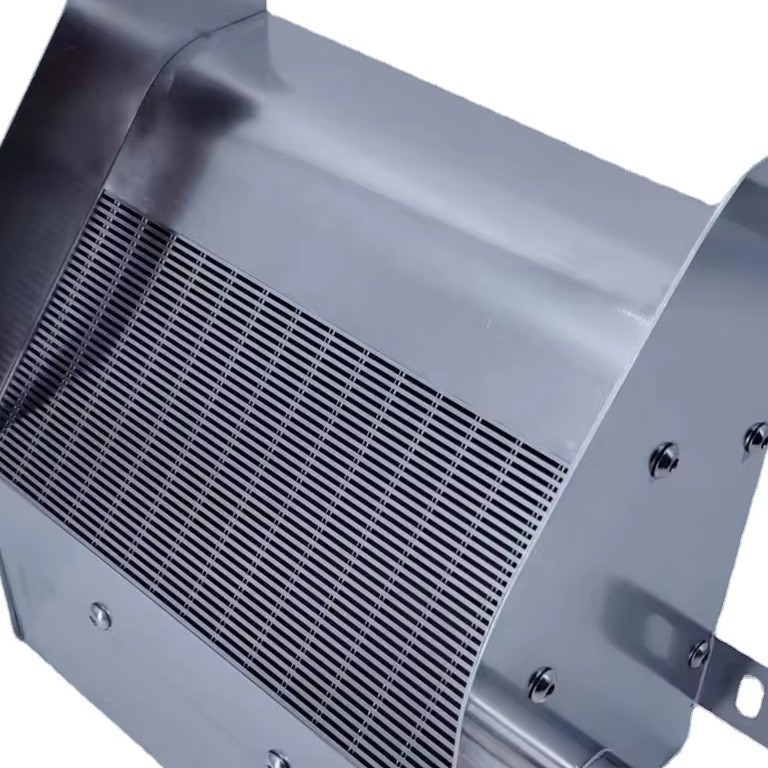
In water intake engineering, separating water from sediment, leaves and fish is an old and stubborn problem. Conventional solutions rely on bar racks, sand traps and mechanical raking equipment — large footprints, constant maintenance. A technology born in coal slurry dewatering took a detour into hydropower intakes half a century later and became the poster child for “passive self-cleaning”: the Coanda screen. Its core is nothing more than a row of inclined wedge wires and a fluid phenomenon named after Henri Coanda.
From coal slurry to intake headworks
The Coanda screen did not start in hydraulic engineering. In 1955 it was developed as a simple wet screening device for coal slurry. Engineers found that a curved deck made of wedge wire showed unusually high throughput on solids-laden liquid and resisted blinding. A few years later it was adopted at small hydropower intakes to replace conventional racks that plugged within hours during leaf fall.
The pivot is logical: coal processing separates water from solids; intake engineering separates solids from water. Physically it is the same operation. In the United States, such screens were installed from the 1980s in systems up to 11.9 MW and flows of 7 m³/s. In Europe, Dulas Ltd. of Wales manufactured them under licence for hydro projects from 0.5 kW to 300 kW.
The Coanda effect: why flow clings to a surface
Henri-Marie Coanda observed the effect in 1910 while testing a jet engine exhaust. The physics is straightforward: when a fluid jet flows along a solid boundary, entrainment on the boundary side is restricted, and the jet tends to remain attached to that surface. If the surface curves gradually away from the jet direction, the flow can stay attached over a considerable distance. A familiar demonstration: hold a finger under a tap and the water bends along the underside of the finger instead of falling straight down.
A Coanda screen exploits this attachment tendency, but its engineering implementation depends on a second element — the inclination of the wedge wire. Hydraulic laboratory testing by the U.S. Bureau of Reclamation (USBR) clarified the mechanism. Without the Coanda effect, flow over a flat-wire deck separates at the high point of each wire and jumps to the next, with almost no water sheared into the slots. With inclined wedge wire — each wire’s upstream edge displaced into the flow — the Coanda effect keeps the water attached to the wire surface and guides it toward the opening formed by the offset of the next downstream wire. A thin layer is sheared off through the deck.
USBR’s conclusion is worth quoting precisely: the high capacity is primarily attributable to the shearing action of the inclined-wire construction, while the contribution of the Coanda effect is “of uncertain importance.” The effect does help keep flow in contact along the full deck length and thus sustains capacity — but the inclined wire, not the attachment phenomenon alone, does the heavy lifting.
Slot width: the parameter that defines the screen’s character
The interception precision of a Coanda screen is set by slot width — the clear opening between adjacent wedge wires. That number maps directly to what the screen retains and what it passes.
Natural Resources Wales provides explicit engineering guidance: at most upland abstraction sites, the maximum slot is 3 mm; in reaches close to the sea, slots must be as fine as 1 mm to prevent upstream-migrating glass eels and juvenile eels from entering the intake. The agency recommends modular Coanda or perforated-plate screens at upland sites because they are “simple and effective” and allow passive operation to be integrated into a weir structure.
Interception performance has measured support. Early literature records that Coanda screens can remove 90% of suspended sediment particles at 0.5 mm and all particles at 1 mm, which allowed many systems to omit a separate sand trap. This capability traces back to the mining origin: the device was designed to separate fine particles from slurry in the first place.
But finer is not automatically better. A narrower slot reduces capacity per metre of width, requires more deck area, and increases head loss. Selection is a balance among interception requirement, available head and design flow.
Passive self-cleaning: real performance and boundary conditions
“Self-cleaning” is the most frequently cited advantage, and it needs to be understood within specific conditions.
USBR’s fish protection manual, summarising field experience, notes that this screen type generally requires no upstream trashrack and that clogging and debris attachment are secondary concerns, because the deck is designed for low maintenance. At several California sites, Coanda screens passed large debris — branches, logs, boulders — during floods with only minor damage. At the Prather Ranch powerhouse, screens operated for over five years without ice blockage, debris problems or fish impingement, although the severity of icing at that site was not documented in detail.
Yet self-cleaning does not mean maintenance-free. The same manual identifies broad leaves and pine needles as the most troublesome debris: leaves may plaster against the deck and resist the sweep flow; pine needles can wedge in the slots and are difficult for the flow to break or dislodge. In warm waters prone to algae, the deck may need daily cleaning. Operating experience at Montgomery Creek, California, showed algae growing vigorously on the wedge wire in summer, forcing operators to clean the screen every day.
Wear is another real constraint. In rivers with heavy bedload, sand and gravel passing over the deck gradually abrades the leading edges of the wedge wires, reducing capacity. At Kanaka Creek and Kekawaka Creek in northern California, panels installed in 1988–1989 had an estimated average life of about three years before replacement.
A case that shows both gains and limits
The retrofit at Iwrch hydropower station in Wales offers a complete picture of what governs Coanda screen applicability.
The original intake used a 5 m weir and a vertical wedge-wire screen with 3 mm slots. In operation, leaf blockage lowered the water level in the intake chamber, and the turbine automatically reduced output to match what it “believed” was a reduced river flow. In February — not even peak leaf-fall — the cycle period was about eight hours, and the station captured only 56% of available energy. During autumn leaf peak, cycles were shorter and losses larger. Heavy bedload also filled the weir pool with gravel, and during floods the screen blinded completely; operators had to wait for flows to drop and bring in an excavator to clear it.
In 2003 the intake was converted to a Coanda screen. The conversion was not a simple swap: the weir had to be extended from 5 m to 8 m to provide sufficient Coanda screen width. Deck head loss was about 700 mm (a half-height screen was used to minimise it), and the weir crest was raised 200 mm to compensate for insufficient submergence. After the retrofit, downtime fell sharply and long-term revenue improved.
The case exposes an engineering fact that promotional material tends to soften: Coanda capacity scales with deck width, and deck width is constrained by the weir. If the existing weir is too narrow, the retrofit requires civil works. Moreover, the deck’s own head loss — typically on the order of 0.7–1 m — can become an economic constraint at low-head sites.
What it suits, and what it does not
Field data and engineering guidance together give a reasonably clear picture.
Where it excels: small hydro or intake projects with medium-to-high head; upland rivers with heavy bedload and debris loads; sites with strict fish protection requirements demanding fine slots; remote intakes where frequent manual maintenance is impractical. USBR’s manual states explicitly that the screen’s excellent cleaning characteristics make it “well suited to remote sites with difficult access.”
Where it is constrained: low-head sites, where deck head loss is a large fraction of available head; waters carrying large quantities of pine needles or plastering leaves; warm, sun-exposed water bodies prone to algae; rivers with highly abrasive bedload requiring frequent panel replacement. The Scottish Environment Protection Agency (SEPA) lists Coanda screens as a preferred screen type for downstream fish passage protection, but requires an associated downstream plunge pool of specified dimensions — depth at least one-third of the fish drop height or 1 m, whichever is less, with an outlet channel at least 150 mm wide and 100 mm deep. The Coanda screen is never a stand-alone device; its ecological effectiveness depends on the overall design of the weir and its downstream pool.
Conclusion
The engineering logic of a Coanda intake screen can be stated in one sentence: take a single inclined wedge wire and convert the physical tendency of water to cling to a surface into an efficient, unpowered Solid-Liquid Separation. Its self-cleaning capability is real but bounded — leaves plaster, pine needles wedge, sand abrades. Its fish-protection capability is recognised within regulatory frameworks, but requires slot dimensions matched to target species and a downstream pool to receive fish swept over the deck.
Understanding those boundaries is more useful than memorising “passive and self-cleaning.” Selecting an intake screen is never a choice between a good technology and a bad one; it is a search for a defensible balance among specific flow, head, sediment, debris and ecological constraints. In upland rivers with medium-to-high head and debris dominated by leaves and coarse sediment, the Coanda screen offers a remarkably elegant answer. Where those conditions do not hold, forcing it in turns “self-cleaning” into self-inflicted trouble.
Please login to write a comment after