 English
 Español
 Français
 日本語
 한국어
 Deutsch
 Português
 Русский
 中文 (中国)

Introduction
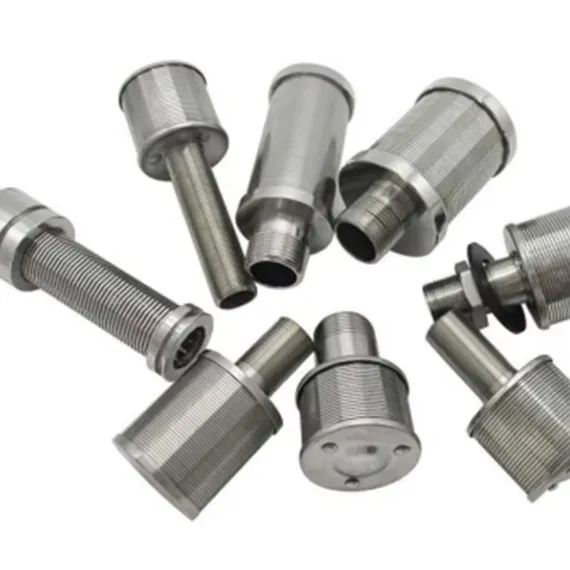
Filter nozzles are small but critical components in resin tanks, ion exchange vessels, softening units, and other media filtration systems. They serve two essential functions: uniformly distributing influent across the resin bed during service, and efficiently collecting backwash water (or air-water mixtures) during regeneration. When standard off-the-shelf nozzles fail to match a vessel’s geometry, flow rate, or media characteristics, custom manufactured Stainless steel filter nozzles become the practical solution.
This article examines the two principal configurations—long handle and Short handle filter nozzles—with particular attention to their use in resin tanks, and outlines the customization parameters that buyers should specify.
Why Stainless Steel?
Stainless steel filter nozzles are increasingly specified in place of ABS plastic alternatives. The reasons are well documented by manufacturers:
-
Longer service life and resistance to aging, temperature, and pressure
-
Higher open area for a given diameter, supporting greater flow capacity
-
Better filtration performance through precision wedge-wire slots
-
Structural integrity under repeated backwash cycles
Common materials include 304, 316, 316L, 321, and 904L stainless steel, with 304 and 316L being the most widely used for water treatment and resin applications. Specialty alloys such as Hastelloy B/C are available for aggressive chemical environments.
Long Handle vs. Short Handle: The Functional Difference
The distinction between long handle and short handle nozzles is not cosmetic—it reflects two different backwash strategies.
Long Handle Filter Nozzles
Long handle nozzles feature an extended threaded stem fitted with air holes, combined with a wedge-wire screen head. They are designed for air-water combined backwashing. During cleaning, air escapes through the holes in the stem and scours the filter bed, while water and air are distributed evenly beneath the filter plate. This makes long handle nozzles suitable for V-type filter basins, large filter vessels, and deep-bed filters where thorough media agitation is required.
Short Handle Filter Nozzles
Short handle nozzles use a shorter threaded stem without air holes and are intended for single-water backwashing only. Their role is to distribute and collect water while retaining filter media—ion exchange resin, quartz sand, activated carbon, and similar materials. Short handle nozzles are the standard choice for pressure filters, ion exchangers, softening tanks, carbon towers, and resin tanks.
For resin tank applications specifically, the short handle configuration is the typical selection, since resin beds are generally cleaned by water backwash alone.
Key Technical Parameters for Customization
Manufacturers offer extensive customization across several dimensions. The following parameters are the ones most frequently specified:
Slot size (filtration gap). Custom slot openings range from 0.05 mm to 2 mm, with 0.2–0.5 mm being the most common band. For ion exchange resin retention, precision slots as fine as 0.1 mm are used; some manufacturers achieve minimum filtration accuracy of 25 μm with tolerances of ±5 μm. Coarser slots (up to 5.0 mm) suit gravel support layers.
Diameter and open area. Standard nozzle diameters span roughly 30 mm to 108 mm, with 45 mm, 53 mm, and 57 mm among the most common. Open area scales with diameter and slot width—for example, a 45 mm nozzle with 0.2 mm slots may offer around 280–330 mm² of open area, while larger 60–70 mm bodies can exceed 900–1,100 mm². Higher open area supports greater flow and lower pressure drop.
Thread and connection type. Options include metric threads (M20, M24, M25, M27, M32), NPT (3/4″, 1″), G, PT, and Z standards, in internal or external thread configurations. Matching nuts, washers, and rubber gaskets are supplied to the same thread standard.
Handle length and body shape. Handles are available in long, medium, and short lengths, typically 50–200 mm, with longer stems for deep-bed installations. Body shapes include tower/conical, hemispherical, and flat flow-through designs.
Flow rating. Nozzles are commonly rated at 0.25, 0.5, 1.0, 1.5, 2.0, 2.5, or 3.0 m³/h, allowing selection to match system hydraulics.
Design Features That Matter in Resin Service
The wedge-wire (V-shaped wire) construction used in most stainless steel nozzles has an outer slot that is narrower than the inner opening. This profile produces a self-cleaning, anti-clogging effect: particles that enter the slot are not trapped, and the continuous slot design resists blinding. Fully welded stainless steel construction eliminates the cracking, pressure limitations, temperature sensitivity, and aging problems associated with plastic water caps, reducing maintenance costs over the vessel’s life.
Uniform slot gaps are equally important in resin tanks—inconsistent openings allow resin beads to escape, causing media loss and downstream fouling. Reputable manufacturers hold gap tolerances to within +0.03 mm.
Selection and Installation Guidance
Two practical points recur in manufacturer guidance. First, nozzle spacing (center-to-center) is typically recommended at 6–12 inches, adjusted for vessel size and flow distribution requirements. Second, the number of nozzles should be calculated from the design flow rate and backwash rate so that flow distribution remains even across the entire resin bed. Poor distribution causes channeling, uneven bed expansion, and reduced exchange capacity.
Customization should therefore begin with the vessel drawing: diameter, filter plate hole pattern, thread specification, required flow per nozzle, media type and particle size, and backwash method (water-only or air-water).
Applications
Custom Stainless steel filter nozzles are used across a broad range of systems, including:
-
Ion exchange vessels, mixed beds, floating beds, and double-chamber beds
-
Water softening and demineralization resin tanks
-
Activated carbon towers and quartz sand pressure filters
-
Gravity filters and V-type filter basins
-
Seawater desalination pretreatment
-
Food, beverage, chemical, mining, and oilfield filtration
Conclusion
Long handle and short handle Stainless steel filter nozzles look similar but serve distinct backwash regimes: long handle units with air holes support air-water combined cleaning in deep-bed and V-type filters, while short handle units without air holes handle single-water backwash in resin tanks, softeners, and pressure filters. Because resin tank performance depends heavily on uniform flow distribution and reliable media retention, custom manufacturing—matched to vessel geometry, thread standard, slot size, open area, and flow rating—is often the most dependable route. Specifying 304 or 316L construction, precision slot tolerances, and correctly calculated nozzle spacing will deliver longer service life and lower maintenance cost than plastic alternatives.
Please login to write a comment after