 English
 Español
 Français
 日本語
 한국어
 Deutsch
 Português
 Русский
 中文 (中国)

- 1. The Geometry That Defines the Claim
- 2. What the Test Data Actually Show
- 3. The Standards Landscape
- 4. The Downhole Reality: Insertion Damage and Initial Clogging
- 5. Failure Modes Beyond Clogging
- 6. Water Well Versus Oil Well: Different Priorities
- 7. What the Evidence Supports—and What It Does Not
- 8. Practical Implications for Specification and Operation
- Conclusion
1. The Geometry That Defines the Claim
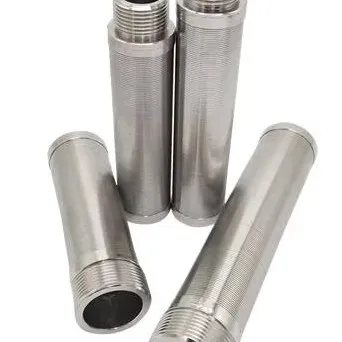
The wedge wire screen, also known as a Johnson screen, consists of a triangular wire profile helically wound around longitudinal support rods and welded at each intersection. The slot formed between adjacent wire wraps is narrowest at the outer surface and widens toward the interior. This geometry is the foundation of the Anti-clogging claim.
The mechanism is well described in patent literature. Particles small enough to enter the slot encounter an expanding passage and pass through without lodging. Irregularly shaped particles that might jam in a constant-width slot can tumble through the diverging opening . The same principle is reiterated in manufacturer documentation: “Particles that just fit the slot pass through without jamming; larger particles roll off the face” .
This is a genuine advantage over slotted liners or perforated pipe, where slot walls are parallel and particles can bridge. But the mechanism has a clear boundary: it applies to particles that are either smaller than the slot or large enough to remain on the surface. Particles that are plastically deformable, fibrous, or prone to agglomeration do not benefit from the V-profile. Scale, wax, and clay flocs can adhere to the wire surface regardless of slot geometry.
2. What the Test Data Actually Show
Published laboratory work on wire-wrapped screen performance is limited, but one recent study offers useful insight. Tananykhin et al. (2023) tested three wire profiles—triangular (wedge), trapezoidal, and drop-shaped—using prepack sand retention methodology. The finding was notable: the trapezoidal profile outperformed the triangular (wedge) profile in both sand production and effluent particle size distribution .
This does not invalidate the wedge wire design, which has decades of field use. But it does challenge the assumption that the triangular wedge is the optimal geometry for all sand retention scenarios. The study suggests that wire profile selection should be based on formation characteristics and retention objectives, not defaulted to the conventional wedge shape.
Quantitative pressure drop data for wedge wire screens is scarce in the public domain. A computational fluid dynamics study on screen geometry reported that smaller slot sizes produce higher pressure drops that increase more rapidly with flow rate—an expected result, but one that underscores the trade-off between sand retention and flow capacity . The study modeled 150, 300, and 600 micron screens and found that the 150 micron screen exhibited the steepest pressure drop curve. This relationship is intuitive but rarely quantified in vendor literature, which tends to emphasize open area percentage without corresponding pressure drop curves.
Manufacturer data from the sugar industry provides one of the few comparative pressure drop measurements available. Johnson Screens reported that reducing profile wire width from 0.5 mm to 0.375 mm—while maintaining a 100 μm slot—increased open area from roughly 17% to 21% and reduced pressure drop from 24 mm to 15 mm water column per square meter of screen at 250 m³/h steady flow . This is a meaningful improvement, but it comes from a non-petroleum application and may not translate directly to downhole conditions.
3. The Standards Landscape
A significant gap in the wedge wire screen literature is the absence of a unified performance standard. The relevant international framework is ISO 17824 (adopted in the U.S. as API 19SS), which covers sand screens for petroleum and natural gas industries. This standard addresses design validation, manufacturing quality, and testing for wire-wrap, prepack, and metal-mesh screens .
Critically, however, ISO 17824 explicitly excludes “analysis for sand retention efficiency” from its scope . The standard provides grades for design validation (V1–V3) and quality control (Q1–Q3), with higher grades requiring collapse and burst resistance validation. But it does not prescribe a methodology for verifying the clogging resistance or flow performance that wedge wire vendors claim.
This means that a purchaser comparing two wedge wire screens from different suppliers has no standardized basis for evaluating their relative Anti-clogging performance. Open area percentage, slot tolerance, and wire dimensions are specified, but the actual flow behavior under fouling conditions is not.
4. The Downhole Reality: Insertion Damage and Initial Clogging
One of the most persistent discrepancies in screen performance is the difference between laboratory-measured flow capacity and downhole performance. A patent from the 1960s identified the cause: screens become partially clogged during insertion .
Even in a hole significantly larger than the screen, contact between the screen’s outer surface and the borehole wall is practically unavoidable. The wedge wire’s outer surface—where the slot is narrowest—is the surface most vulnerable to this contact. Dirt and grit pressed into the slot openings during running reduce the effective open area before production even begins. The patent’s solution was to design the outer surface with a convex profile to minimize contact area, but the underlying problem remains relevant for any screen run in a barefoot or openhole completion.
This has implications for the “high flow” claim. A screen that tests at a given pressure drop on the surface may exhibit a higher initial pressure drop downhole due to insertion-related clogging. Operators should account for this in completion design, particularly in wells where the screen will be run through a long openhole section.
5. Failure Modes Beyond Clogging
The clogging narrative tends to obscure other failure mechanisms that affect wedge wire screens in service. A 2022 SPE paper on plasma spray coatings for wedge wire screens identified four common failure mechanisms: plugging, corrosion, erosion, and mechanical deformation . Erosion occurs when formation particles impact the screen surface at high velocity or during sustained production through the openings. Corrosion depends on metallurgy and fluid chemistry. Mechanical deformation can result from running damage or formation compaction.
The industry response has been incremental metallurgical improvement. Super-duplex alloys provide approximately 2.7 times the proof and tensile strength of 300-series stainless steels, allowing either smaller wire profiles for higher open area or maintained profiles for higher burst resistance . Surface treatments such as Kolsterising (a carburizing process for austenitic stainless steels) have been reported to achieve hardness exceeding 1,000 HV to a depth of 50 μm without reducing corrosion resistance, and customers report extended operating life .
These developments are relevant to the high-flow objective because a screen that resists erosion and deformation maintains its slot geometry—and therefore its flow performance—over a longer service life.
6. Water Well Versus Oil Well: Different Priorities
The same wedge wire geometry serves both water and oil applications, but the performance priorities differ.
In water wells, the emphasis is on open area and entrance velocity. The U.S. EPA’s documentation on Johnson Screens notes that high open area allows water to enter freely with minimal drawdown, reducing pump energy consumption. The continuous slot design permits lower entrance velocity, which “reduces encrustation rates” and resists plugging . Well development—removing drilling fluid and fines from the formation—is also faster with high open area.
In oil wells, the screen is typically part of a Sand control completion, often with gravel packing. Field cases from the Bohai Sea and South China Sea describe wire-wrapped screens used in gravel pack completions with 6.05-inch and 4.62-inch outside diameters. In the Bohai case, no sand production problems occurred over more than 10 years of production . These are encouraging field results, but they reflect the performance of the complete Sand control system—gravel, screen, and completion design—not the screen alone.
The distinction matters for the “high flow” claim. In a gravel-packed well, the gravel is the primary sand filter and the screen serves as a support and flow conduit. In a stand-alone screen completion, the screen itself must retain formation sand. The clogging behavior and flow capacity of the same screen will differ significantly between these two configurations.
7. What the Evidence Supports—and What It Does Not
Supported by available data:
-
The V-shaped slot geometry reduces the likelihood of particle wedging compared to parallel-sided slots, particularly for irregularly shaped particles .
-
Wedge wire screens can achieve high open area, with manufacturer data suggesting values in the range of 17–21% for fine-slot industrial screens, and higher values for coarser slots .
-
Reducing wire profile width increases open area and reduces pressure drop at equivalent slot size .
-
The screens have a long field history in both water and oil applications, with documented multi-year performance in gravel-packed completions .
Not supported by publicly available data:
-
A direct, quantitative comparison of clogging rates or cleaning intervals between wedge wire screens and alternative technologies under controlled downhole conditions.
-
Pressure drop versus flow rate curves for specific commercial wedge wire products across a range of slot sizes and fluid viscosities.
-
A standardized test method for verifying vendor claims of “self-cleaning” or “high flow” performance.
-
Data on the initial flow capacity loss due to insertion damage in realistic borehole conditions.
8. Practical Implications for Specification and Operation
For engineers specifying wedge wire screens for high-flow, clogging-sensitive applications, the following considerations emerge from the evidence:
Specify the full flow curve, not just open area. Open area percentage is a geometric parameter. Request pressure drop versus flow rate data at representative downhole fluid properties and, if possible, with simulated fouling.
Match wire profile to formation. The triangular wedge is not universally optimal. Where sand retention is the primary objective, consider whether alternative profiles have been tested against the specific formation particle size distribution .
Account for insertion effects. In openhole completions, design the running string and hole condition to minimize screen-wall contact. Where contact is unavoidable, consider whether the convex outer profile or centralization can reduce initial clogging.
Monitor differential pressure. The most reliable indicator of screen condition is the pressure differential across the screen. A rising ΔP at constant flow indicates loss of effective open area—whether from clogging, scale, or mechanical damage. This should be a standard surveillance parameter.
Recognize the limits of the self-cleaning claim. The V-slot resists wedging of rigid particles. It does not prevent scale deposition, wax accumulation, or biological fouling. Chemical treatment programs and backwash capability remain necessary for sustained performance.
Conclusion
The wedge wire well screen is a mature technology with a genuine geometric advantage for particle passage. Its V-shaped slot reduces the wedging failure mode that afflicts parallel-slot designs, and its welded construction provides mechanical robustness suited to downhole conditions.
But the “high flow, reduced clogging” claim is often presented without the quantitative context needed for engineering decisions. The available evidence supports the mechanism but not the magnitude of the benefit in specific applications. The absence of a standardized performance test—ISO 17824 explicitly excludes sand retention efficiency from its scope—means that vendor claims cannot be directly compared.
For operators, the path forward is not to dismiss the technology but to specify it more rigorously. Demand flow curves, not just open area. Test wire profiles against actual formation samples where feasible. Design completions to minimize insertion damage. And monitor differential pressure as the primary indicator of screen health.
The wedge wire screen is a useful tool. Like any tool, its performance depends on using it under the conditions for which it was designed—and recognizing where those conditions end.
Please login to write a comment after