 English
 Español
 Français
 日本語
 한국어
 Deutsch
 Português
 Русский
 中文 (中国)

- The Century-Old Technical Foundation: The “Self-Cleaning” Logic Behind the V-Shaped Wire Profile
- Recent Technological Breakthrough: Slot Precision Reaches Microfiltration-Grade
- Process Evolution for the Future: Additive Manufacturing and Material Expansion
- Jinjue Johnson Screens: Local Manufacturing, Global Technical Standards
Vee-Wire® (also known as wedge wire screens or wound wire screens) has undergone more than a century of development since its inception. From its early application in water well sand control to current deployment in petrochemical reactors, food and beverage processing, and microfiltration separation, technical precision and structural reliability remain the core criteria by which end-users evaluate a supplier’s capability. With recent manufacturing process improvements, the slot opening accuracy of Vee-Wire® screens has been pushed down to the 20-micron level and even smaller, opening up new possibilities for conventional mechanical filtration.
The Century-Old Technical Foundation: The “Self-Cleaning” Logic Behind the V-Shaped Wire Profile
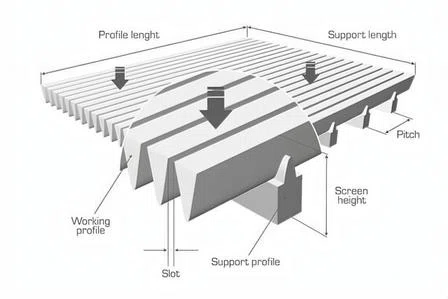
Unlike conventional perforated plates or woven wire mesh, the defining feature of the Johnson screen lies in its unique V-shaped (trapezoidal) cross-section wire profile. The V-shaped wire is helically wound around longitudinal support rods and securely welded into a rigid cylindrical structure via resistance welding. This structural design translates into three key operational advantages in industrial applications:
1. Wedge-shaped slots prevent clogging
The V-shaped wire is oriented with the narrow tip facing outward and the wider base welded inward, creating a tapered slot configuration—narrower at the outer surface and wider internally. During solid-liquid separation, particles larger than the slot are retained on the surface, while those smaller pass through freely without becoming lodged within the screen structure. This geometry fundamentally avoids the “particle entrapment” commonly seen in round-hole perforated screens or straight-slit designs, enabling a self-cleaning effect that facilitates backwashing, significantly reducing maintenance frequency and operational costs.
2. Reduced inlet velocity minimizes scaling and energy consumption
For applications such as water wells and oil/gas wells, the continuous-slot design of Vee-Wire® screens significantly reduces the fluid inlet velocity as flow enters the screen. The immediate benefits include: reduced scaling tendency, protection of downstream pumps from abrasive sand particles, and lower pressure drop and energy consumption. The high open area ratio ensures low flow resistance, thereby enhancing extraction or pumping efficiency.
3. Structural strength and extended service life
The fully welded construction—with each wire welded to every support rod—imparts exceptionally high collapse strength and tensile strength to the screen. Compared to fragile perforated pipes or woven meshes, all-welded wound wire screens are structurally robust, heat-resistant, corrosion-resistant, and offer long service life, capable of withstanding harsh downhole or reactor conditions.
Recent Technological Breakthrough: Slot Precision Reaches Microfiltration-Grade
Despite the inherent advantages of Vee-Wire® technology, its applicability had long been confined to coarse filtration and larger-particle separation, primarily due to limitations in slot size and precision control at the micron level.
According to published technical reports from Aqseptence Group (the parent company of the Johnson Screens brand), a new manufacturing platform has enabled Vee-Wire® screens to achieve slot openings smaller than 20 microns, accompanied by significant improvements in slot size distribution uniformity. This marks a critical milestone: Johnson screens have formally acquired the technical capability to enter the microfiltration market.
This advancement offers new alternatives for industrial filtration. Compared to consumable media such as single-use filter membranes, Vee-Wire® microfiltration-grade screens retain the inherent advantages of being online-backwashable, cleanable, and reusable without frequent replacement, delivering clear potential benefits in operational cost and environmental sustainability. For industries including wastewater treatment, chemical catalyst recovery, and food/beverage fine filtration, this presents a compelling, more durable alternative.
Process Evolution for the Future: Additive Manufacturing and Material Expansion
Beyond conventional resistance welding, leading Johnson Screens manufacturers are exploring the application of additive manufacturing (3D printing) . Johnson Screens has reportedly collaborated with HP to produce polypropylene filter components via 3D printing, with test units maintaining a zero-failure record to date. This initiative aims to enable more flexible design geometries and reduced material consumption, while meeting demanding requirements in water treatment applications including corrosion resistance and moisture absorption resistance.
Jinjue Johnson Screens: Local Manufacturing, Global Technical Standards
As a specialized manufacturer in the Johnson screen sector, Jinjue Johnson Screens consistently benchmarks against world-class Vee-Wire® technical standards. We understand that for industrial clients, a supplier’s manufacturing precision and material quality control are of paramount importance.
Jinjue Johnson Screens currently offers wound wire screens with slot precision down to 20 microns (0.02 mm) , available in a range of materials including 304, 316L, duplex stainless steel, and Hastelloy alloys, tailored to meet diverse corrosion, temperature, and strength requirements. Our products are widely deployed in water well sand control, oil and gas extraction, petrochemical catalytic reforming, food and beverage filtration, and mining classification and dewatering applications.
We believe that sound technical understanding combined with rigorous manufacturing discipline is the foundation for long-term partnerships. Should you have specific filtration challenges or customization needs, we welcome the opportunity for in-depth discussion.
Please login to write a comment after