 English
 Español
 Français
 日本語
 한국어
 Deutsch
 Português
 Русский
 中文 (中国)

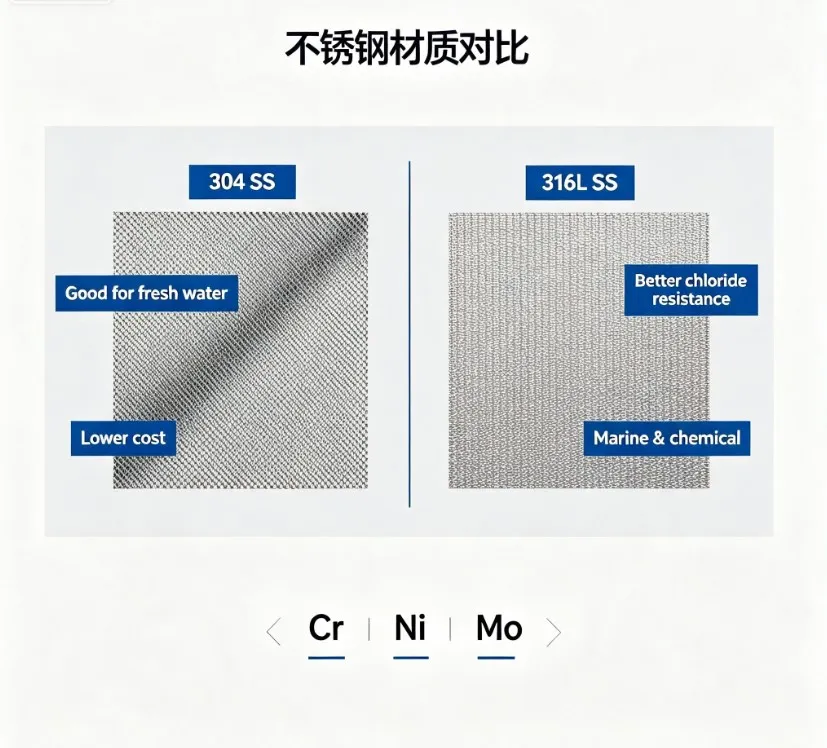
- 🔬 Chemical Composition · The Core Difference
- 📊 Performance Metrics · Side-by-Side
- ✅ When to Choose 304 Stainless Steel
304 vs 316L Stainless Steel Wedge Wire Screen
When selecting wedge wire screens, the choice between 304 and 316L directly impacts service life, maintenance costs, and operational integrity. This guide provides a clear, data-backed roadmap based on chemical composition, PREN values, chloride tolerance, and real-world performance.
🔬 Chemical Composition · The Core Difference
| Element / Grade | SS 304 / 304L | SS 316 / 316L | Performance Impact |
|---|---|---|---|
| Chromium (Cr) | 18.0 – 20.0% | 16.0 – 18.0% | Base corrosion resistance |
| Nickel (Ni) | 8.0 – 10.5% | 10.0 – 14.0% | Toughness, formability |
| Molybdenum (Mo) | — | 2.0 – 3.0% | Chloride pitting resistance |
| Carbon (C) – L grade | ≤ 0.03% | ≤ 0.03% | Low carbon avoids sensitisation |
Critical takeaway: 316L contains 2–3% molybdenum, which dramatically improves resistance to pitting, crevice corrosion, and chloride attack — the key differentiator.
📊 Performance Metrics · Side-by-Side
| Parameter | SS 304 / 304L | SS 316 / 316L |
|---|---|---|
| PREN Value (Pitting Resistance) | 18 – 20 | 24 – 26 |
| Chloride Tolerance | ≤ 200 ppm | ≤ 1,000 ppm |
| Max Operating Temperature | ≤ 400 °C (752 °F) | ≤ 450 °C (842 °F) |
| Corrosion Resistance (overall) | Good | Very Good |
| Weldability (sensitisation risk) | Good (304L better) | Excellent (low carbon) |
| Relative Cost | Baseline | +15 – 25% |
| Typical Service Life | 5 – 10 years | 10 – 20+ years |
✅ When to Choose 304 Stainless Steel
304 Suitable Applications
- Fresh water treatment (Cl⁻ < 200 ppm)
- Neutral media general industrial filtration
- Indoor / away from salt spray
- Non-chlorinated water systems
- Temperature ≤ 400 °C
⚠️ 304 Limitations
- Pitting risk increases sharply above 200 ppm Cl⁻
- Susceptible in marine or coastal atmospheres
- Prone to crevice corrosion under deposits/gaskets
- Limited resistance to acidic/chemical cleaners
Example: In municipal fresh water screening (Cl⁻ < 100 ppm), 304 can deliver 8–10 years of reliable service at a lower upfront cost.
✅ When to Choose 316L Stainless Steel
316L Suitable Applications
- Wastewater with chlorinated disinfection
- Seawater / brackish water (up to 1,000 ppm Cl⁻)
- Food & beverage (FDA, 3-A, EHEDG)
- Pharmaceutical / CIP chemical cleaning
- Coastal or high-humidity environments
- High-temperature service up to 450 °C
✦ Key Advantages
- Excellent pitting, crevice & SCC resistance
- Low carbon (≤0.03%) prevents welding sensitisation
- Compatible with aggressive CIP chemicals
- Extended service life reduces replacements & downtime
Example: In municipal wastewater with chlorine disinfection (Cl⁻ 500–800 ppm), 304 may pit within months, while 316L maintains integrity for 10–15 years.
🏭 Application-Specific Recommendations
| Industry / Environment | Recommended Material | Notes |
|---|---|---|
| Fresh water intake (Cl⁻ < 50 ppm) | 304 | Cost-effective |
| Cooling water with chlorination | 316L | Chloride resistance |
| Wastewater chlorine disinfection | 316L | First choice |
| Open seawater intake | Super Duplex 2507* | PREN > 40, 25+ years |
| Dairy / beer / juice processing | 316L (electropolished) | FDA, 3-A compliant |
| Pharmaceutical / Biotech | 316L (Ra < 0.8 μm) | EHEDG preferred |
| Neutral non-chlorinated chemical | 304 | Neutral pH |
| Acidic / alkaline / chlorinated streams | 316L | Corrosion-resistant |
💰 Total Cost of Ownership (TCO)
While 316L carries a 15–25% higher upfront cost, the long-term savings in corrosive environments typically outweigh the initial premium:
| Cost Factor | 304 (Fresh Water) | 316L (Chlorinated Water) |
|---|---|---|
| Initial cost | $1.00 (baseline) | $1.20 |
| Replacement frequency | Every 5–8 years | Every 10–15 years |
| Maintenance downtime cost | Higher | Lower |
| Unplanned shutdown risk | Moderate | Low |
| 10‑year TCO | Higher (multiple replacements) | Lower (longer life) |
🧭 Selection Decision Flow
📈 Material Upgrade Path
| Grade | PREN Value | Chloride Tolerance | Cost Premium (vs 304) | Best For |
|---|---|---|---|---|
| 304 | 18–20 | ≤ 200 ppm | Baseline | Fresh water |
| 316L | 24–26 | ≤ 1,000 ppm | +15–25% | Chlorinated water, chemicals |
| Duplex 2205 | 34–35 | ≤ 2,500 ppm | +40–60% | Moderate seawater |
| Super Duplex 2507 | > 40 | ≤ 5,000+ ppm | +40–80% | Open seawater, 25+ years |
📌 Summary & Final Recommendation
✅ Choose 304 when:
- Chloride < 200 ppm
- Temperature < 400 °C
- Fresh water, indoor, neutral pH
- No aggressive chemical cleaning
- Upfront cost is a primary constraint
✅ Choose 316L when:
- Chloride 200 – 1,000 ppm
- Temperature up to 450 °C
- Wastewater, seawater, coastal, chemicals
- CIP / acidic / sanitizer exposure
- Regulatory compliance (FDA, 3‑A, EHEDG)
- Long-term lifecycle cost priority
304 is the economical choice for fresh water, neutral media, and indoor applications with chloride consistently below 200 ppm.
316L is the superior investment for wastewater, chemical processing, food/pharma, seawater, and any chloride-rich environment.
The cost difference is typically 15–25% upfront, but the wrong choice can cost 3–5× more in downtime, premature replacement, and production losses. When in doubt, choose 316L — its corrosion resistance and extended life make it the safer long-term investment for most industrial applications.