 English
 Español
 Français
 日本語
 한국어
 Deutsch
 Português
 Русский
 中文 (中国)

- Introduction
- The Self-Cleaning Geometry: Quantitative Evidence
- Precision Slot Consistency and Cut-Point Reliability
- Durability Under Abrasive Conditions
- Configuration for Diverse Dewatering Duties
- Complementary Strategies: Data from Conditioning and Pretreatment
- Limitations and Application-Specific Considerations
- Conclusion
Introduction
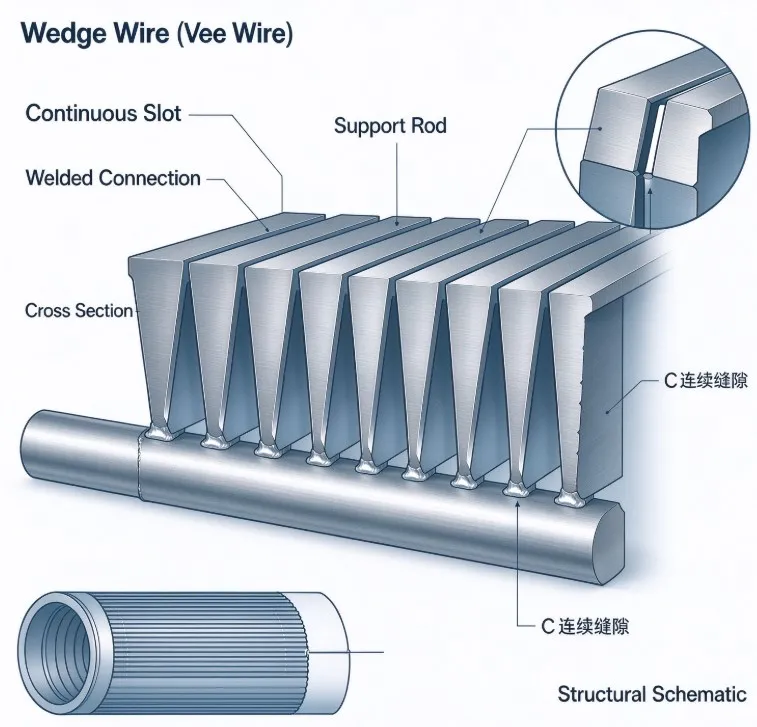
Solid-liquid separation in Mining dewatering faces a persistent challenge: fine particles, abrasive slurries, and corrosive process water degrade screening media rapidly, causing downtime, product loss, and environmental risk. Wedge wire screens—constructed from V-shaped profile wires welded across support rods—have become a benchmark solution in this demanding environment. This article examines the mechanisms behind their performance, supported by field data and quantitative evidence from mining operations, and explores complementary strategies for optimizing dewatering circuits.
The Self-Cleaning Geometry: Quantitative Evidence
The defining feature of wedge wire is its V-shaped profile: the slot is narrowest at the screening surface and widens toward the underside. This geometry creates a self-cleaning effect because particles that enter the slot encounter an expanding passage rather than a parallel one, preventing wedging and blinding. The relationship between slot geometry and hydraulic capacity is predictable and quantifiable.
The economic impact of this design is documented at PT Trubaindo Coal Mining in Indonesia, where vibrating screens process approximately 85 tonnes of coal per hour at an average feed size of 50–100 mm. The site initially used competitor wedge wire panels that failed within one to two months due to insufficient support bars, developing large cracks and holes. When forced to switch to perforated panels with a 3 mm aperture—larger than ideal—up to 2,000 tonnes of valuable coal seeped into the sediment pond every month.
Replacing just 6 of 21 panels with customized Aspir® wedge wire panels featuring a 0.5 mm aperture and strengthened support bars eliminated this loss. Over 12 months, the panels reduced maintenance shutdowns from once every 6 weeks to only once per annum, cutting maintenance costs by approximately US$18,800 annually**. The estimated recovery of production reached nearly **24,000 tonnes of coal, equating to US$1.2 million per annum.
Table 1. Wedge Wire vs. Perforated Panels at PT Trubaindo
| Metric | Competitor Wedge Wire | Perforated Panels (3 mm) | Customized Aspir® Wedge Wire (0.5 mm) |
|---|---|---|---|
| Service life | 1–2 months | — | 12 months |
| Coal loss to pond | — | 2,000 t/month | Eliminated |
| Maintenance shutdowns | — | Every 6 weeks | Once per annum |
| Annual maintenance savings | — | — | ~US$18,800 |
| Annual coal recovery | — | — | ~24,000 t (US$1.2M) |
Precision Slot Consistency and Cut-Point Reliability
Dewatering efficiency depends not only on water removal but on directing the correct particle sizes to the correct streams. Wedge wire screens are manufactured with slot tolerances typically within ±5% of nominal value, verified by feeler gauge measurement at multiple points. This dimensional stability contrasts with woven wire cloth, whose apertures can distort under load.
The relationship between slot geometry and open area is predictable: for a slot opening *s* and wire crown width *w*, the percentage open area equals s/(s+w) × 100. A 0.5 mm slot with AW 28 wire yields 18.5% open area, while wider slots or narrower wires increase this proportion.
This precision translates into reliable separation at fine cut-points. Derrick Static Screen field trials at an ultrafine coal application targeting 25 microns demonstrated consistent performance over 10 sampling rounds. The unit produced clean oversize product with an average ash reduction of 7.2 percentage points relative to the 9.5% feed ash, with an average ash rejection of 38.3% and combustible recovery of 83.3%.
Table 2. Derrick Static Screen Performance for Ultrafine Coal (25 µm cut)
| Sampling Round | Feed Ash (%) | Oversize Ash (%) | Undersize Ash (%) |
|---|---|---|---|
| 1 | 9.0 | 7.0 | 18.0 |
| 2 | 8.3 | 6.6 | 16.7 |
| 3 | 9.2 | 6.9 | 19.2 |
| 4 | 9.9 | 7.7 | 21.5 |
| 5 | 9.9 | 7.5 | 19.7 |
| 6 | 9.4 | 7.3 | 19.4 |
| 7 | 10.5 | 7.9 | 22.6 |
| 8 | 10.2 | 7.6 | 21.7 |
| 9 | 9.7 | 6.9 | 18.6 |
| 10 | 9.0 | 6.8 | 17.2 |
| Average | 9.5 | 7.2 | 19.5 |
Key metrics: Ash rejection = 38.3%; Combustible recovery = 83.3%; Ash reduction in oversize = 2.3 percentage points.
Durability Under Abrasive Conditions
Mining dewatering subjects screens to high-velocity slurry, angular particles, and often acidic or saline water. Wedge wire’s resistance-welded construction creates a rigid structure where support rods carry mechanical loads, allowing profile wires to be spaced for open area without sacrificing strength. Material selection extends service life further. Standard grades include 304 and 316 stainless steel, with 430 SS and 3CR12 offering enhanced abrasion resistance for high-wear duties.
The PT Trubaindo case provides a direct comparison: competitor wedge wire panels lasted 1–2 months, while the customized Aspir® panels operated for 12 months before scheduled replacement—a wear life improvement of approximately 6–12 times. Open area data from wedge wire specifications illustrates the trade-off between slot size and flow capacity. For a 10 SB series screen, slot gaps of 0.05 mm yield 6.30% open area, while 0.20 mm slots achieve 21.10%. This range allows operators to balance filtration precision against hydraulic throughput for specific duties.
Configuration for Diverse Dewatering Duties
Wedge wire screens adapt to multiple equipment types. In static sieve bends and DSM screens, curved wedge wire sections provide high open area for gravity-fed dewatering. In dynamic applications, panels are deployed on vibrating screens, cylindrical baskets in centrifuges, and drum screens.
For vibrating screen centrifuges in coal dewatering, segmental wedge wire baskets with apertures of 0.3–0.5 mm combine centrifugal force with precise slot geometry to achieve low product moisture. Multotec’s vibrating screen centrifuges, available in models from HSG 600 to HSG 1650, use wedge wire profiles 34 Sbb, 42 Sbb, and 50 Sbb with basket apertures of 0.5 mm, 0.4 mm, and 0.3 mm. The configurability allows matching Screen media to each dewatering stage, from primary drainage to fine tailings recovery.
Complementary Strategies: Data from Conditioning and Pretreatment
Wedge wire performance is enhanced when integrated with feed preconditioning. A U.S. Bureau of Mines study on phosphatic clay waste demonstrated that a curved static wedge-wire screen, combined with polyethylene oxide (PEO) flocculant at 1.6 kg per ton of dry solids, dewatered feed from 3.9% solids to approximately 17% solids in a single pass. Further dewatering using a vibrating screen achieved 31% solids, while a trommel reached 27% solids. The study noted that reducing PEO dosage below approximately 1.5 kg/ton resulted in weak flocs that failed to release clear water.
Emerging research on ultrasonic pretreatment offers another avenue. Studies on kaolinite tailings found that optimized ultrasonic treatment (40 kHz, 40 W, 12 minutes) reduced filter cake moisture by 2.02 percentage points and increased filtration rate by 2.5 times. The mechanism involves acoustic cavitation modifying floc structure and filter cake porosity. For lead-zinc tailings, ultrasonic treatment increased particle contact angle from 52.0° to 66.5° and reduced zeta potential magnitude from −31.31 mV to −14.59 mV, promoting aggregation.
Limitations and Application-Specific Considerations
Wedge wire screens are not universally optimal. A Norwegian University of Science and Technology study evaluated wedge wire drying beds for dewatering backwash water from a Brazilian water treatment plant. The wedge wire pilot achieved only 21% suspended solids removal, compared to 76% for geotextile filter cloth, and failed to meet Brazilian discharge standards for BOD₅ and settleable solids. The researchers concluded that the wedge wire pore openings were too large for the specific backwash water characteristics and noted that “a treatment method that works for one type of sludge may not be appropriate to another.”
This finding underscores a critical principle: wedge wire excels in Mining dewatering because of its abrasion resistance, structural rigidity, and self-cleaning geometry under high-solids loads. For low-solids, chemically conditioned streams with fragile flocs, alternative media may perform better.
Conclusion
Wedge wire screens improve Mining dewatering through quantified mechanisms: self-cleaning geometry that resists blinding, slot tolerances within ±5% for reliable cut-points, and welded construction that delivers 6–12 times the wear life of competitor panels. Field data from PT Trubaindo demonstrates the economic scale of these benefits: US$18,800 annual maintenance savings, 24,000 tonnes of coal recovered, and US$1.2 million in annual production value from a single screen installation. Derrick Static Screen trials confirm cut-point reliability at 25 µm with 83.3% combustible recovery, while flocculant conditioning at 1.5–1.6 kg/ton raises solids from 3.9% to 17–31%. These advantages are amplified when wedge wire is integrated with appropriate feed conditioning and emerging ultrasonic pretreatment. However, the technology is not a universal solution; its performance depends on matching slot geometry and open area to the specific particle size distribution and solids loading of each dewatering duty. As mining operations face increasing pressure on water recovery, tailings management, and product moisture, wedge wire technology—with its documented performance and adaptable configurations—remains a foundational tool for efficient Solid-Liquid Separation.
Please login to write a comment after