 English
 Español
 Français
 日本語
 한국어
 Deutsch
 Português
 Русский
 中文 (中国)

- 1. Introduction
- 2. Working Principle: How They Separate
- 2.1 Sieve Bend Screen: Gravity and the Coanda Effect
- 2.2 Wedge Wire Flat Panel: Vibration or Static Drainage
- 3. Performance Comparison: Key Data
- 4. Structural and Manufacturing Differences
- 5. Selection Criteria: How to Choose
- 6. Typical Applications
- 7. Conclusion
1. Introduction
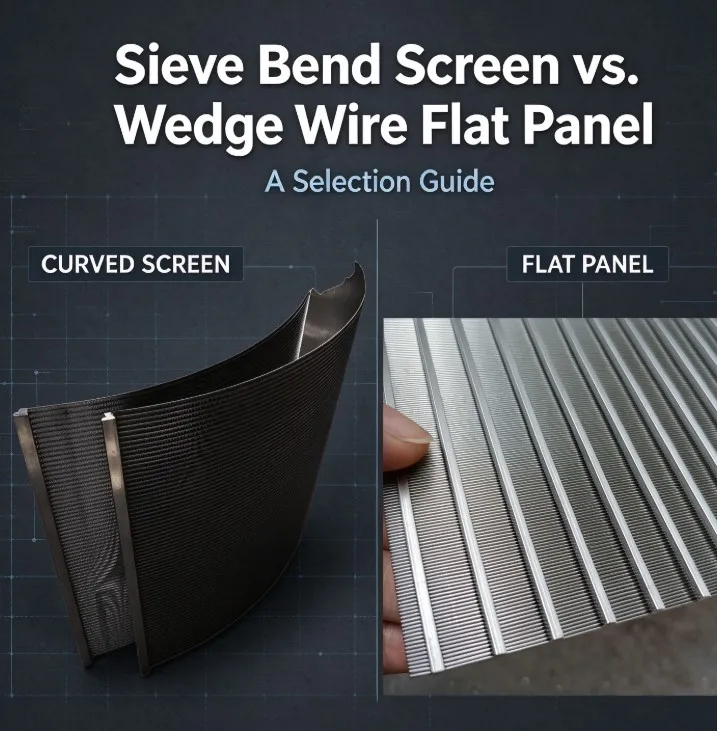
Wedge wire screens are widely used in filtration, dewatering, and classification across mining, Wastewater Treatment, food processing, and chemical industries. Two of the most common configurations are the Sieve Bend Screen (also known as a DSM screen or curved screen) and the Wedge Wire Flat Panel.
Although both are made from the same basic components—profile wire and support rods—they are not interchangeable. Choosing the wrong type can lead to poor separation efficiency, premature wear, or excessive energy consumption. This article explains the key differences and provides a clear selection guide.
2. Working Principle: How They Separate
2.1 Sieve Bend Screen: Gravity and the Coanda Effect
A Sieve Bend Screen is a curved, static screening device. Slurry is fed tangentially onto the concave surface and flows downward by gravity. The separation mechanism relies on the Coanda effect: as the fluid layer hugs the curved surface, the sharp edges of the profile wire “shear” a thin layer of liquid through the slots. Solid particles, due to their inertia, remain on the surface and slide off the bottom.
Key implication: The actual separation size (d50) is significantly smaller than the physical slot width—typically about half to two-thirds of the slot opening.
2.2 Wedge Wire Flat Panel: Vibration or Static Drainage
A Wedge Wire Flat Panel is a rigid, flat screening surface. It does not separate on its own. It must be installed on a vibrating screen or a static drainage platform.
-
On a vibrating screen: Vibration causes particles to stratify and jump. Fine particles pass through the slots, while oversize particles travel across the panel and discharge.
-
On a static drainage platform: Separation is purely gravitational, with no shear effect.
Key implication: The separation efficiency depends on the vibration parameters (amplitude, frequency) and the material’s behavior on the screen.
3. Performance Comparison: Key Data
| Parameter | Sieve Bend Screen | Wedge Wire Flat Panel |
|---|---|---|
| Separation Mechanism | Gravity + Coanda effect (shear) | Vibration or static gravity |
| Effective Separation Size (d50) | ~0.5 × slot width | ~slot width (in ideal conditions) |
| Hydraulic Capacity | 120–250 m³/h per meter width (0.5 mm slot, 60° arc) | Lower; depends on vibration and slope |
| Open Area | 25–45% (typical) | 25–45% (similar, but support structure limits) |
| Power Requirement | Zero (static) | Requires motor/vibrator |
| Typical Slot Range | 0.05 mm – 12 mm | 0.05 mm – 12 mm |
| Surface Life (Gravity Feed) | 1,000–2,000 hours | Depends on vibration and abrasion |
| Surface Life (High-Pressure Feed) | 200–300 hours | Not applicable (no high-pressure feed) |
Note: Open area is calculated as:%OA = Slot / (Slot + Crown Width) × 100
4. Structural and Manufacturing Differences
4.1 Load-Bearing Behavior
-
Sieve bend screen: The curved frame distributes stress. The screen surface primarily resists abrasion and shear forces, not bending.
-
Flat panel: Acts as a self-supporting beam. It must withstand bending and vibration-induced stresses. Support rod spacing and wire diameter are critical.
4.2 Welding Requirements
-
Flat panel: For vibrating applications, TIG welding is preferred over resistance welding due to deeper penetration and better fatigue resistance.
-
Sieve bend screen: Welding strength requirements are generally lower due to the curved geometry and gravity-driven flow.
4.3 Materials
Both types are commonly made from SS304, SS316L, duplex 2205, and in special cases 904L. Material selection depends on corrosion resistance and abrasion resistance requirements.
5. Selection Criteria: How to Choose
Use the following decision logic:
-
Feed Method
-
Gravity flow on a curved surface → Sieve Bend Screen
-
Material on a vibrating flat surface → Flat Panel
-
-
Capacity Requirement
-
High-flow, continuous dewatering (e.g., mineral processing, coal washing) → Sieve Bend Screen (higher capacity per unit area)
-
Lower flow, precise classification → Flat Panel
-
-
Application Type
-
Static separation, fiber recovery, fine classification (starch, paper, mining desliming) → Sieve Bend Screen
-
Vibrating screening, dry classification, architectural grating, material conveying → Flat Panel
-
-
Energy and Maintenance
-
Zero power, no moving parts → Sieve Bend Screen
-
Requires motor, vibrator, and regular maintenance → Flat Panel
-
6. Typical Applications
Sieve Bend Screen
-
Mining and coal: desliming, pre-dewatering, heavy media recovery
-
Municipal and industrial wastewater: pre-screening
-
Starch and sugar: extraction and juice filtration
-
Pulp and paper: white water fiber recovery
-
Food processing: Solid-Liquid Separation
Wedge Wire Flat Panel
-
Vibrating screens and shakers: mineral and coal classification
-
Static drainage platforms
-
Reactor support grids
-
Architectural floor grating
7. Conclusion
Sieve bend screens and Wedge Wire Flat Panels are both valuable wedge wire products, but they serve different purposes. The Sieve Bend Screen excels in high-capacity, gravity-driven, static separation with zero power consumption. The flat panel is the correct choice for vibrating screening systems, dry classification, and structural applications.
When selecting, always start with the feed method and capacity requirement. If the material flows by gravity on a curve, choose a sieve bend. If it moves on a vibrating plane, choose a flat panel.
Please login to write a comment after