 English
 Español
 Français
 日本語
 한국어
 Deutsch
 Português
 Русский
 中文 (中国)

- Introduction
- Why Internal Distribution Matters
- The Radial Fractal Lateral Concept
- Key Performance Data
- Design and Engineering Considerations
- Slot Sizing and Resin Retention
- Flow Rate and Pressure Drop
- Residence Time Distribution (RTD)
- Maintenance and Accessibility
- Comparison with Conventional Systems
- Applications
- Conclusion
Introduction
Inside every Water Treatment Vessel—whether an ion exchange softener, a demineralizer, or a fixed-bed filter—the performance of the system depends as much on how water enters and leaves the resin bed as on the resin itself. An poorly designed Internal Distribution system creates channeling, dead zones, and premature breakthrough. A well-designed one approximates plug flow, minimizes regenerant waste, and uses nearly the entire bed volume.
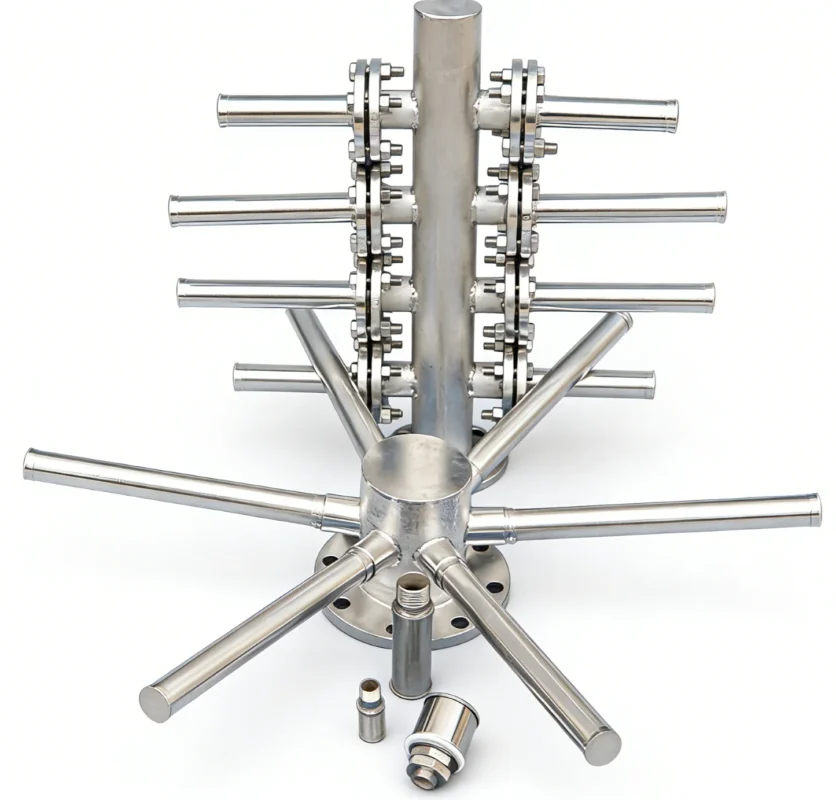
This article examines a specific class of internal components: the Radial Fractal Lateral Water Collector, used for both distribution and collection inside Water Treatment Vessels. It combines three design ideas:
-
Radial lateral geometry — laterals arranged around a central hub rather than along a straight header.
-
Fractal-inspired flow paths — each flow path designed to have equal residence time, approximating the behavior of a fractal network.
-
Flat-head vessel compatibility — eliminating the mixing zone created by dished or domed heads.
The result is a distribution/collection system that improves media utilization, sharpens the separation between process and regeneration fronts, and reduces the volume of mixed waste.
Why Internal Distribution Matters
In a typical fixed-bed vessel, water enters through a distribution header, flows through the resin or media bed, and exits through a collector at the opposite end. If the flow is not uniform:
-
Channeling develops, where water preferentially follows paths of least resistance.
-
Dead zones form, where resin is never fully contacted or regenerated.
-
Premature breakthrough occurs, shortening the service cycle.
-
Regenerant waste increases, because mixed zones require additional rinse volume.
Traditional collectors use a central header pipe with straight laterals branching off at regular intervals. This works reasonably well in the straight cylindrical section, but leaves poorly served regions near the vessel heads—particularly with dished or domed heads, where the geometry forces fluid to converge or diverge unevenly.
The Radial Fractal Lateral Concept
Radial Lateral Geometry
Instead of straight laterals along a single header, radial laterals are arranged around a central hub, radiating outward like spokes. The laterals may include angled arms that follow the curvature of the vessel head, reaching into regions that conventional headers cannot serve effectively.
Johnson Screens, a manufacturer of this type of system, reports that its radial “Spider Lateral” design can utilize up to 71% more available media volume compared to traditional header-lateral assemblies. The laterals are positioned to match the head contour, reducing the unused volume near the vessel ends.
Fractal-Inspired Flow Paths
The term “fractal” here is used in an engineering sense rather than a strict mathematical one. The design goal is to make every flow path—from the distribution hub, through each lateral, through the media bed, and into the collection hub—have approximately the same residence time. This is the defining characteristic of an idealized fractal distribution network: flow paths that are self-similar in their transport behavior regardless of direction or distance.
Patents covering this approach (including EP1431248 and WO2003008064) describe systems where:
-
Each fluid particle travels approximately the same distance.
-
Each fluid particle spends approximately the same time in the system.
-
The flow approximates plug flow rather than mixed flow.
This is achieved through a combination of radial geometry, variable perforation sizes along the laterals, and tapered or contoured headers that equalize pressure drop across all paths.
Flat-Head Vessel Compatibility
One of the more counterintuitive aspects of this design is its use with flat vessel heads rather than traditional dished heads. In conventional vessels, the domed head provides a natural plenum for flow distribution—but it also creates a mixing zone where treated water, regenerant, and rinse water can blend.
By using a flat head combined with a fractal distribution plate, the mixing zone is largely eliminated. The result, as described in EP1431248, is a system that produces sharp fronts between process water, regenerant, and rinse water—dramatically reducing the volume of mixed waste that must be treated or disposed of.
Key Performance Data
The following data points are drawn from patent filings and manufacturer documentation. They should be treated as design targets or reported results, not as universally validated performance guarantees.
| Parameter | Reported Value / Range |
|---|---|
| Media volume utilization improvement (radial vs. traditional) | Up to 71% |
| Vessel inner diameter (typical) | 0.6–1.5 m; preferred 1.1–1.25 m |
| Vessel height (typical) | ≤1.3 m; preferred 1.2–1.3 m |
| System footprint (3-vessel unit) | ≤2.30 m W × 2.37 m H × 6.08 m L |
| Resin particle size (nitrate removal) | ≥98% within 400–1000 μm |
| Resin particle size (perchlorate/arsenate) | Harmonic mean 400–700 μm; preferred 600–650 μm |
| Lateral diameters | 32, 40, 70, 76, 89 mm |
| Hub diameters | 76, 89, 108, 133, 159, 219 mm |
| Slot opening sizes | 0.05–1 mm (50–1000 μm); down to 25 μm for specialty screens |
| Materials | 304/316L SS, 2205 Duplex, 2507 Super Duplex, C276 Hastelloy, Inconel 625, titanium, 904L, Monel |
Important caveat: These figures represent specific product configurations and patent embodiments. Actual performance depends on vessel geometry, resin properties, flow rate, and regenerant chemistry.
Design and Engineering Considerations
Slot Sizing and Resin Retention
Slot openings must be small enough to retain the resin but large enough to avoid excessive pressure drop. A common rule of thumb is to size slots at roughly one-third to one-half of the smallest resin particle diameter. For a resin with a minimum particle size of 400 μm, this suggests slots in the 130–200 μm range—though specialty applications may require smaller openings.
Flow Rate and Pressure Drop
Radial lateral systems are typically designed for flow rates that maintain uniform distribution without excessive pressure drop. The exact relationship depends on:
-
Lateral diameter and number
-
Slot open area
-
Media bed depth and permeability
-
Vessel diameter
CFD analysis is commonly used to optimize slot patterns and lateral positioning, as noted in Johnson Screens’ product documentation.
Residence Time Distribution (RTD)
The claim that the system “approximates plug flow” can be verified experimentally through RTD studies. A well-designed fractal lateral system should show:
-
A narrow RTD curve (low variance)
-
A high Peclet number (indicating low axial dispersion)
-
Minimal tailing, which would indicate dead zones or stagnant regions
Note: Published RTD data for specific commercial systems is limited. This is an area where independent verification would strengthen the case for the technology.
Maintenance and Accessibility
Radial lateral systems with angled arms and hub connections can be more complex to install and service than straight-header designs. Threaded connections, as used in some FRP vessel distributors, allow for removal and replacement, but the spider-like geometry may require partial media removal for access to certain components.
Comparison with Conventional Systems
| Aspect | Conventional Header-Lateral | Radial Fractal Lateral |
|---|---|---|
| Media utilization | Baseline | Up to 71% higher |
| Flow pattern | Mixed, with head-induced turbulence | Approaching plug flow |
| Waste volume | Higher (mixed zones) | Lower (sharp fronts) |
| Head type | Dished/domed | Flat (preferred) |
| Installation complexity | Lower | Higher |
| Maintenance access | Easier | More complex |
| Best-fit applications | General softening, filtration | Ion exchange with frequent regeneration; waste-sensitive processes |
Applications
Radial fractal lateral collectors are most valuable in applications where:
-
Regenerant waste is costly or regulated (nitrate, perchlorate, arsenic removal)
-
High media utilization is required to minimize vessel size
-
Plug flow behavior is critical for sharp separation between process and regeneration cycles
-
Containerized or skid-mounted systems demand compact footprints
They are less suited to applications with very high suspended solids, where slot plugging may occur, or where resin swelling and shrinking is extreme.
Conclusion
The Radial Fractal Lateral Water Collector represents a meaningful evolution in Internal Distribution design for Water Treatment Vessels. By combining radial geometry, fractal-inspired equal-residence-time flow paths, and flat-head compatibility, it addresses several long-standing limitations of conventional header-lateral systems:
-
Higher media utilization (up to 71% improvement reported)
-
Flow approaching plug behavior, reducing mixing and waste
-
Compact footprints suitable for containerized systems
-
Compatibility with fine resins through precision slot sizing
However, the technology is not universally superior. It introduces additional installation and maintenance complexity, and its performance advantages are most pronounced in specific applications—particularly ion exchange with frequent regeneration and strict waste constraints.
For engineers specifying Internal Distribution systems, the Radial Fractal Lateral design is worth evaluating when waste minimization, media utilization, and flow uniformity are prioritized over simplicity and ease of access.
Please login to write a comment after