 English
 Español
 Français
 日本語
 한국어
 Deutsch
 Português
 Русский
 中文 (中国)

- Introduction
- The Mass Transfer Problem: Why Conventional Ozone Delivery Falls Short
- Sintered Titanium Technology: Engineering the Microbubble
- Application 1: Recirculating Aquaculture Systems (RAS)
- Application 2: Beverage Industry and Bottled Water
- Ozone in Beverage Processing
- Microbial Inactivation Performance
- Emerging Contaminant Removal
- Residual Ozone Management
- Application 3: Commercial Swimming Pools
- Comparative Performance: Titanium Sintered Diffuser vs. Alternatives
- Conclusion
Introduction
Ozone (O₃) is one of the most powerful oxidizing agents available for water treatment, with an oxidation potential 1.5 times that of chlorine. Despite its efficacy, conventional ozone delivery systems suffer from a fundamental limitation: poor gas-liquid Mass transfer. The volumetric Mass transfer coefficient (kLa) in conventional bubble columns typically ranges from 0.2–0.5 min⁻¹, resulting in ozone utilization efficiencies of only 30–64%. This inefficiency translates directly into higher operational costs and, in some cases, insufficient treatment.
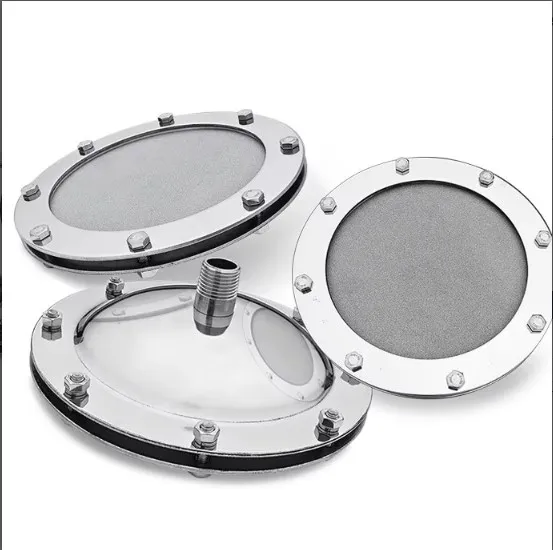
The Sintered titanium disc diffuser with flange represents a technically superior solution to this Mass transfer bottleneck. By generating micro-scale bubbles through precisely controlled pore structures, this device fundamentally enhances ozone dissolution, reaction kinetics, and oxidative capacity across diverse water treatment applications.
The Mass Transfer Problem: Why Conventional Ozone Delivery Falls Short
Ozone’s poor solubility in water is the primary constraint on treatment efficiency. Conventional macro-bubble systems (bubble diameter >100 μm) produce bubbles that rise rapidly, coalesce at the surface, and release the majority of their ozone payload back into the atmosphere before meaningful dissolution occurs. The result is ozone utilization rates that rarely exceed 50%, with many systems operating below 40%.
Micro-nano bubble (MNB) systems address this limitation through four synergistic mechanisms: elevated ozone solubility, improved Mass transfer coefficients, prolonged reactive half-life, and amplified hydroxyl radical (·OH) yields. Direct comparative studies demonstrate that O₃-MNBs achieve a 40% enhancement in ozone Mass transfer efficiency and a 100% increase in ·OH radical yield relative to conventional macrobubble systems.
The practical implications are substantial. A 2024 study on norovirus inactivation found that Ozone microbubbles maintained a half-life of 14 ± 0.81 minutes, compared to only 3 ± 0.35 minutes for conventional aqueous ozone. After 20 minutes, microbubble ozone retained 1.49 ± 0.23 ppm dissolved ozone, while aqueous ozone had decayed to 0.09 ± 0.01 ppm.
Sintered Titanium Technology: Engineering the Microbubble
Material Properties
The Sintered titanium disc diffuser is manufactured from pure titanium powder (purity ≥99.6899%) through high-temperature, high-vacuum sintering. This process creates a homogeneous porous structure with controlled pore geometry, typically featuring aeration apertures of 4–10 microns. The resulting diffuser produces bubbles with a median diameter of 10–60 microns, depending on pore size and operating pressure.
Titanium’s material advantages are critical for ozone service. The metal exhibits exceptional corrosion resistance across a wide pH range, resists oxidation, and demonstrates no reactivity with microorganisms. Unlike ceramic alternatives that may degrade or fracture under thermal cycling, Sintered titanium maintains mechanical integrity over extended service life. Industrial experience with PA-2 titanium dispersers in Minsk’s drinking water treatment system (200,000 m³/day capacity) documented zero replacements over a 10-year operational period.
Flange Configuration
The flanged design serves both structural and hydraulic functions. Flange connections ensure secure, leak-free integration with ozone supply lines and reactor vessels, while the flange geometry facilitates uniform gas distribution across the disc surface. Standard configurations include 4″ (ZG1/2″) or 6″ connections with female or male threading, available in tower-type or flat configurations.
Operational Specifications
| Parameter | Specification |
|---|---|
| Pore Size | 4–10 microns |
| Bubble Diameter | 10–60 microns (median) |
| Oxygen Utilization | 20–30% |
| Available Diameters | 100mm, 125mm, 150mm, 180mm, 245mm |
| Service Area | 0.15–0.5 m² (model dependent) |
| Energy Reduction | 40% lower than conventional aerators |
Application 1: Recirculating Aquaculture Systems (RAS)
The ORP Control Imperative
Ozone application in RAS requires precise control to avoid toxicity while capturing water quality benefits. The Freshwater Institute, a leading RAS research facility, controls ozone dosing through oxidation-reduction potential (ORP) probes with a target set point of 290–320 mV. This range effectively oxidizes dissolved metals, nitrite-nitrogen, and suspended solids while maintaining fish welfare.
However, ORP thresholds vary by species. Research on European sea bass (Dicentrarchus labrax) demonstrated that ORP levels of 300–320 mV induced measurable stress responses, including altered blood glucose and plasma protein concentrations. Mortality occurred when ORP exceeded 320 mV, even at total residual oxidant concentrations as low as 0.03–0.05 mg/L. Critically, the damage appeared irreversible—mortality continued even after ORP was reduced in subsequent periods.
Long-term studies (90 days) confirmed that ORP maintained at 300–320 mV reduced feed intake, feed conversion rate, and growth rate, although it improved resistance to Vibrio anguillarum infection. The recommendation from this research is that ORP for sea bass in RAS should not exceed 300 mV, with a slightly elevated range of 240–270 mV providing disease resistance benefits without growth penalty.
Material Compatibility in RAS
Ozone’s corrosive nature demands careful material selection throughout the RAS ozone pathway. The Freshwater Institute specifies stainless steel tubing for ozone gas transfer and notes that some fiberglass resins exhibit superior ozone resistance compared to others. In one documented case, extensive corrosion occurred in the first chamber of a fiberglass low-head oxygenator exposed to ozone gas. Solenoid and metering valves must incorporate ozone-resistant seals and bodies; failed seals can cause valves to stick open, allowing uncontrolled ozone release.
Titanium’s inherent corrosion resistance makes Sintered titanium diffusers particularly suitable for marine RAS environments where chloride ions accelerate degradation of less robust materials. The diffuser’s ceramic-like hardness and chemical inertness ensure no leaching of contaminants into the culture water.
Safety Considerations
Human health protection requires attention to ambient ozone concentrations. The 15-minute worker exposure limit is 0.3 ppm, and the 8-hour limit is 0.1 ppm. Ozone can enter building atmosphere through leaky fittings or improperly managed water levels at oxygenator distribution plates. Off-gas ports should be exhausted appropriately, and high-ORP alarm setpoints should provide sufficient warning for corrective action.
Application 2: Beverage Industry and Bottled Water
Ozone in Beverage Processing
The beverage industry utilizes ozone for disinfection of product water, process equipment, and packaging. Ozone’s advantage lies in its rapid decomposition to oxygen, leaving no chemical residue that could affect taste or require post-treatment removal. The Sintered titanium diffuser enables efficient ozone delivery even in high-TDS or non-neutral pH waters where ozone efficacy is otherwise compromised.
Microbial Inactivation Performance
Recent research demonstrates the microbubble advantage for pathogen control. A 2023 study on Salmonella Enteritidis inactivation on shell eggs achieved a 5.19 log CFU/egg reduction using ozone microbubble water, compared to only 1–2 log reductions with ozone-only or microbubble-only treatments. The microbubble system generated bubbles with average diameters of 29.05–36.50 μm, within ISO microbubble definition.
Norovirus inactivation studies similarly confirm microbubble efficacy. Ozone microbubbles produced 1.43 ± 0.44 log₁₀ viral reduction at 2 minutes post-generation, compared to 0.8 ± 0.28 log₁₀ for conventional aqueous ozone.
Emerging Contaminant Removal
The enhanced ·OH radical generation from microbubble systems provides superior degradation of trace organic pollutants. A 2025 pilot study demonstrated that O₃-MNBs achieved higher removal rates of 2,4-D, atrazine, norfloxacin, and oxytetracycline within 10 minutes compared to conventional ozone macrobubbles. For pharmaceutical compounds, ozone micro-nano bubbles achieved 97% removal of ciprofloxacin and 100% removal of levofloxacin under optimized conditions (pH 9, 40-minute ozonation, 5 mg/L initial concentration).
Residual Ozone Management
Beverage producers must ensure that ozone residuals do not affect product quality. UV-based ozone destruction systems, such as the PureLine DO AF series, are designed for food and beverage applications and use FDA-approved materials for all wetted parts. These systems can be remotely controlled to allow residual ozone to treat process loops during SIP (sterilization-in-place) cycles, then activated to remove ozone before product contact.
Application 3: Commercial Swimming Pools
Ozone as a Primary Disinfectant
Commercial pools face unique challenges: high bather loads introduce organic contaminants rapidly, and chlorine by-products (chloramines) cause respiratory irritation and odor. Ozone addresses both issues through rapid oxidation of organic matter and destruction of chloramine precursors.
Ozone’s oxidation power is approximately 10 times that of chlorine, making it particularly effective against chlorine-resistant pathogens such as Cryptosporidium and Giardia. The Sintered titanium diffuser’s microbubble generation maximizes ozone transfer efficiency, reducing the required ozone dose while achieving superior water quality.
Engineering Considerations
Commercial pool ozone systems typically employ a venturi injection principle, where the suction created by the pool circulation pump draws ozone gas into the water stream. The Sintered titanium diffuser can be integrated either as a primary injection point or as a secondary contactor for enhanced dissolution.
Critical operational requirements include:
-
Ozone gas lines must use PTFE or stainless steel with backflow prevention
-
Contact time (Ct value) must be sufficient for disinfection: Ct ≥ 1.6 for pool water
-
Ambient ozone in pool atmosphere must not exceed 0.2 mg/m³
Comparative Performance: Titanium Sintered Diffuser vs. Alternatives
| Technology | Bubble Size | Ozone Utilization | Lifespan | Corrosion Resistance |
|---|---|---|---|---|
| Sintered Titanium | 10–60 μm | 20–30% (O₂) | 10+ years | Excellent |
| Ceramic Diffuser | 100–400 μm | ~30% (O₂) | 3–5 years | Good (pH limited) |
| EPDM Membrane | 500–1000 μm | 15–25% | 2–3 years | Poor (ozone degrades EPDM) |
| Venturi Injection | Variable | 40–60% | N/A (no diffuser) | N/A |
The titanium diffuser’s primary advantage is its combination of fine bubble generation with exceptional durability. Ceramic diffusers may produce comparable bubble sizes but are susceptible to fracture under thermal cycling and mechanical stress. EPDM membranes are explicitly not recommended for ozone service. Venturi systems achieve high ozone transfer but require significant energy input and may not achieve the fine bubble distribution necessary for maximum dissolution.
The PA-2 Sintered titanium disperser case study provides the most compelling evidence of long-term value. Replacing 1,000 German Schumacher ceramic tube dispersers with 2,000 PA-2 titanium dispersers in Minsk’s water treatment system (200,000 m³/day) reduced ozone and gas injection requirements while maintaining purification levels, with zero replacements over 10 years.
Conclusion
The Sintered titanium disc diffuser with flange addresses the fundamental limitation of ozone water treatment: inefficient gas-liquid Mass transfer. By generating micro-scale bubbles through precisely engineered pore structures, this technology achieves ozone Mass transfer enhancements of 40% and ·OH radical yield increases of 100% compared to conventional systems.
Across RAS aquaculture, beverage processing, and commercial pool applications, the device delivers consistent performance advantages: finer bubbles, higher ozone utilization, lower energy consumption, and exceptional material durability. The 10-year field record of titanium dispersers in municipal water treatment provides validated evidence of long-term reliability.
For engineers and operators designing ozone systems, the Sintered titanium diffuser represents not merely a component selection, but a fundamental process optimization—transforming ozone from an expensive treatment input into an efficiently utilized resource.
Please login to write a comment after