 English
 Español
 Français
 日本語
 한국어
 Deutsch
 Português
 Русский
 中文 (中国)

- 1. Introduction
- 2. Working Principle
- 3. Design Features and Performance
- 3.1 Wedge Wire Screen Construction
- 3.2 Reversible Screen Design
- 3.3 Quantitative Performance Data
- 3.4 Low Maintenance and Reliability
- 4. Applications Across Industries
- 4.1 Coal Preparation and Mineral Processing
- 4.2 Starch Processing
- 4.3 Pulp and Paper
- 4.4 Wastewater Treatment
- 4.5 Food and Beverage Processing
- 4.6 Chemical Processing
- 5. Selection and Design Considerations
- 6. Summary and Conclusions
Sieve Bend Screen: Working Principle & Application
Abstract — The Sieve Bend Screen, also known as the DSM screen, is a static Solid-Liquid Separation device that achieves efficient Dewatering, desliming, and Classification through a curved wedge wire surface without any moving parts. Invented by Dutch State Mines (DSM), this equipment offers approximately ten times the capacity of conventional vibrating screens while consuming no energy and requiring minimal maintenance. This article systematically examines the working principles, design parameters, performance characteristics, and industrial applications of Sieve Bend Screens, providing quantitative data from academic research and industrial practice to support equipment selection and process optimization.
1. Introduction
In industries ranging from mineral processing to Wastewater Treatment, the efficiency of Solid-Liquid Separation directly impacts product quality, equipment longevity, and operational costs. While various separation technologies exist, the Sieve Bend Screen stands out for its elegant simplicity, high efficiency, and low maintenance requirements. The device operates without mechanical or electrical drive systems, relying instead on gravity, centrifugal force, and the unique cutting action of wedge-shaped screen wires to achieve precise separation.
The Sieve Bend Screen is also known by various names, including side hill screens, parabolic screens, run-down screens, gravity screens, and DSM screens—the latter after Dutch State Mines, which introduced the technology. Today, these screens are manufactured globally and have found applications in Coal Preparation, mineral processing, pulp and paper, starch production, food processing, sugar refining, and municipal Wastewater Treatment.
2. Working Principle
2.1 Fundamental Mechanism
The working principle of the Sieve Bend Screen is based on the interplay of several physical forces acting on a slurry as it flows across a curved wedge wire surface. Unlike vibrating screens that use mechanical agitation, the sieve bend relies on fluid dynamics and the geometric properties of its screen surface.
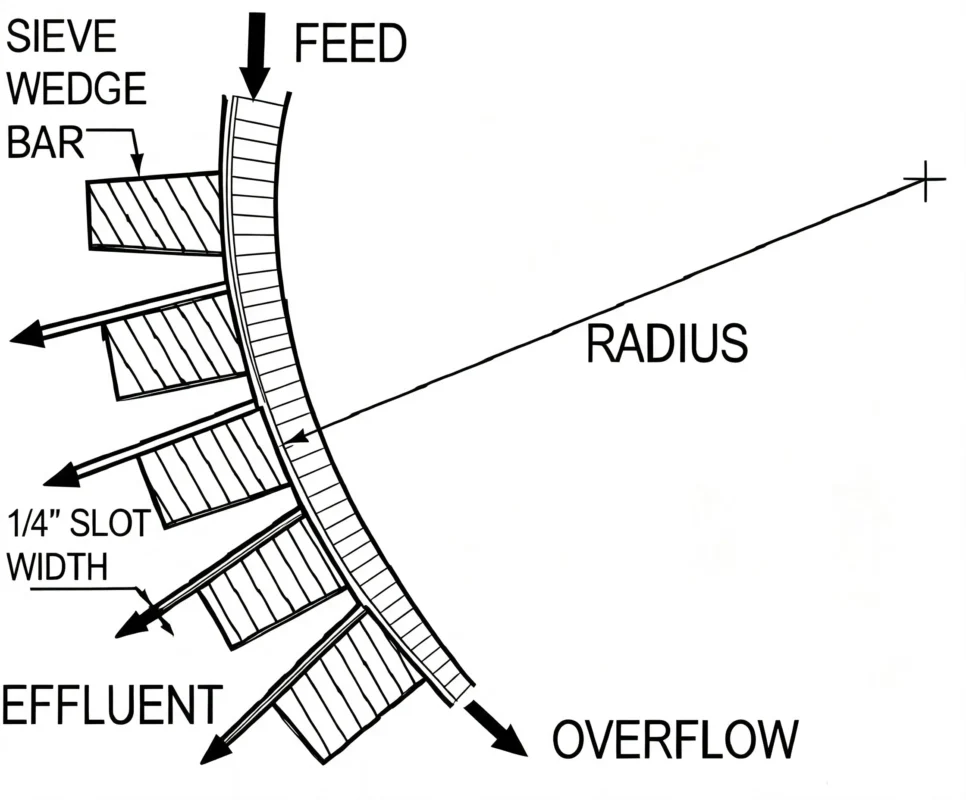
Tangential Feed Introduction — Slurry is directed vertically and tangentially onto the full width of the upper screen surface. The feed enters at a velocity that is carefully controlled—either through pressure (0.2–0.4 MPa for pressure-fed units) or gravity flow for non-pressurized configurations. The tangential entry ensures that the slurry spreads evenly across the screen width and maintains contact with the screen surface throughout its downward journey.
Cross-Flow Separation — As the slurry flows down the concave curved surface, the liquid passes through the slots between wedge-shaped profile wires. The screen openings are oriented perpendicular to the flow direction. The wedge wire profile—with a narrow top and wider base—creates a self-cleaning effect: particles have only two points of contact with the wire, preventing them from becoming lodged in the openings.
The Cutting Action of Wedge Wires — The critical mechanism that distinguishes the sieve bend from other screens is the cutting action of the wedge wire’s leading edge. The sharp, V-shaped profile of each wire acts like a series of knives that slice away a thin layer of water and fine particles from the underside of the flowing slurry. This layer then passes through the slots as filtrate, while the larger solids continue across the top of the screen surface.
The Coandă Effect — The curvature of the screen surface creates an additional separation advantage. As liquid flows over a curved surface, it tends to adhere to the surface—a phenomenon known as the Coandă effect. This adherence maximizes the contact time between the liquid and the screen surface, increasing the opportunity for liquid to pass through the slots before the solids are discharged from the bottom edge.
2.2 Key Operational Parameters
The performance of a Sieve Bend Screen is governed by several interconnected design and operating parameters:
Screen Curvature (Arc Angle) — The arc angle—the degree of curvature of the screen—determines the residence time of the slurry on the screen surface. Common arc angles include 30°, 45°, 60°, 90°, 120°, 180°, and 270°. Generally, shallower arcs (45°) are used for higher-capacity scalping applications, while deeper arcs (60°, 120°) provide longer residence time, making them ideal for finer separations and Dewatering. For pressure-fed applications, 180° arc screens are common, while gravity-fed configurations typically use smaller arcs of 45° or 60°.
| Feed Type | Pressure Range | Typical Application | Characteristics |
|---|---|---|---|
| Pressure-fed (one-stage) | 0.2–0.4 MPa | Coarse particle Classification | Higher capacity, lower efficiency (40–50%) |
| Gravity-fed (two-stage) | No pressure | Fine particle Classification | Lower capacity, higher efficiency (50–60%), reduced screen wear |
In two-stage configurations, the oversize from the first screen is directed to a second screen with added dilution water, improving Classification efficiency.
Screen Slot Size — The width of the slots between wedge wires determines the separation cut point. Available slot sizes range from 0.025 mm to 10 mm. In practice: fine separation applications use 0.05–0.5 mm; coarse separation uses 1.0–3.0 mm; for starch processing, 0.50 mm and 0.75 mm are common. A critical characteristic—and one of the most valuable features—is that the separation size is considerably smaller than the nominal screen opening. Typically, particles that pass through are approximately one-half the slot width. For example, with a 0.2 mm slot, the effective cut point may be around 0.1 mm. In some cases, the finest achievable separation reaches 0.043 mm. This characteristic explains why the screen resists clogging and achieves a cut point finer than the physical slot size would suggest.
3. Design Features and Performance
3.1 Wedge Wire Screen Construction
The screen surface is the heart of the Sieve Bend Screen. It is constructed from V-shaped (wedge) profile wires welded to support rods. The wedge shape provides three critical advantages: large open area (the V-profile maximizes the percentage of open area relative to total surface area); self-cleaning design (particles cannot become wedged in the slot because they only contact the wire at two points); structural strength (the wide base of the wedge wire provides mechanical rigidity). The screen plate is typically made from 304 or 316L stainless steel, with duplex stainless steel available for highly corrosive environments. The all-stainless construction ensures long, corrosion-free service life.
3.2 Reversible Screen Design
Many modern Sieve Bend Screens feature a reversible screen panel design. The screen frame uses a pivot mechanism that allows the screen to be rotated 180°, exchanging the feed end with the discharge end. This feature is critical because most wear occurs at the top (feed) section of the screen. By periodically reversing the screen, the operational life is effectively doubled, significantly reducing maintenance costs and downtime. In some designs, the screen can be reversed without tools, and screen replacement typically takes less than 10 minutes.
3.3 Quantitative Performance Data
Industrial and academic studies provide concrete performance metrics for Sieve Bend Screens:
- Separation accuracy — A study comparing a 0.2 mm fine-slot Sieve Bend Screen with a classifying hydrocyclone for clean coal slurry processing found that the sieve bend significantly outperformed the cyclone: average probable deviation ≈ 1/3 of the hydrocyclone’s deviation; Classification efficiency 80.45% for the sieve bend vs. 73.87% for the hydrocyclone—a 6.58 percentage point advantage; separation at the specified particle size of 0.125 mm.
- Two-stage Classification — In a two-stage fine-slot (0.2 mm) screen application at a Coal Preparation plant, comprehensive testing revealed: comprehensive screening efficiency 83.66%; allocation particle size (S50) 0.146 mm; average probable deviation only 0.027 mm—indicating exceptionally high separation precision.
- Processing capacity — Space efficiency: up to 122 L/s per square metre of floor space; typical throughput: 40–400 tonnes per hour depending on screen width and application; capacity relative to vibrating screens: approximately ten times greater capacity than conventional vibrating screens of similar footprint.
- Handling volume — Typical capacity range (for YHS overflow-type): 60–70 m³/h per unit with 0.15 mm slot size; operating feed concentration (for pressure type): 0–2% with solids output concentration of 2–5%.
3.4 Low Maintenance and Reliability
The absence of moving parts is a defining advantage of the Sieve Bend Screen. The screen operates with no energy consumption (relies solely on gravity or existing head pressure); no mechanical vibrations (quiet operation); no rotating components (eliminates bearing, motor, and drive system failures); and minimal maintenance (in typical applications, the screen requires little more than periodic visual inspection and occasional reversal of the screen panel). The self-cleaning action of the wedge wire design further reduces maintenance requirements by preventing slot blinding—a common problem with traditional woven wire screens.
4. Applications Across Industries
4.1 Coal Preparation and Mineral Processing
The coal and mineral processing industry remains the largest application area for Sieve Bend Screens. Typical uses include:
- Pre-Dewatering, desliming, and demedium removal — In Coal Preparation plants, Sieve Bend Screens are installed before downstream equipment to remove water, fine slimes, and heavy media from coarse coal streams. The HS series screens with 45° or 60° arc angles and 2030 mm radius are commonly specified.
- Coarse clean coal slurry recovery — Fine-slot (0.2 mm) two-stage screens are used for the deep Classification and recovery of coarse clean coal slurry, preventing the loss of quality coal fines to the flotation circuit. As documented at the Qipanjing Coal Preparation Plant, these screens achieve over 83% screening efficiency with exceptionally high precision (probable deviation 0.027 mm).
- Hydrocyclone circuit integration — Sieve bend screens are frequently paired with hydrocyclones in closed-circuit grinding and Classification systems. While hydrocyclones provide the initial Classification, sieve bends are used to dewater and deslime the cyclone underflow or overflow streams.
- Alternative to hydrocyclones for fine screening — In mineral processing, Sieve Bend Screens offer a significant advantage over hydrocyclones for certain fine screening applications. Because hydrocyclone Classification is density-dependent, it can misclassify particles based on specific gravity rather than size. Screens, by contrast, achieve size-based Classification unaffected by particle density. As a result, 0.2 mm fine-slot Sieve Bend Screens have demonstrated superior Classification efficiency compared to hydrocyclones for fine coal slurry processing.
4.2 Starch Processing
The starch industry relies heavily on Sieve Bend Screens (often referred to as “curved screens” or “curved sifters”) for separating starch from fiber, germ, and other insoluble solids.
- Pressure curved screens (120° arc) — Used for the fine separation of starch milk from fiber residue in the grinding and refining stages. These screens operate at 0.2–0.4 MPa pressure with slot sizes of 0.50 mm or 0.75 mm. Typical multi-stage (6+ stages) counter-current washing configurations are employed to maximize starch recovery.
- Gravity curved screens (50° arc) — Used for the coarse separation of starch from germ, fiber, and hulls before fine grinding. These screens operate without pressure, relying solely on gravity flow, with larger slot sizes of 1.0–1.5 mm.
- Process results — Sieved starch particles typically measure approximately half the screen slot width. For example, a 0.50 mm slot screen will yield starch particles of approximately 0.25 mm, demonstrating the fine separation capability characteristic of the wedge wire cutting action.
4.3 Pulp and Paper
In the pulp and paper industry, Sieve Bend Screens serve multiple functions: fiber recovery (recovering valuable fibers from white water streams); wastewater clarification (removing suspended solids before biological treatment); fine screening (final screening of pulp suspensions); and sludge thickening (Dewatering process sludges). The YHS overflow-type screen with 0.15 mm slot size is specifically designed for fiber recovery and white water treatment, achieving 65 m³/h throughput with 0.15 mm slots and requiring only intermittent high-pressure (0.3–0.5 MPa) cleaning sprays.
4.4 Wastewater Treatment
Sieve bend screens are widely used as pre-filters in municipal and industrial Wastewater Treatment plants. By removing suspended solids upstream of the clarifier, the screen dramatically reduces the load on downstream biological treatment systems; improves clarifier performance; and extends the service life of downstream equipment. Typical applications include sewage treatment plants (primary screening); industrial effluent treatment (food processing, textile, leather, sugar, brewing, and petrochemical); and surface water intake screening (removing debris before water treatment). Specific applications documented include poultry, fish, fruit, and vegetable processing wastewater; laundry wash water clean-up; and slaughterhouse waste treatment.
4.5 Food and Beverage Processing
Beyond starch processing, Sieve Bend Screens find numerous applications in food and beverage production:
- Sugar refining: juice screening, bagasse Dewatering
- Corn wet milling: fiber removal and solids recovery
- Brewing: spent grain separation and wort clarification
- Fruit and juice processing: pulp separation and wastewater clean-up
- Dairy: curd separation and whey filtration
4.6 Chemical Processing
In chemical manufacturing, Sieve Bend Screens are used for plastic pellet Dewatering; catalyst recovery; and solid Classification in various chemical processes.
5. Selection and Design Considerations
5.1 Key Selection Factors
When selecting a Sieve Bend Screen for a specific application, the following factors should be considered:
Material compatibility — SS304: general-purpose corrosion resistance; SS316L: enhanced corrosion resistance for acidic or chloride-containing environments; Duplex stainless steel: maximum corrosion resistance for the most demanding applications.
| Application Area | Typical Slot Size |
|---|---|
| Wastewater treatment | 0.5 – 2.0 mm |
| Starch processing | 0.15 – 0.5 mm |
| Mining slurry | 1 – 3 mm |
| Fine coal recovery | 0.2 – 0.5 mm |
Arc angle — The arc angle should be selected based on the required separation sharpness and space constraints: 45° for high capacity, shallower installations; 60° for standard, most common configuration; 90°–120° for enhanced Dewatering and finer separations; 180° for pressure-fed applications (one-stage) with higher capacity.
Screen width — Screens are manufactured in widths ranging from 700 mm to 2400 mm, with capacity proportional to width.
5.2 Installation Requirements
Sieve bend screens require minimal infrastructure for installation: headroom only 1.1 metres (44 inches) for a 900 mm arc length unit; feed arrangement even, tangential distribution across the full screen width; head pressure for gravity-fed units, a minimum of approximately 0.3–0.5 metres of head may be required; and drainage adequate collection and drainage for the filtrate stream.
5.3 Comparison with Alternative Technologies
| Characteristic | Sieve Bend Screen | Vibrating Screen | Hydrocyclone |
|---|---|---|---|
| Energy consumption | None | High | Moderate (pump required) |
| Moving parts | None | Yes (vibrator) | None (pump required) |
| Maintenance | Very low | High | Moderate |
| Space efficiency | Excellent | Moderate | Good |
| Separation basis | Particle size | Particle size | Density and size |
| Separation precision | High (probable deviation 0.027 mm) | Moderate | Moderate |
| Relative capacity (same footprint) | 10× vibrating screen | 1× | N/A |
6. Summary and Conclusions
The Sieve Bend Screen is a remarkably effective Solid-Liquid Separation device that demonstrates the principle that elegance in engineering often lies in simplicity. Its key advantages can be summarized as follows:
- Energy-free operation — The screen operates without any moving parts or energy input, relying solely on gravity and fluid dynamics.
- Exceptional capacity — The curved design provides approximately ten times the capacity of conventional vibrating screens of similar footprint.
- High separation precision — With probable deviations as low as 0.027 mm and Classification efficiencies reaching 80–84%, the Sieve Bend Screen provides superior size-based separation compared to alternative technologies.
- Self-cleaning action — The wedge wire profile and cutting action prevent slot blinding, a chronic problem with woven wire screens.
- Extended service life — Reversible screen designs, combined with the self-cleaning action, provide extended operational life with minimal maintenance.
- Versatility — From 0.025 mm slots for ultra-fine Classification to 10 mm slots for coarse scalping, the Sieve Bend Screen serves a broad spectrum of applications across multiple industries.
The quantitative data from industrial and academic studies confirm the Sieve Bend Screen’s role as an essential component in modern Solid-Liquid Separation systems. As industries continue to demand higher efficiency with lower operating costs, the Sieve Bend Screen—with its unique combination of simplicity, reliability, and performance—remains a technology that warrants careful consideration in any process design.