 English
 Español
 Français
 日本語
 한국어
 Deutsch
 Português
 Русский
 中文 (中国)

- Introduction
- 1. Basic Structure & Material Selection of Stainless Steel Perforated Filter Baskets
- 2. Perforation Aperture, Open Area Ratio & Filtration Precision
- 3. Dimension, Lifting Handle & Structural Design
- 4. Pressure & Flow Verification
- 5. Application Cases across Industries
- Case 1: Traditional Chinese Medicine Extraction (Inline filter basket inside extraction tank)
- Case 2: Water Treatment / Wastewater Pre-filtration
- Case 3: Oil & Lubricant Filtration
- 6. Common Selection Mistakes
- 7. Maintenance & Service Life Reference
- Conclusion
Introduction
Basket strainers are the most widely used Solid-Liquid Separation equipment for pre-treatment of industrial fluid pipelines, applied extensively in traditional Chinese medicine extraction, chemical processing, water treatment, petroleum oil products, food & beverage and other fluid processes. The stainless steel perforated filter basket serves as the core filter element of basket strainers, which directly controls filtration precision, flow capacity, pressure resistance and service life of the whole equipment.
Many procurement and engineering staff only focus on overall dimensions during selection, while ignoring critical parameters such as plate thickness, perforation aperture, material grade, composite structure and surface polishing. This negligence may cause on-site failures including basket deformation, tearing, corrosion and rapid clogging, and bring costly production shutdown losses. Based on years of custom manufacturing experience, this article systematically explains the key points for selecting stainless steel perforated filter baskets with supporting reference data, to help users select filter baskets matching their actual working conditions.
1. Basic Structure & Material Selection of Stainless Steel Perforated Filter Baskets
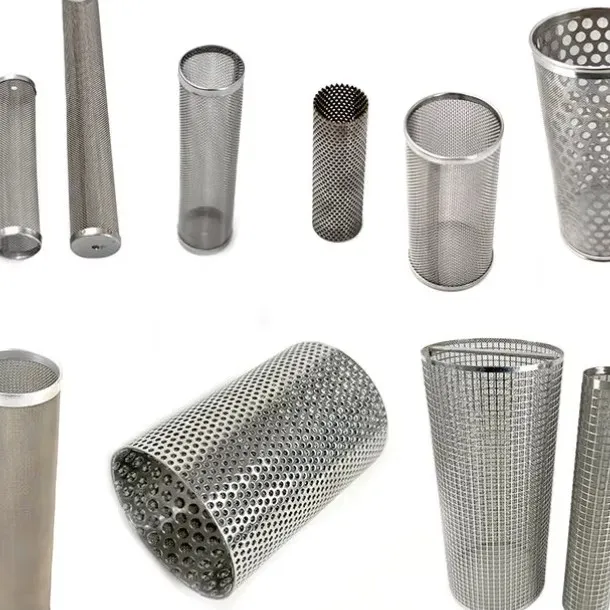
A perforated filter basket is formed by rolling and welding stainless steel perforated plates, equipped with reinforcing rings and lifting handles. Composite structures with inner woven wire mesh are adopted for some working scenarios. The commonly used materials include 304, 316 and 316L stainless steel, which differ greatly in corrosion resistance and applicable working conditions.
表格
| Material | Alloy Features | Applicable Media | Max Temperature |
|---|---|---|---|
| 304 Stainless Steel | Basic austenitic stainless steel with general corrosion resistance | Clean water, neutral liquid medicine, normal-temperature oil, low chloride ion content | ≤80℃ |
| 316 Stainless Steel | Molybdenum added to improve chloride resistance | Seawater, low-chloride wastewater, food fluids, TCM extraction liquid | ≤120℃ |
| 316L Stainless Steel | Low-carbon grade for intergranular corrosion resistance, excellent weldability | High-temperature acid-base fluids, ethanol extraction liquid, long-term immersion service | ≤150℃ |
Selection Tip: When chloride ion content in the medium exceeds 50 ppm, 316L is preferred over 304. For fluids containing organic acid or ethanol reflux extraction (e.g. herbal extraction), 316L is recommended to avoid corrosion leakage at welding seams.
Standard plate thickness options: 1.0 mm /1.5 mm /2.0 mm /2.5 mm /3.0 mm. For low-pressure conditions (pressure <0.6 MPa), 1.5~2.0 mm perforated plate is recommended. For high pressure, large flow rate and heavy solid residue working conditions, plate thickness ≥2.5 mm is required to prevent bulging and deformation under pressure.
2. Perforation Aperture, Open Area Ratio & Filtration Precision
The open area ratio of the perforated basket is the core indicator affecting flow capacity. The conventional open area of perforated plates ranges from 30% to 60%. A higher open area brings lower fluid resistance and pressure drop, yet reduces the overall structural strength of the plate.
- Round hole common apertures: 1 mm, 2 mm, 3 mm, 4 mm, 5 mm, 6 mm, 8 mm, 10 mm.
- For finer filtration to capture tiny particles, perforated plate + stainless steel woven mesh composite structure is adopted. The outer perforated plate acts as a pressure-bearing skeleton while the inner metal mesh achieves fine filtration, with precision ranging from 50 μm to 2000 μm.
Selection Logic
- Coarse filtration (large particles, herb residues, bulk impurities): Aperture 3~10 mm, open area ratio 45%~60%, suitable for extraction tanks and front pipeline pre-filtration.
- Medium precision filtration (fine debris, suspended solids): Aperture 1~3 mm, open area ratio 35%~45%.
- Fine filtration: Perforated skeleton combined with composite mesh, 50~500 μm, for fine chemical and food raw material filtration.
Engineering Reference Data: For baskets of identical size, raising open area ratio from 35% to 50% can reduce fluid pressure drop by about 30% and cut pump energy consumption. However, once open area exceeds 60%, structural strength declines sharply and rupture risk rises under high pressure. Aperture principle: The target captured particle size shall be more than 1.5 times larger than the effective aperture of the basket to avoid particle wedging and rapid clogging.
3. Dimension, Lifting Handle & Structural Design
Filter baskets are cylindrical. Key dimensions: outer diameter, effective filtration height and overall height. Formula for effective filtration area: Effective Filtration Area = π × Basket Diameter × Effective Filtration Height × Open Area Ratio
Example: Basket diameter 200 mm, effective height 400 mm, open area 40% Effective filtration area = 3.14 × 0.2 m × 0.4 m × 0.4 = 0.1005 ㎡. Under the same flow rate, larger filtration area reduces load per unit area, extends clogging cycle and lowers cleaning frequency.
Structural Accessories Selection
- Lifting Handle Single handle or double handles are available. Single handle works for baskets under 15 kg. Double reinforced handles are mandatory when basket weight ≥15 kg or loaded with heavy wet solid residues. Full penetration welding between handle and cylinder prevents fracture during lifting and cleaning.
- Top & Bottom Reinforcing Rings Reinforcing rings installed on both ends resist fluid impact and avoid cracking of rolling welds. Reinforcing rings are required for high-pressure working conditions.
- Surface Treatment
- Brushed finish: Low cost, for general industrial wastewater and coarse filtration.
- Electropolishing: Reduced surface roughness, less material adhesion, easy rinsing. Ideal for food, pharmaceutical and herbal extraction applications to minimize residue sticking.
4. Pressure & Flow Verification
Maximum working pressure must be verified during selection. For single-layer perforated baskets with 2 mm plate thickness and diameter ≤250 mm, recommended max working pressure ≤1.0 MPa. For pressure higher than this value, thicker plate, internal support ribs or composite mesh construction should be considered.
Simplified flow reference: 304 perforated basket, 3 mm aperture, 45% open area, medium as room-temperature clean water. Recommended filtration flow velocity: 0.6~1.2 m/min. Excessively high velocity causes two problems:
- Sharp rise of differential pressure across the basket;
- Continuous scouring of plate edges by hard particles carried by high-speed fluid, accelerating abrasion and shortening service life.
5. Application Cases across Industries
Case 1: Traditional Chinese Medicine Extraction (Inline filter basket inside extraction tank)
Medium: High-temperature aqueous extract, ethanol extraction liquid, containing plant/animal herb residues and trace organic acid. Recommended solution: 316L material, plate thickness 1.5~2.0 mm, aperture 2~5 mm, electropolished surface, double lifting handles. Advantages: Good corrosion resistance, low residue adhesion, removable for full cleaning and reusable.
Case 2: Water Treatment / Wastewater Pre-filtration
Medium: Sediment-laden wastewater with suspended solids, ambient temperature. Recommended solution: 304 material, plate thickness 1.5 mm, aperture 3~6 mm, brushed finish, single handle for cost optimization.
Case 3: Oil & Lubricant Filtration
Medium: Mineral oil with rust particles and solid impurities. Recommended solution: 304 /316, aperture 1~3 mm, optional fine composite mesh, protecting downstream pumps and valves.
6. Common Selection Mistakes
- Only checking outer diameter while ignoring effective filtration height. Many buyers only match the housing diameter of strainers. Insufficient effective height leads to small filtration area and frequent clogging.
- Blind pursuit of high open area ratio. High open area reduces pressure drop yet sacrifices mechanical strength; deformation occurs easily under heavy residue and pressure fluctuation.
- Improper material downgrade. Using 304 for media with chloride or organic acid leads to weld corrosion and perforation after months of operation.
- Omission of reinforced lifting handles. Handle rupture hazard exists when lifting baskets full of wet residues.
7. Maintenance & Service Life Reference
With regular cleaning under normal working conditions:
- Clean water / neutral oil service: 18~36 months service life.
- Herbal extraction / weak acid medium: 6~18 months service life.
- Strongly corrosive and high-abrasion media: 3~8 months service life.
It is recommended to take out and rinse the basket once differential pressure reaches 0.05 MPa. Do not wait for severe clogging. Long-term high differential pressure will accelerate plastic deformation of the filter basket.
Conclusion
As the core element of basket strainers, stainless steel perforated filter baskets cannot be selected merely by outer dimensions. Material grade, plate thickness, aperture, open area, structural accessories and surface finish shall be comprehensively evaluated according to medium composition, temperature, pressure, impurity particle size and flow rate. Custom manufacturing is available for non-standard diameter, height and composite-structure filter baskets based on customer strainer drawings and process parameters, to satisfy industrial Solid-Liquid Separation demands in pharmaceutical, chemical, water treatment and oil industries.
Please login to write a comment after