 English
 Español
 Français
 日本語
 한국어
 Deutsch
 Português
 Русский
 中文 (中国)

Introduction
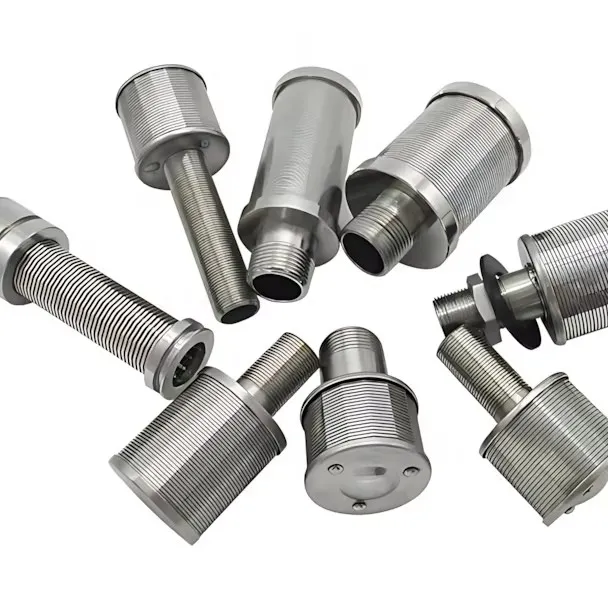
In ion exchange vessels, sand filters, and catalyst retention systems, the water cap (also called filter nozzle or strainer head) is a small component that determines how evenly fluid distributes, how effectively media is retained, and how completely the filter regenerates during backwash. Among the available designs, the stainless steel Johnson wedge wire water cap has gained ground as a replacement for plastic slotted caps, particularly in high-temperature, high-pressure, and corrosive service. Its defining feature—a V-shaped wire profile with an outward-narrowing slot—makes both filtration and backwash behave differently from conventional perforated or mesh-based elements. This article reviews the construction, customizable slot range, backwash mechanism, material selection, and engineering boundaries of wedge wire water caps, drawing on manufacturer data and published product specifications.
1. Construction and Nomenclature
A wedge wire water cap is built from stainless steel wedge-shaped (trapezoidal) wire wound around longitudinal support rods and welded at each contact point, with an end plate closing the top and a threaded connection at the base for mounting to the filter plate. The same family of products appears under several names: Johnson screen water cap, trapezoidal wire water cap, wedge wire strainer head, and wedge wire filter nozzle. The “Johnson” designation derives from the original Johnson screen technology, in which the wire profile creates a continuous slot with a precisely controlled gap between adjacent turns.
The V-shaped opening is the structural core of the design. The slot is narrow on the outside and widens toward the inside. During filtration, particles larger than the slot are retained on the outer surface; during backwash, the diverging passage allows captured material to release more readily. The welded wedge wire cage forms a continuous, rigid structure with a nearly two-dimensional filtration surface, which manufacturers describe as having no dead zones for particle accumulation.
2. Customizable Slot Width: Range and Tolerances
Slot width is the primary specification variable. Published manufacturer data places the producible slot range for wedge wire screen tubes at approximately 0.02 mm to 35 mm, with filtration ratings from roughly 20 to 3000 microns. One manufacturer states that the minimum slot can be held to 20 microns with a tolerance of 5 microns, while another reports slot precision of 25 microns with an error of 0.01 mm (capable of “2丝,” approximately 650 mesh). For finished water caps specifically, common catalog slots fall in the 0.2–0.25 mm range, while custom caps are offered from 0.05 mm to 2 mm. Diameters typically span 45–108 mm, with threaded connections in M20–M33, G1″–G2″, and NPT/PT/Z variants; flow areas are quoted from roughly 380 to 4600 mm² depending on model.
The practical takeaway is that 0.02 mm represents the lower bound claimed by multiple manufacturers, while the typical custom window for a finished water cap is 0.05–2 mm, with slot tolerances at the ±0.01–0.03 mm level. This precision matters because slot uniformity directly controls media retention and flow distribution across the filter plate.
3. Backwash Performance: Mechanism and the Data Gap
The backwash advantage of wedge wire caps is structural rather than incidental. Because the slot narrows at the outer surface and widens inward, the filtration surface is effectively two-dimensional and smooth; particles are intercepted at the surface rather than embedded in a depth matrix. During backwash, flow reverses and the diverging slot geometry concentrates cleaning energy at the gap, promoting release of the retained cake. Manufacturers consistently describe this as improved “regeneration” or “self-cleaning” behavior compared with plastic slotted caps.
A second factor is flow area. One source states that the slot open area of a stainless steel water cap is approximately 2–3 times that of a plastic slotted cap of the same specification, which reduces initial pressure drop and supports higher backwash flow at a given supply pressure. Stainless steel construction also eliminates the temperature and aging limitations of ABS plastic caps, which are described in manufacturer literature as prone to cracking and pressure-related failure.
A caution on quantitative claims: the available sources describe the backwash mechanism qualitatively but do not provide comparable performance data—such as pressure-drop recovery ratio before and after backwash, backwash water consumption relative to plastic or mesh caps, or minimum backwash velocity for cake detachment under defined slot widths. Articles making performance claims should either obtain such data from controlled testing or clearly frame the backwash advantage as a design mechanism rather than a measured result.
4. Material Selection
The material spectrum runs from general-purpose to severe-corrosion grades:
-
304 stainless steel: the economic baseline, with published heat resistance of roughly 1000–1200 °C, yield strength ≥205 MPa, and tensile strength ≥520 MPa.
-
316/316L: addition of molybdenum improves corrosion resistance and high-temperature strength; heat resistance quoted at 1200–1300 °C, with yield ≥205 MPa, tensile ≥520 MPa, and elongation ≥40%. Suitable for marine and aggressive industrial atmospheres.
-
904L: a high-alloy austenitic grade for extreme chemical service, with tensile strength ≥490 MPa, yield ≥216 MPa, and density 8.0 g/cm³; used where chlorides and reducing acids attack 316L.
-
Duplex 2205 and Hastelloy: specified for the most aggressive media, where even 904L is marginal.
Material selection should be driven by the actual medium chemistry—particularly chloride concentration and temperature—rather than by a default preference for 316L. In chloride-bearing service, the risk of pitting and stress corrosion cracking sets a real upper boundary on 304/316L suitability that deserves explicit treatment in specification documents.
5. Engineering Selection: Matching Slot Width to Media
The customizable slot range is only useful if the engineer can translate media specifications into a slot width. The governing principle, reflected in manufacturer guidance, is to size the slot against the minimum particle size of the retained media: the slot must be small enough to prevent unacceptable media loss (“resin escape”) yet large enough to avoid rapid plugging and excessive pressure drop. Published application experience includes:
-
Ion exchange vessels: slots typically 0.2–0.25 mm to retain resin beads while permitting adequate flow.
-
Catalyst retention: slot sized to the catalyst particle size distribution, often finer than resin applications.
-
Coarse filtration / media retention: slots of 0.5 mm and above, where the retained material is larger and plugging risk dominates.
A practical rule of thumb used in the industry is to set the slot at roughly one-half to two-thirds of the minimum media particle size, then verify against backwash intensity and allowable media loss. Slot widths below about 0.1 mm increase the risk of fine-particle wedging and require more careful backwash design; slot widths above the media’s minimum particle size invite media carryover. This trade-off—finer slot for better retention versus coarser slot for lower plugging risk—is the central selection decision and should be documented for each application.
6. Failure Modes and Application Boundaries
Manufacturer literature tends to present stainless steel caps as virtually failure-free, but sound specification should account for known failure modes:
-
Slot wedging: fine particles forced into the V-groove under differential pressure can lodge and resist backwash, progressively raising pressure drop.
-
Weld fatigue at support-rod junctions: cyclic backwash loading can initiate cracks at wire-to-rod welds, particularly in long-service vessels with aggressive cycling.
-
Thread loosening: caps mounted on threaded studs can loosen under alternating flow and vibration, causing bypass and media loss.
-
Chloride-assisted corrosion: 304 and 316L are vulnerable to pitting and stress corrosion cracking above threshold chloride levels and temperatures; 904L or duplex grades should be specified where these thresholds are exceeded.
Life-cycle cost comparisons should therefore include cap unit price, replacement interval, and downtime cost—not simply the purchase price difference against plastic caps. The claim that stainless caps “pay back in one year” appears in manufacturer material and should be treated as a vendor estimate unless supported by documented case data.
7. Market Context
Published figures place the domestic stainless steel screen tube market at over RMB 4.5 billion in 2023 with a compound annual growth rate of 7.2%, though this figure covers screen tubes broadly rather than water caps specifically, and the source is a commercial website rather than an independent industry report. The substitution of stainless caps for plastic caps is consistently described as a trend in manufacturer literature, but independent penetration or replacement-rate statistics were not identified. Market claims in a technical article should therefore be scoped narrowly and attributed to their sources.
Conclusion
The stainless steel Johnson wedge wire water cap combines a continuously welded wedge wire cage with a V-shaped slot that narrows at the filtration surface and widens inward. Its customizable slot—producible from approximately 0.02 mm and commonly specified between 0.05 and 2 mm for finished caps, with tolerances in the ±0.01–0.03 mm range—allows engineers to match retention performance to media size. The backwash advantage is grounded in the two-dimensional filtration surface and diverging slot geometry, supported by a flow area roughly two to three times that of comparable plastic caps, though published quantitative backwash data remain limited. Material selection from 304 through 316L, 904L, duplex, and Hastelloy should follow the medium chemistry, and specification should acknowledge failure modes such as slot wedging, weld fatigue, thread loosening, and chloride-assisted corrosion. Used with an explicit slot-selection rationale and realistic life-cycle assumptions, the wedge wire water cap is a defensible choice for ion exchange, catalyst retention, and media filtration service—particularly where plastic caps have reached their pressure or temperature limits.
Please login to write a comment after