 English
 Español
 Français
 日本語
 한국어
 Deutsch
 Português
 Русский
 中文 (中国)

- 2. The Engineering Foundation
- 2.1 Media Retention Principle
- 2.2 Flow Distribution Uniformity
- 2.3 Open Area and Hydraulic Performance
- 2.4 Pressure Drop Calculation
- 3. Design Considerations
- 4. Advantages of Wedge Wire Nozzles
- 4.1 Self-Cleaning, Non-Clogging Design
- 4.2 Uniform Flow Distribution
- 4.3 High Mechanical Strength
- 4.4 Long Service Life and Low Maintenance
- 5. Applications
- 6. Conclusions
In modern water treatment systems, the underdrain assembly—the component responsible for collecting filtered water and distributing backwash flow—is often the critical factor that determines overall system performance. A poorly designed underdrain can undermine even the most carefully selected filter media, leading to uneven flow distribution, media loss, channeling, and premature breakthrough.
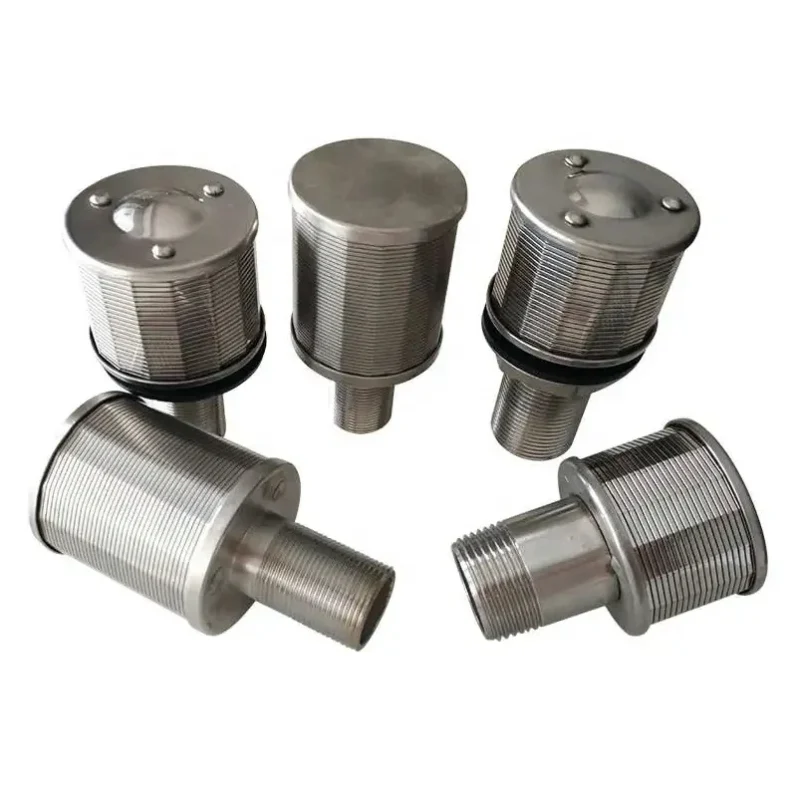
Wedge wire filter nozzles have emerged as a reliable solution to these challenges. Precision-engineered from V-shaped (wedge) profile wire welded onto support rods, these nozzles provide continuous slot openings that combine accurate filtration, high mechanical strength, and excellent resistance to clogging. This article explores the engineering principles, design considerations, and application benefits that make wedge wire nozzles a preferred choice in water treatment.
2. The Engineering Foundation
2.1 Media Retention Principle
The fundamental requirement of any underdrain nozzle is to retain the filter media while allowing water to pass. For wedge wire nozzles, this is governed by a simple relationship: the slot width ww must be finer than the smallest media grain dmindmin in the bed:
w≤dminw≤dmin
In practice, designers typically specify w≈0.5×dminw≈0.5×dmin to provide a safety margin against media migration. For ion-exchange resins with particle sizes of 0.3–1.2 mm, retention slots of 0.15–0.25 mm are common; for sand filtration systems with 0.5–1.0 mm media, 0.2–0.5 mm slots are typical.
2.2 Flow Distribution Uniformity
Uniform flow distribution is not automatic—water always follows the path of least resistance. In a lateral-and-nozzle system, the flow split between near and far outlets is governed by the ratio of orifice headloss hoho to lateral pipe friction headloss hfhf:
ΔQQ≈12⋅hfhoQΔQ≈21⋅hohf
Uniform distribution is achieved when the nozzle headloss dominates—that is, when ho≫hfho≫hf. The orifice headloss itself follows the square law:
ho=Q2(Cd⋅Aslot)2⋅12gho=(Cd⋅Aslot)2Q2⋅2g1
Where CdCd is the discharge coefficient, AslotAslot is the total open slot area, and gg is gravitational acceleration. Designers therefore select the total open area so that hoho is several times hfhf, ensuring even flow across the entire filter bed.
2.3 Open Area and Hydraulic Performance
One of the key advantages of wedge wire technology is its high effective open area. The open area percentage is calculated as:
Open Area(%)=Slot WidthSlot Width+Wire Top Width×100Open Area(%)=Slot Width+Wire Top WidthSlot Width×100
Wedge wire screens typically achieve 15–65% open area, significantly outperforming perforated plate designs (20–35%) at equivalent separation sizes. A higher open area translates directly into greater flow capacity per unit area, lower pressure drop, and reduced approach velocity—resulting in less turbulence, less wear, and better separation accuracy.
For example, a screen with 0.50 mm slots and 1.50 mm wire width has 25% open area; reducing the wire width to 1.00 mm increases the ratio to 33%—an 8 percentage point gain that means 33% more flow per square meter.
2.4 Pressure Drop Calculation
The pressure drop across a wedge wire nozzle can be calculated using the following formula:
ΔP=ξ⋅ρ⋅v22ΔP=ξ⋅2ρ⋅v2
Where:
-
ξξ = resistance coefficient of the nozzle
-
ρρ = fluid density (for water, ρ=1000ρ=1000 kg/m³)
-
vv = flow velocity through the slots
For design purposes, the resistance coefficient ξξ varies with slot width:
| Slot Width Range | Recommended ξ |
|---|---|
| 0.2–0.3 mm | 3.0–5.0 |
| 0.4–0.5 mm | 1.5–3.0 |
Worked Example: For a nozzle with a 0.25 mm slot, taking ξ=4ξ=4, the pressure drop is approximately 1,056 Pa.
3. Design Considerations
3.1 Slot Velocity
The flow velocity through nozzle slots directly impacts system performance. Recommended slot velocities vary by application:
| Application | Recommended Velocity |
|---|---|
| Standard ion exchangers (softening, demineralization) | 0.3–1.0 m/s (optimum: 0.5–0.8 m/s) |
| Condensate polishing systems | 0.2–0.5 m/s |
| Mixed bed systems | 0.2–0.8 m/s |
| High-flow industrial exchangers | 0.5–1.5 m/s |
Excessive velocity leads to high pressure drop, increased energy consumption, and turbulence in the media bed. Conversely, overly low velocity may cause uneven water distribution and channeling.
3.2 Slot Size Selection
Slot size represents one of the most critical design choices. An incorrectly selected slot opening can compromise the entire filtration system:
-
Slot too large: Media particles escape, filtration performance declines, downstream equipment is affected
-
Slot too small: Flow resistance increases, pressure drop rises, backwashing becomes less effective
The ideal slot size depends on the type and size of filtration media, and should always be evaluated in the context of the complete filtration process.
3.3 Material Selection
Wedge wire nozzles are manufactured from a wide range of alloys to suit different operating environments. Common material grades include 304, 304L, 316, 316L, 310S, 904L, C276, duplex (S32205), super duplex (S32750), and titanium Gr.2.
For general water treatment applications with moderate corrosion requirements, Type 304 stainless steel is typically sufficient. Type 316L is preferred for chemical filtration, marine environments, and industrial wastewater treatment where enhanced corrosion resistance is required. For demanding applications involving high chloride exposure or aggressive chemicals, duplex stainless steels and special alloys are recommended.
4. Advantages of Wedge Wire Nozzles
4.1 Self-Cleaning, Non-Clogging Design
The V-shaped profile wire of wedge wire nozzles creates slots that widen internally. This geometry prevents particles from becoming wedged in the opening—if a particle enters the slot, it encounters an expanding rather than constricting channel, allowing it to release during backwashing. This self-cleaning characteristic maintains stable flow performance over extended operating periods and reduces maintenance frequency.
4.2 Uniform Flow Distribution
Optimized slot arrangement ensures even water collection and backwash distribution across the entire filter bed. This balanced flow prevents dead zones, mud balls, and channeling—issues that plague poorly designed underdrain systems.
4.3 High Mechanical Strength
The fully welded construction of wedge wire nozzles provides outstanding load-bearing capacity and resistance to deformation, even under high operating pressures and during aggressive backwash cycles.
4.4 Long Service Life and Low Maintenance
The durable stainless steel structure reduces replacement frequency and operating costs over the system lifecycle. Unlike plastic or perforated alternatives that may degrade or clog over time, high-quality wedge wire nozzles can provide reliable service for many years in demanding water treatment applications.
5. Applications
Wedge wire filter nozzles are widely used across water treatment and industrial process filtration:
| Sector | Applications |
|---|---|
| Water Treatment | Multimedia filters, sand filtration, drinking water treatment, activated carbon filters |
| Ion Exchange | Resin retention, uniform regeneration flow, demineralizers, softeners |
| Industrial Process | Chemical processing, power plant water treatment, food and beverage filtration |
| Wastewater | STP treatment, industrial effluent filtration |
Typical flow capacities for standard single-head nozzles range from 0.5 to 3.0 tons per hour, with filtration areas from 280 to 1,200 mm² depending on model configuration.
6. Conclusions
Wedge wire filter nozzles represent a proven, engineering-based solution for water treatment underdrain systems. Their design—rooted in the principles of media retention, headloss management, and open area optimization—delivers uniform flow distribution, reliable media retention, and efficient backwash performance.
The technology’s advantages over conventional perforated or mesh-type nozzles are clear: higher open area, superior anti-clogging characteristics, greater mechanical strength, and longer service life. Whether applied in municipal water treatment, industrial filtration, or ion-exchange systems, wedge wire nozzles provide the hydraulic performance and operational reliability that modern water treatment facilities demand.
For engineers and system designers, the availability of detailed design tools—including open area calculators, pressure drop estimation methods, and material selection guidelines—enables precise sizing and optimization for virtually any application. As water treatment requirements continue to evolve toward higher efficiency and stricter effluent quality standards, wedge wire filter nozzles offer a robust foundation for reliable filtration system performance.
Please login to write a comment after