 English
 Español
 Français
 日本語
 한국어
 Deutsch
 Português
 Русский
 中文 (中国)

- The Structural Foundation: Engineering for Pressure
- The Conical Advantage: Geometry Optimized for High-Pressure Separation
- The V-Shaped Wire Profile: Precision Meets Durability
- Material Selection: Matching the Basket to the Challenge
- High-Pressure Performance: Testing and Validation
- Applications Across Industries
- Mining and Mineral Processing
- Chemical Processing
- Pharmaceutical and Food Processing
- Water and Wastewater Treatment
- Case Example: High-Pressure Chemical Processing
- Selection Guidelines for High-Pressure Applications
- 1. Define the Pressure Profile
- 2. Match Slot Size to Cut Point Requirements
- 3. Select Material for the Environment
- 4. Verify Dynamic Compatibility
- Conclusion
In the realm of industrial solid-liquid separation, the convergence of high pressure, high centrifugal force, and abrasive process streams presents one of the most demanding engineering challenges. Conventional screen baskets – whether perforated plates, woven wire mesh, or polymer-clad designs – frequently fail under these aggressive conditions. The failure modes are familiar to plant operators: structural deformation, slot enlargement from abrasion, fatigue cracking, and ultimately, premature replacement that drives up maintenance costs and unplanned downtime.
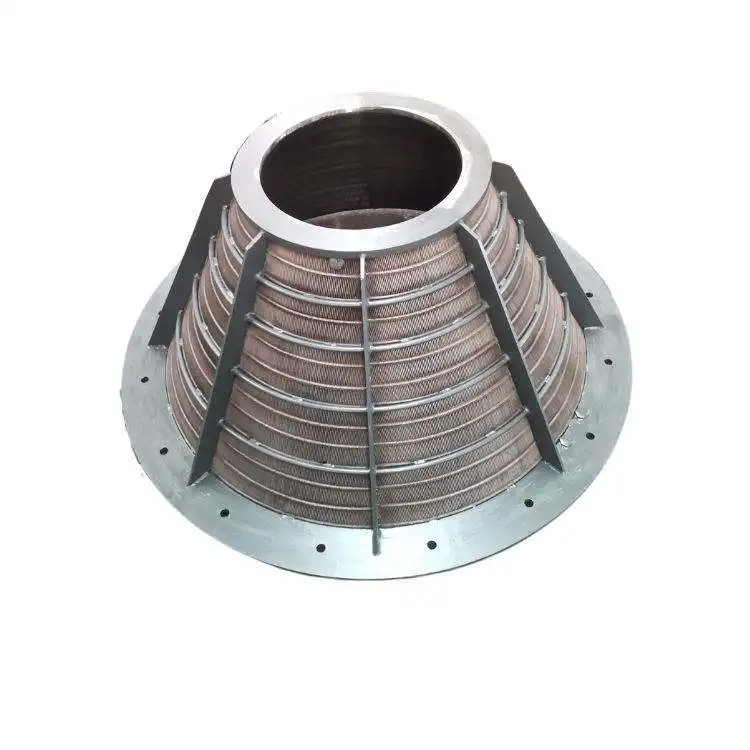
The heavy duty wedge wire conical basket offers a purpose-engineered solution to this challenge. By combining the inherent strength of a self-supporting welded structure, the precision of V-shaped profile wire, and the hydraulic advantages of conical geometry, this screen design delivers reliable, high-efficiency separation under the most demanding pressure and centrifugal loading conditions.
This article examines the structural design, performance characteristics, material selection strategies, and application engineering principles that make the wedge wire conical basket the preferred choice for high-pressure solid-liquid separation across multiple industries.
The Structural Foundation: Engineering for Pressure
Self-Supporting Wedge Wire Construction
Unlike woven mesh screens that rely on external support structures, the wedge wire conical basket is fabricated from V-shaped (wedge) profile wires welded longitudinally to a cage of support rods. This creates a rigid, self-supporting structure with continuous, precisely controlled slots.
The fundamental engineering advantage of this construction is its ability to withstand full differential pressure and repeated backwashing – conditions that cause woven mesh to fatigue, deform, or blind. The welded intersection of each wedge wire to the support rods distributes mechanical loads across the entire structure, eliminating stress concentration points that typically initiate failure in conventional designs.
Quantified Strength Parameters
Performance data from industrial applications demonstrates the structural capabilities of heavy duty wedge wire conical baskets:
| Parameter | Typical Value |
|---|---|
| Collapse strength | Up to 399 PSI (2.75 MPa) |
| Tensile load capacity | 6 – 11 tons |
| Centrifugal force tolerance | >3,000 G |
| Operating temperature range | -196°C to +400°C |
| Slot tolerance | ±0.02 mm |
| Balancing grade | ISO 1940 G2.5 (vibration-free operation up to 10,000 RPM) |
| Open area | 15% – 50% |
These values are not theoretical maximums but verified performance parameters achieved through precision manufacturing and rigorous quality control. The collapse strength, in particular, is directly relevant to high-pressure operation – the basket must maintain its structural integrity and dimensional stability under both steady-state pressure and transient pressure spikes common in process startups and shutdowns.
The Conical Advantage: Geometry Optimized for High-Pressure Separation
The conical shape of the basket is not merely a manufacturing convenience; it is a deliberate engineering choice that enhances separation performance under pressure:
Centrifugal Force Amplification
As slurry moves upward along the conical surface (in typical vertical centrifuge configurations), the increasing radius generates progressively higher centrifugal forces. This centrifugal amplification creates a self-intensifying dewatering effect – solids near the large-diameter discharge end experience the highest G-forces, ensuring maximum liquid removal at the point of solids exit.
Continuous Solids Discharge
The conical geometry enables continuous, gravity-assisted solids discharge. Unlike cylindrical baskets that require mechanical scraping or intermittent discharge cycles, the conical design allows solids to flow steadily toward the discharge edge under the combined effects of centrifugal force and gravity. This continuous operation is particularly valuable in high-pressure, high-throughput processes where downtime is prohibitively expensive.
Slot Orientation for Optimized Flow
In properly designed conical baskets, the wedge wire slots are oriented parallel to the direction of solids movement (typically along the cone generatrix). This alignment serves two critical functions:
-
Accelerated filtrate drainage – Liquid flows unobstructed through the slots without fighting against solids transport
-
Reduced particle impingement – Solids slide over the smooth V-shaped wire surfaces rather than impacting slots at perpendicular angles, reducing both blinding and wire wear
The V-Shaped Wire Profile: Precision Meets Durability
Self-Cleaning Geometry
The defining feature of the wedge wire basket is the V-shaped profile of its surface wires. Tapering from a narrow top (the screening surface) to a wider base (welded to support rods), this profile creates a natural gap-clearing action.
When particles approach a slot, the converging wedge shape guides them over the surface rather than allowing them to lodge inside the opening. This self-cleaning characteristic is essential in high-pressure applications, where the increased driving force would otherwise force finer particles into the slot gaps of conventional screens, leading to rapid blinding.
Precision Slot Control
The manufacturing process for heavy duty wedge wire baskets achieves slot tolerances of ±0.02 mm, with minimum slot openings as small as 6 – 15 microns. This level of precision is critical for applications with tight separation specifications, where the margin between acceptable filtrate clarity and product loss is measured in microns.
Notably, the V-shaped slot actually increases in width as it deepens (narrower at the surface, wider at the base). This profile means that a particle that begins to enter the slot is unlikely to become permanently wedged – the expanding clearance allows it to be washed back out or dislodged during cleaning cycles.
Wear-Resistant Surface
As the surface wire wears over extended service, the V-shape maintains its dimensional precision for longer than flat or round wire profiles. The wear that does occur primarily affects the wire tips while the slot width remains stable – separation performance is preserved even as the basket approaches the end of its useful life.
Material Selection: Matching the Basket to the Challenge
The choice of construction material is perhaps the single most important decision in specifying a heavy duty wedge wire basket for high-pressure service. High pressure often correlates with corrosive process streams, elevated temperatures, or both. The following material options span the full range of industrial requirements:
| Material | PREN* Value | Chloride Tolerance | Max Temperature | Key Application |
|---|---|---|---|---|
| 304/304L Stainless | 18 – 20 | ≤200 ppm | 450°C | General purpose, mild conditions |
| 316/316L/316Ti Stainless | 24 – 26 | ≤1,000 ppm | 450°C (316L) / 550°C (316Ti) | Chemical processing, food grade |
| Duplex 2205 | 33 – 38 | Brackish water | 300°C | High chloride, high strength |
| Super Duplex 2507 | ≥40 | Seawater | 300°C | Aggressive marine/chemical |
| Hastelloy / Titanium | — | Unlimited | Custom | Extreme corrosion, specialty chemicals |
*PREN = Pitting Resistance Equivalent Number, a measure of corrosion resistance
For high-pressure applications, duplex and super duplex stainless steels offer a compelling combination of properties:
-
PREN values of 33 – 40 provide excellent resistance to chloride-induced pitting and crevice corrosion – common failure mechanisms in pressure vessels handling saline or chemically aggressive streams
-
Yield strength approximately twice that of 316L enables thinner sections for the same pressure rating, reducing basket weight and centrifuge drive loads
-
Superior abrasion resistance (approximately 1.8× that of 304-grade materials) extends service life in solids-laden streams
High-Pressure Performance: Testing and Validation
Hydrostatic Pressure Testing
Every heavy duty wedge wire basket intended for high-pressure service should undergo hydrostatic pressure testing to verify structural integrity. Industry practice requires testing to at least two times the maximum allowable working pressure (MAWP) – a safety margin that ensures the basket can withstand pressure surges without catastrophic failure.
For a basket rated at 399 PSI (2.75 MPa) collapse pressure, this represents a substantial safety factor over typical operating pressures in most industrial processes, providing plant operators with confidence in long-term reliability.
Dynamic Balancing
At high centrifugal speeds, even minor mass imbalances become significant forces. The precision dynamic balancing of wedge wire conical baskets to ISO 1940 G2.5 grade ensures:
-
Vibration-free operation up to 10,000 RPM
-
Reduced bearing and shaft wear on the centrifuge drive
-
Extended service life for both the basket and the host equipment
-
Consistent separation performance without pressure-induced vibration artifacts
Fatigue Life Validation
The welded wedge wire construction has demonstrated fatigue life exceeding 10⁷ cycles under cyclic pressure loading. This is achieved through:
-
Continuous welding along the entire length of each support rod
-
Absence of stress risers found in bolted or clamped screen designs
-
Uniform load distribution across the basket circumference
Applications Across Industries
The heavy duty wedge wire conical basket finds application across a diverse range of high-pressure solid-liquid separation processes:
Mining and Mineral Processing
In coarse coal slime dewatering and tailings treatment, conical baskets handle abrasive slurries at high feed pressures. The combination of high wear resistance (duplex stainless steel), self-cleaning slot geometry, and continuous solids discharge makes the wedge wire basket the industry standard for centrifuge installations.
Typical configuration: Slot openings of 0.3 – 1.0 mm, diameters from 305 mm to 1,900 mm, with service life of 3 – 4 months in abrasive coal slurry service – a significant improvement over conventional screen designs.
Chemical Processing
High-pressure chemical reactors often discharge slurries containing aggressive solvents, elevated temperatures, and fine catalyst particles. Wedge wire conical baskets in these applications are typically fabricated from:
-
316Ti stainless steel for service up to 550°C
-
Hastelloy or titanium for extreme chemical resistance
-
Slot openings as fine as 15 microns for catalyst retention
Pharmaceutical and Food Processing
In processes where product purity is paramount, wedge wire conical baskets fabricated from 316L stainless steel with surface finishes of Ra ≤ 0.1 µm (achieved through electropolishing) provide:
-
Non-reactive, non-contaminating separation surfaces
-
CIP (clean-in-place) compatibility
-
Compliance with FDA and ASME BPE standards
Water and Wastewater Treatment
High-pressure membrane pre-treatment and sludge dewatering applications benefit from the combination of high flow capacity and fine slot precision, with 316L or duplex stainless steel providing corrosion resistance to chemically conditioned streams.
Case Example: High-Pressure Chemical Processing
Application: Catalyst recovery from a high-pressure hydrogenation reactor discharge
Challenge: The process stream operated at 3.5 MPa pressure and 250°C, containing fine catalyst particles (d₅₀ = 20 microns) in a hydrocarbon solvent with 500 ppm chlorides. Conventional woven mesh baskets failed within 6-8 weeks due to:
-
Wire fatigue at the intersection points
-
Slot enlargement from particle abrasion
-
Chloride stress corrosion cracking of 304-grade materials
Solution: A heavy duty wedge wire conical basket with the following specifications:
-
Material: Duplex 2205 (PREN 33 – 38) for chloride resistance and high strength
-
Slot opening: 20 microns (to retain catalyst fines)
-
Construction: Heavy gauge wedge wire with enhanced support rod count
-
Balancing: ISO 1940 G2.5
Result:
-
Service life extended to 18 months (a 10× improvement over conventional screens)
-
Consistent catalyst retention throughout the campaign
-
Eliminated unplanned downtime for screen replacement
-
Total cost of ownership reduced by an estimated 65%
Selection Guidelines for High-Pressure Applications
For engineers specifying wedge wire conical baskets for high-pressure service, the following considerations should guide the selection process:
1. Define the Pressure Profile
Understand not only the normal operating pressure but also:
-
Maximum pressure during process upsets
-
Pressure transients during startup and shutdown
-
Differential pressure across the screen (not just absolute pressure)
The selected basket should have a collapse strength with a minimum safety factor of 2× the maximum expected differential pressure.
2. Match Slot Size to Cut Point Requirements
Slot size should be selected based on the particle size distribution (PSD) of the solids to be retained. The effective cut point (d₅₀) is approximated as 0.5× the slot width – a slot of 20 microns will retain particles down to approximately 10 microns.
3. Select Material for the Environment
Consider the following environmental factors:
-
Corrosion: Use PREN values to match the chloride and acid levels in the process stream
-
Temperature: Ensure material maintains strength at operating temperature
-
Abrasion: Select duplex or super duplex grades for high wear service
-
Food/pharma compliance: Specify 316L with electropolished finish
4. Verify Dynamic Compatibility
For centrifuge applications, confirm that the basket is balanced to the appropriate ISO standard and that the natural frequency of the basket does not coincide with the operating speed of the centrifuge.
Conclusion
The heavy duty wedge wire conical basket represents a mature, proven technology for high-pressure solid-liquid separation. Its engineering advantages are grounded in fundamental principles:
-
Self-supporting wedge wire construction provides exceptional collapse strength without the maintenance burdens of woven mesh
-
Conical geometry optimizes centrifugal force distribution and enables continuous solids discharge
-
V-shaped wire profile delivers precision separation with self-cleaning performance
-
Advanced metallurgy allows application across the full spectrum of chemical, thermal, and mechanical aggressiveness
For plant operators, process engineers, and project managers facing the challenges of high-pressure separation, the wedge wire conical basket offers a robust, reliable, and cost-effective solution. With documented service life improvements of 10× over conventional screens and total cost of ownership reductions exceeding 60% in demanding applications, this technology has earned its position as the industry standard.
As process industries continue to push toward higher pressures, finer separations, and longer campaign lengths, the heavy duty wedge wire conical basket – with its inherent design robustness and manufacturing precision – will remain an essential tool in the separation engineer’s portfolio.
Please login to write a comment after