 English
 Español
 Français
 日本語
 한국어
 Deutsch
 Português
 Русский
 中文 (中国)

- 1. Introduction
- 2. Manufacturing Principles and Structural Characteristics
- 3. Quantitative Performance Comparison
- 4. The Wedge Wire Advantage: Engineering Rationale
- 4.1 Slot Stability
- 4.2 Anti-Clogging Performance
- 4.3 Higher Open Area, Higher Throughput
- 4.4 Structural Durability
- 5. Engineering Case Studies
- 5.1 Case Study 1: Coal Preparation Plant — Woven Mesh to Wedge Wire Conversion
- 5.2 Case Study 2: Indonesian Coal Mine — The Cost of Mis-Selection
- 6. Practical Selection Guidelines
- 7. Cost-Benefit Analysis: Initial Investment vs. Total Cost of Ownership
- 8. Conclusion
1. Introduction
In industrial solid-liquid separation, screening, and filtration applications, three types of screen media dominate the market: wedge wire screens (also known as profile wire screens or Johnson screens), Woven Wire Mesh, and perforated plates. While all three serve the fundamental purpose of separating particles by size, their performance, longevity, and suitability for specific applications vary dramatically due to fundamental differences in their manufacturing processes and structural geometries.
Selecting the wrong screen type can lead to premature failure, frequent maintenance shutdowns, product loss, and significantly higher total operating costs. Conversely, the optimal selection can improve separation efficiency by over 20%, extend service life by several hundred percent, and deliver a return on investment within months.
This paper provides a comprehensive engineering comparison of these three screen types, covering their manufacturing principles, quantitative performance data, real-world case studies, and practical selection guidelines.
2. Manufacturing Principles and Structural Characteristics
2.1 Wedge Wire Screen
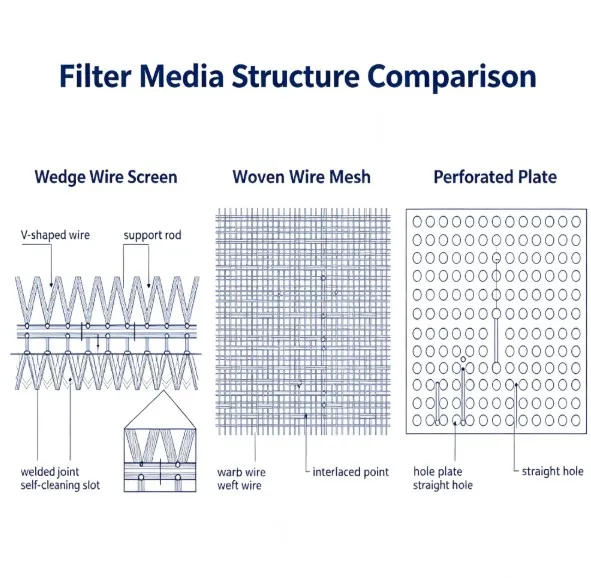
The wedge wire screen is manufactured through a continuous resistance welding process. Profile wires (V-shaped or wedge-shaped in cross-section) are wrapped around a series of longitudinal support rods and welded at every intersection. The V-shaped wires form precisely controlled slots between them, with the narrowest opening at the top surface and a progressively wider gap toward the bottom.
Key structural features:
-
The slot opening is permanently locked by the welding process
-
The V-shaped cross-section creates a self-cleaning profile that prevents particle wedging
-
The support rods provide exceptional mechanical strength under high differential pressure
-
Material options: stainless steel 304, 304L, 316, 316L, duplex steel, and other corrosion-resistant alloys
Slot opening range: 20 µm to over 10 mm
2.2 Woven Wire Mesh
Woven wire mesh is produced by interlacing warp and weft wires in a loom, similar to textile weaving. The wires are mechanically crimped or pressed together at their intersections, without any bonding or welding.
Key structural features:
-
Openings are formed by the spaces between interlaced wires
-
The mesh is flexible and can conform to curved surfaces
-
The intersections are not bonded — wires can shift under vibration
-
Finer filtration is achievable due to thinner wire diameters
Mesh range: As fine as 2,000 mesh (approximately 5 µm) for ultra-fine filtration
2.3 Perforated Plate
Perforated plate is manufactured by mechanically punching or stamping holes into a solid sheet of metal. The holes can be round, square, slotted, or custom-shaped, arranged in straight or staggered patterns.
Key structural features:
-
Simplest manufacturing process among the three
-
Highest structural strength per unit thickness
-
No “wire” structure — holes are cut directly into the sheet
-
Hole edges are typically sharp or slightly deformed from punching
Hole size range: Typically > 5 mm for industrial screening applications
3. Quantitative Performance Comparison
The following table summarizes the key performance differences based on engineering data:
| Parameter | Wedge Wire Screen | Woven Wire Mesh | Perforated Plate |
|---|---|---|---|
| Slot/Opening Accuracy | Permanently fixed by welding; no drift over time | Drifts/stretches under vibration and pressure | Enlarges progressively as wear occurs |
| Open Area Ratio (1 mm opening) | 35% – 45% | Lower due to wire intersections | 23% – 30% |
| Open Area Ratio (typical range) | 8% – 18% (fine, 0.1–0.25 mm slot) 30% – 65% (coarse, 1–3 mm slot) |
30% – 60% (adjustable) | 30% – 60% (adjustable) |
| Self-Cleaning Ability | High (V-shaped slot prevents wedging) | Medium | Low (particles become trapped in blind holes) |
| Typical Service Life | 5 – 15 years | Weeks to months (subject to metal fatigue) | Limited by wear and impact deformation |
| Filtration Limit | ≥ 20 µm (practical ≥ 25 µm) | ≥ 5 µm (ultra-fine capability) | > 5 mm (coarse screening) |
| Structural Integrity | Very high — welded construction | Limited — wire intersections can shift | High — rigid plate |
Open area calculation formula for wedge wire screens:
Open Area (%) = Slot Width ÷ (Slot Width + Wire Width) × 100%
For example, with a 0.5 mm slot and 1.5 mm wire width, the open area is approximately 25%.
4. The Wedge Wire Advantage: Engineering Rationale
4.1 Slot Stability
The resistance welding process permanently locks the slot opening. Unlike woven mesh, where mechanical vibration and hydraulic pulsation gradually stretch the wire intersections — altering the mesh opening — the wedge wire screen maintains its original filtration accuracy throughout its service life. Similarly, perforated plate holes progressively enlarge as abrasive particles erode the hole edges.
4.2 Anti-Clogging Performance
The V-shaped profile wire creates a divergent slot: the opening at the top surface is narrow (the filtration gap), while the gap widens inwardly. When a particle enters the slot, it does not encounter parallel walls that would wedge it in place. Instead, the widening gap allows the particle to pass through or be easily dislodged during backwashing.
By contrast:
-
Woven mesh has square or rectangular openings with parallel wire surfaces — particles of near-opening size tend to wedge permanently
-
Perforated plates have straight-wall holes that trap particles irreversibly
4.3 Higher Open Area, Higher Throughput
At the same filtration accuracy, a wedge wire screen offers substantially higher open area than a perforated plate. For example, at 1 mm slot width, the wedge wire screen achieves 35–45% open area, while a perforated plate achieves only 23–30% at the same hole size.
This translates directly to:
-
Higher flow capacity for the same footprint
-
Lower pressure drop across the screen
-
Reduced pumping energy consumption
4.4 Structural Durability
The welded support rod construction enables wedge wire screens to withstand high differential pressure, mechanical vibration, and abrasive wear far better than woven mesh. This is why wedge wire screens are the preferred choice for high-solids, high-wear applications such as mining, coal preparation, and food processing.
5. Engineering Case Studies
5.1 Case Study 1: Coal Preparation Plant — Woven Mesh to Wedge Wire Conversion
A coal preparation plant in Australia had been using conventional woven wire screens for classification and dewatering. The plant experienced the following challenges:
-
Frequent screen failures every 3–4 weeks
-
Declining screening efficiency as the mesh stretched
-
High maintenance labor and production downtime
After switching to wedge wire screens with identical slot openings, the plant documented:
| Metric | Woven Mesh (Before) | Wedge Wire (After) | Improvement |
|---|---|---|---|
| Screening efficiency | 75% | 90% | +20% |
| Screen service life | 1 month | 3 months | +200% |
| Maintenance costs | Baseline | Reduced 35% | -35% |
| Plant availability | 88% | 97% | +9% |
| ROI payback period | — | 9 months | — |
5.2 Case Study 2: Indonesian Coal Mine — The Cost of Mis-Selection
PT Trubaindo Coal Mine in Indonesia originally used wedge wire screens but experienced a short service life of only 1–2 months, leading them to switch to perforated plates with 3 mm openings in an effort to reduce equipment load and costs.
However, the larger openings of the perforated plates resulted in excessive loss of fine coal:
-
Lost product: Approximately 2,000 tonnes per month of clean coal passing through the screen
-
Annual revenue loss: Approximately US$1.2 million
After this costly lesson, the plant returned to wedge wire screens — but with an optimized design (0.5 mm slot, increased wire profile height). The result:
| Metric | Perforated Plate | Wedge Wire (Optimized) |
|---|---|---|
| Product recovery | Poor (2,000 t/month lost) | Excellent (loss eliminated) |
| Screen life | Moderate | 12 months |
| Annual maintenance cost | Baseline | $18,800 reduction |
This case demonstrates a critical engineering principle: initial cost savings from selecting a cheaper screen can be vastly outweighed by product loss, reduced recovery, and operational inefficiencies.
6. Practical Selection Guidelines
Based on the performance data and case study evidence, the following selection matrix is recommended:
Select Wedge Wire Screen when:
| Requirement | Rationale |
|---|---|
| High precision and high throughput are simultaneously required | Highest open area per slot size |
| Process involves high solids concentration | V-shaped profile resists blinding |
| Continuous or long-run operation | Extended service life (5–15 years) |
| Abrasive or corrosive media | Durable alloys + welded construction |
| Product recovery value is high | Precision slot ensures maximum recovery |
| Downtime is costly | Reduced maintenance frequency |
Select Woven Wire Mesh when:
| Requirement | Rationale |
|---|---|
| Ultra-fine filtration below 25 µm | Wedge wire cannot achieve this precision |
| Initial capital cost is the primary constraint | Lower upfront cost |
| Flexible or curved screening surface needed | Mesh conforms more easily than rigid screens |
| Short-term or pilot-scale operation | Quick installation, lower commitment |
Select Perforated Plate when:
| Requirement | Rationale |
|---|---|
| Coarse screening above 5 mm | Hole size is inherently large |
| High mechanical impact loading | Rigid plate absorbs impact better |
| Structural support application | High strength per thickness |
| Non-critical separation | Precision and recovery are not primary concerns |
7. Cost-Benefit Analysis: Initial Investment vs. Total Cost of Ownership
While wedge wire screens generally command a higher initial purchase price than woven mesh or perforated plates, the total cost of ownership (TCO) analysis tells a different story:
| Cost Component | Wedge Wire Screen | Woven Mesh / Perforated Plate |
|---|---|---|
| Initial cost | Higher | Lower |
| Replacement frequency | Once every 5–15 years | Multiple times per year |
| Labor cost for replacements | One-time | Recurring |
| Production loss during downtime | Minimal (rare) | Significant (frequent) |
| Product loss from oversize openings | Negligible | Can be substantial |
| Energy cost (pumping) | Lower (higher open area) | Higher (lower open area) |
| Total Cost Over 5 Years | Substantially Lower | Higher |
As the Indonesian coal mine case illustrates, a “cheaper” screen can cost millions in lost product revenue. The Australian coal preparation plant achieved full ROI in nine months solely through efficiency and lifespan improvements.
8. Conclusion
The selection of screening media should never be based on initial price alone. Wedge wire screens, Woven Wire Mesh, and perforated plates each have distinct engineering characteristics rooted in their fundamentally different manufacturing processes:
-
Wedge wire screens offer permanently accurate slots, the highest open area per filtration precision, excellent self-cleaning properties, and exceptional longevity (5–15 years). They are the optimal choice for high-value, continuous, and demanding industrial applications.
-
Woven wire mesh provides the ultimate fine filtration capability (<25 µm) at a lower initial cost but suffers from rapid performance degradation due to metal fatigue, wire shifting, and frequent replacement.
-
Perforated plates deliver maximum mechanical strength and coarse screening (>5 mm) but lack the precision, throughput, and anti-blinding characteristics of wedge wire screens.
The engineering data and case studies presented in this paper demonstrate that while wedge wire screens require a higher upfront investment, they consistently deliver superior total value across service life, operational reliability, maintenance cost, and product recovery. For any process where screen performance directly affects product quality or plant throughput, the wedge wire screen is the proven long-term solution.
Please login to write a comment after