 English
 Español
 Français
 日本語
 한국어
 Deutsch
 Português
 Русский
 中文 (中国)

Introduction
In the petrochemical industry, filtration is not merely an auxiliary process — it is a critical factor that directly impacts product quality, production efficiency, and the safety of entire production units. As refineries and chemical plants face increasingly stringent requirements for product purity and environmental compliance, the demand for high-performance filtration solutions has never been greater. Among the emerging technologies, high‑precision sintered metal filter elements have proven themselves as a reliable new option for fine filtration in petrochemical applications.
The Challenge of Petrochemical Filtration
Petrochemical processes present some of the most demanding filtration challenges in any industry. Media can be corrosive, operate at extreme temperatures, and contain fine particulate matter that must be removed with high efficiency. In petroleum refining, sintered metal powder filters are widely used to remove catalyst particles from oil slurry — a critical step that affects downstream processing and product quality.
The S‑Zorb gasoline and diesel hydrodesulfurization process, another common refining application, relies on sintered metal powder filters to separate adsorbent particles from the product stream. In both cases, the catalyst and adsorbent particles are extremely fine, demanding very high filtration precision. Traditional homogeneous sintered metal powder filters, while effective, face certain limitations: high filtration resistance, relatively low flow rates, and reduced plant capacity.
From Homogeneous to Gradient: The Technology Evolution
Early homogeneous sintered metal powder filters typically featured wall thicknesses of 1 to 5mm. While they provided adequate filtration, their uniform pore structure across the entire wall thickness created inherent trade-offs: finer pores meant higher filtration resistance and lower throughput, while coarser pores compromised filtration accuracy. This limitation became increasingly problematic as petrochemical processes demanded ever-higher precision and productivity.
The breakthrough came with the development of composite and gradient sintered filter technologies. Instead of a single uniform pore structure, these advanced filters incorporate multiple layers with progressively finer pore sizes — from a coarse, high-permeability support layer to a thin, precise filtration control layer. The result is a filter element that achieves high filtration precision without sacrificing flow rate.
For example, the gradient composite filter designed specifically for S‑Zorb adsorption desulfurization units features a base powder sintered body with an average pore size of 5‑35μm, overlaid with a filtration membrane coating just 0.1‑0.5mm thick that reduces the average pore size to 3‑7μm. This structure provides the fine filtration needed to capture adsorbent particles while maintaining the flow characteristics required for continuous refinery operations.
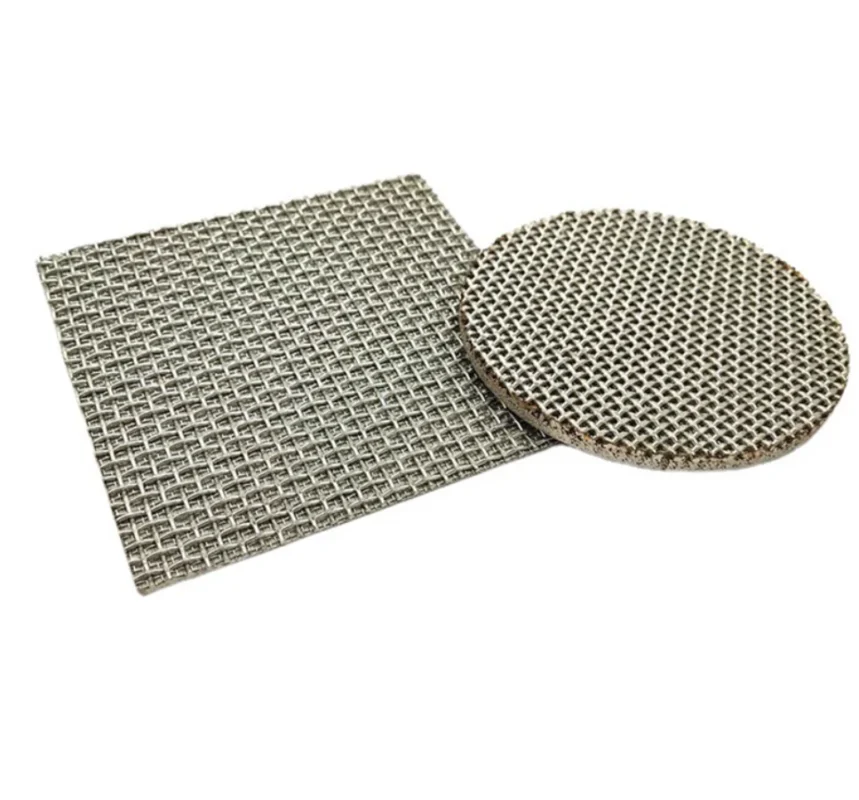
Similarly, composite filters combining metal powder with sintered metal mesh offer a thin filtration control layer supported by a low‑resistance structural layer. Compared to homogeneous powder filters, this design delivers lower filtration resistance, higher fluid flux, superior regeneration capability, and extended service life — all critical attributes for continuous petrochemical production.
Technical Specifications and Performance Data
Sintered metal filter elements are available in a range of configurations to match specific application requirements. The following table summarizes key specifications for typical 316L stainless steel powder‑sintered filters:
| Parameter | Specification |
|---|---|
| Filtration precision | 0.2μm to 100μm (customizable) |
| Porosity | 30%‑50% (adjustable, typically 40%±5%) |
| Operating temperature | Up to 600℃ (non‑oxidizing), 400℃ (oxidizing) |
| Forward pressure resistance | ≥3.0MPa |
| Reverse pressure resistance | ≥1.5MPa |
| Recommended differential pressure | 0.1‑0.3MPa |
For applications requiring even higher performance, sintered metal fiber felt offers a 70‑85% void ratio, which provides exceptionally low filtration resistance and high contaminant retention. This makes it particularly valuable for removing gel contaminants in high‑molecular‑weight polymers — a common requirement in petrochemical manufacturing. GKN Sinter Metals reports that its advanced metal membrane filter technology can achieve up to four times the flow rate of traditional sintered metal filters while maintaining absolute filtration ratings as fine as 0.1μm, with a membrane layer thickness of just 200μm.
The porous structure formed by cold isostatic pressing and high‑temperature vacuum sintering creates a three‑dimensional, interconnected pore network that provides uniform pore distribution and excellent mechanical strength. The absence of binders prevents media shedding and eliminates the risk of secondary contamination.
Field‑Proven Performance
Real‑world validation demonstrates the effectiveness of sintered metal filters in petrochemical environments. In a commercial refinery pilot study using an automated 10 GPM filter system, sintered metal media achieved filtrate quality of less than 25 ppm total suspended solids, with most cycles producing less than 10 ppm. The test, which ran continuously through more than 2,500 filtration and backwash cycles, used sintered metal media grades 0.5, 2, and 5. With feed concentrations ranging from 500‑1000 ppm and an average particle size of about 20μm, the filters operated effectively. Filtration cycles of approximately 40 minutes were achieved with terminal pressures of 37‑40 PSI, and recovery pressures after backwash ranged from 2‑5 PSI.
For high‑temperature gas cleaning applications, sintered metal fiber filters have demonstrated exceptional performance in FCC (Fluid Catalytic Cracking) units. Operating at temperatures up to 550℃ and pressures of 0.28 MPa, these filters achieved:
-
Inlet particulate concentration: 150‑165 mg/Nm³
-
Outlet particulate concentration (steady operation): 0.71‑2.77 mg/Nm³
-
Filtration efficiency: 98.23%‑99.55%
-
Inlet particulate median particle size (volume): approximately 1 μm
-
Outlet particulate median particle size (volume): approximately 2.2 μm
China University of Petroleum research has also validated sintered metal fiber filters in high‑pressure natural gas pipeline compressor stations. Field testing revealed that while steady‑state pressure drop increases by 10‑13 kPa compared to laboratory conditions (and cumulative filtration efficiency decreases by about 5 percentage points), the tested filters achieved a quality factor 0.018 kPa⁻¹ higher than imported alternatives — demonstrating superior overall filtration performance.
Custom Solutions for Key Petrochemical Processes
The diversity of petrochemical applications demands tailored filtration solutions:
S‑Zorb Adsorption Desulfurization
This process requires high‑precision filters with pore sizes of 3‑7μm to effectively separate adsorbent particles from gasoline and diesel streams. Gradient composite sintered filters are specifically engineered to address the challenges of long‑term stable operation that traditional filters could not achieve.
Fischer‑Tropsch Synthesis
In slurry‑bed reactors, sintered metal filters with pore sizes below 1μm ensure that catalyst particles are not carried out with liquid products — a critical requirement for maintaining reactor performance and product quality.
FCC Unit High‑Temperature Flue Gas Treatment
Sintered metal fiber filters operating at 550℃ and 0.28 MPa achieve over 99% filtration efficiency, enabling refineries to meet stringent emission standards while recovering valuable catalyst fines.
Polymer Filtration
High‑porosity (70‑85%) sintered metal fiber felt effectively removes gel contaminants from high‑molecular‑weight polymers — an essential step in producing polyester, plastics, and fibers with consistent quality.
Durability and Life‑Cycle Economics
A key advantage of sintered metal filters is their reusability. Through online or offline backwashing — using compressed air, nitrogen, or clean liquids — filters can be regenerated and returned to service. For more stubborn fouling, ultrasonic cleaning, acid pickling, or high‑temperature combustion at up to 600℃ can restore performance without damaging the media.
This combination of high precision, chemical resistance, thermal stability, mechanical strength, and cleanability makes sintered filters a cost‑effective solution over the long term — outperforming disposable filter cartridges that generate waste and increase operating costs. When evaluated on a total cost of ownership basis, the extended service life and regeneration capability of sintered metal filters deliver compelling economic advantages, particularly in large‑scale continuous petrochemical operations.
Conclusion
As the petrochemical industry continues to push for higher product purity, greater operational efficiency, and reduced environmental impact, high‑precision sintered metal filter elements offer a proven, cost‑effective solution. The evolution from homogeneous powder filters to advanced gradient composite designs — incorporating metal powder, sintered mesh, and metal fiber felt in tailored configurations — has overcome the traditional limitations of filtration resistance and flow capacity.
Today, sintered metal filters are validated by extensive field data: 99.55% filtration efficiency in FCC flue gas, less than 10 ppm suspended solids in refinery slurry filtration, and quality factors surpassing imported alternatives in natural gas pipeline applications. Their ability to operate in high‑temperature, high‑pressure, and corrosive environments — while maintaining micron‑level filtration precision and enabling clean‑in‑place regeneration — positions them as a new standard for fine filtration.
For refineries, chemical plants, and other petrochemical facilities seeking to upgrade their filtration systems, sintered metal elements represent not merely an alternative to conventional filters, but a technologically superior option that delivers measurable improvements in performance and total cost of ownership.
Please login to write a comment after