 English
 Español
 Français
 日本語
 한국어
 Deutsch
 Português
 Русский
 中文 (中国)

- 1. Introduction
- 2. Vale‘s Tailings Strategy: The Context for Dewatering Technology
- 2.1 From Wet to Dry: A Strategic Inflection
- 2.2 Natural Moisture Processing: Eliminating Tailings at Source
- 2.3 The Remaining Dewatering Challenge: Fine and Ultrafine Tailings
- 3. Wedge Wire Screen Technology: Characteristics and Mineral Processing Applications
- 3.1 Technical Principles
- 3.2 Established Applications in Mineral Processing
- 3.3 Performance Data from Brazilian Iron Ore Contexts
- 4. Positioning Wedge Wire Screens within Vale’s Dewatering Chain
1. Introduction
The Brazilian iron ore industry occupies a paradoxical position. It is among the world‘s largest and highest-grade iron ore producers, yet its recent history has been defined by two catastrophic tailings dam failures: the 2015 Fundão disaster (Samarco joint venture) and the 2019 Brumadinho collapse (Vale S.A.), which together claimed over 280 lives and caused immeasurable environmental damage. These events triggered a regulatory and operational reckoning that has fundamentally reshaped how Brazilian miners manage mineral waste.
Vale‘s response has been multifaceted: accelerating the decommissioning of upstream dams, investing in filtration infrastructure, and pioneering dry processing technologies that eliminate water from ore beneficiation altogether. By 2023, 69% of Vale‘s ore production utilized natural moisture processing, and of the remaining 31% that generated tailings, approximately half (15.5%) were filtered and dry-stacked. In effect, 84.5% of Vale‘s iron ore production no longer depends on tailings dams for disposal.
This transition creates both demand and opportunity for Dewatering equipment. Wedge wire screens—also known as profile wire screens or v-wire screens—represent one category of equipment whose technical characteristics align well with the requirements of iron ore tailings Dewatering. This article examines the plausible applications of Wedge wire screens within Vale‘s tailings management operations, drawing on published data about Vale’s strategy, technical literature on wedge wire screen performance, and analogous applications in Brazilian and international iron ore contexts.
2. Vale‘s Tailings Strategy: The Context for Dewatering Technology
2.1 From Wet to Dry: A Strategic Inflection
Vale’s 2024 sustainability reporting provides the clearest quantitative picture of its tailings transition. The company reported that of the 31% of iron ore production that still generates tailings from wet processing, approximately 15.5% undergoes filtration and dry stacking, leaving only 15.5% of total production dependent on tailings dams. This represents a dramatic reduction from the pre-Brumadinho era, when wet disposal was the default for most operations.
The company has also invested directly in filtration capacity. Vale announced an investment plan of US$2.3 billion between 2020 and 2025 to increase filtration and dry stacking, targeting 16% of total production by 2025. At the Vargem Grande complex in Minas Gerais, tailings filtration has been operational since March 2023, enabling dry stacking of the majority of material.
2.2 Natural Moisture Processing: Eliminating Tailings at Source
Perhaps more significant than filtration investments is Vale‘s development of natural moisture processing, a technology that eliminates water from the beneficiation process entirely. At the Carajás complex in Pará state, which accounts for 36% of Vale’s annual iron ore production, screening using the ore‘s natural moisture has been implemented across multiple production lines. Of 17 operational production lines, eight no longer use water, eliminating pumps, cyclones, screens, pipes, tanks, and classifiers.
This innovation carries substantial operational implications. Vale reports annual water savings equivalent to the consumption of a city of 430,000 inhabitants (19.7 million m³), power savings exceeding 18,000 MWh per year, and elimination of tailings dam construction for new projects adopting the technology. The S11D project in Canaã dos Carajás was planned around this system and will operate without a tailings dam.
For Dewatering equipment suppliers, the natural moisture strategy presents a paradox: it reduces the volume of tailings requiring Dewatering, but for the remaining wet-process tailings—particularly fine and ultrafine fractions—the Dewatering challenge intensifies. As Vale‘s process engineers noted, implementing natural moisture screening required designing new equipment and accessories because “the market did not offer components that meet the invention’s requirements”.
2.3 The Remaining Dewatering Challenge: Fine and Ultrafine Tailings
The tailings that remain after natural moisture processing and coarse tailings dry stacking are predominantly fine-grained. At the Pau Branco mine in Minas Gerais, operated by Vallourec (not Vale, but representative of Brazilian iron ore tailings characteristics), researchers characterized the material requiring Dewatering as ultrafine slimes (<45 μm) and magnetic concentration rejects (45–150 μm).
This particle size distribution has direct implications for equipment selection. Coarse Dewatering screens—including those using wedge wire surfaces—operate effectively on particles above approximately 150 μm. Below this threshold, screening efficiency declines rapidly, and alternative technologies (thickeners, filter presses, vacuum filtration) become necessary. The Pau Branco study proposed a hybrid flowsheet: cyclone classification at 45 μm, with coarse tailings treated by Dewatering screening (100 tph) and fine tailings processed through a thickener feeding a horizontal filter press (200 tph), both achieving approximately 15% final moisture.
3. Wedge Wire Screen Technology: Characteristics and Mineral Processing Applications
3.1 Technical Principles
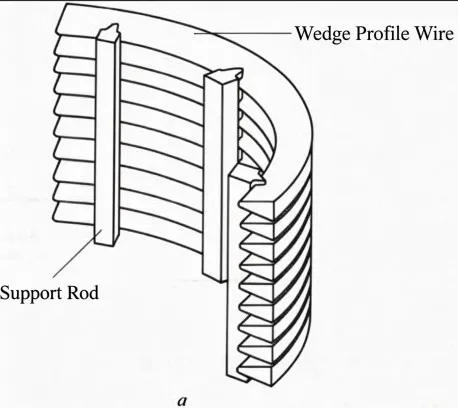
Wedge wire screens consist of a series of parallel profile wires—typically V-shaped or triangular in cross-section—welded to perpendicular support rods. The profile wire geometry creates a slot opening that is narrower at the surface than at the base, a configuration that resists plugging (pegging) and promotes efficient drainage. The wedge shape also produces a sharp cutting edge that enhances Dewatering performance under gravity-fed conditions.
Key technical parameters include:
-
Slot sizes: ranging from 0.05 mm for fine filtration to 5 mm for coarse sizing
-
Materials: grade 430 stainless steel for abrasive applications (no nickel, high wear resistance); grades 304 and 316 for corrosive environments
-
Open area: significantly higher than woven mesh or perforated plate, maximizing drainage throughput
-
Configuration: flat panels, sieve bends (static curved screens), cylindrical baskets, and trommel screens
3.2 Established Applications in Mineral Processing
Wedge wire screens are widely used in mining and mineral processing for Dewatering, desliming, sizing, and media recovery. Specific applications include:
Static sieve bends for gravity-fed Dewatering and desliming in coal, iron ore, and industrial minerals processing. ANDRITZ manufactures wedge wire sieve bends with profile wire as narrow as 0.35 mm and slot openings from 0.05 mm, capable of 150 μm filtration under gravity. These are positioned as “simple, cost-effective” solutions for solid-liquid separation.
Vibrating screen panels for Dewatering, sizing, and rinsing. Multotec produces custom wedge wire panels for vibrating screens, designed to reduce pegging in difficult applications. International mining companies use these panels for high wear resistance and drainage throughput in “some of the world‘s harshest operating conditions”.
Centrifuge baskets and screen scroll centrifuges for fine coal and potash Dewatering, where wedge wire or milled plate screens provide the filtration medium.
CIP/CIL interstage screens in gold processing, where wedge wire cylinders with slot sizes matched to carbon particle size prevent carbon migration while maintaining high flow rates.
3.3 Performance Data from Brazilian Iron Ore Contexts
While no published study documents Wedge wire screens specifically at Vale‘s operations, data from analogous Brazilian iron ore tailings projects provide relevant performance benchmarks.
At the Pau Branco mine, Dewatering screening tests on magnetic concentration rejects (45–150 μm) used a high-frequency screen with 0.15 mm aperture and 3 m² useful area, processing 25 tph of pulp at 30% solids. The final moisture obtained was 15%, appropriate for dry stacking (maximum recommended moisture 20–25%). This establishes that high-frequency screening can achieve dry-stackable moisture for iron ore tailings in the 45–150 μm range—though the screen surface material (wedge wire vs. polyurethane vs. woven mesh) was not specified in the available literature.
In a pilot-scale study in Hebei Province, China, a high-efficiency cyclone combined with a variable-frequency Dewatering screen achieved 14–18% moisture in the screen overflow from iron ore tailings, enabling dry discharge via belt conveyor. This confirms the cyclone-plus-Dewatering-screen flowsheet as an industrially proven approach for coarse iron ore tailings.
More broadly, Dewatering screens are recognized in the industry as capable of achieving surface moisture as low as 7% for coarse materials, though final moisture depends strongly on surface area, morphology, and hydrophobicity. For fine materials (100% passing 150 μm), moisture content may exceed 20% even with drip-free consistency.
4. Positioning Wedge Wire Screens within Vale’s Dewatering Chain
4.1 A Plausible but Undocumented Application
The central finding of this review is that no published literature directly documents wedge wire screen applications at Vale‘s Brazilian iron ore operations. This absence is notable given the technology’s widespread use in mineral processing globally, and it suggests either that Wedge wire screens are employed in ancillary roles not highlighted in public reporting, or that Vale‘s Dewatering chain relies primarily on other equipment categories (filter presses, thickeners, polyurethane-screen Dewatering screens).
This evidentiary gap should not be interpreted as evidence of absence. Vale‘s natural moisture screening technology—which required designing new equipment because the market lacked suitable components—may well incorporate wedge wire elements in its proprietary configurations, but such details are not disclosed in public documentation. Similarly, the company‘s filtration circuits at Vargem Grande and other sites likely include pre-Dewatering or classification stages where Wedge wire screens could plausibly be deployed, but specific equipment inventories are not published.
4.2 The Rational Application Space
Based on technical logic and analogous applications, Wedge wire screens plausibly fit into Vale‘s tailings Dewatering chain in three roles:
Cyclone underflow Dewatering (coarse fraction). In a flowsheet analogous to the Pau Branco design, cyclone classification at 45–150 μm would produce a coarse underflow amenable to Dewatering screening. A wedge wire screen—either static sieve bend or vibrating panel—could serve as the Dewatering element, achieving the 14–18% moisture range demonstrated in Brazilian and Chinese iron ore applications. The wedge wire profile’s anti-pegging geometry would be advantageous for the angular, abrasive iron ore particles.
Pre-filtration thickening (intermediate fraction). Before filter press feed, a Dewatering screen could reduce slurry volume and increase solids concentration, improving filter press cycle times. The wedge wire screen‘s high open area and abrasion resistance (grade 430 stainless) suit this duty, though the fine particle sizes (if <45 μm) would likely be too small for effective screening.
Tailings recovery and water reclamation. Wedge wire screens in trommel or static configurations are used in tailings recovery to capture coarse particles while recovering process water for reuse. While Vale’s reported water recovery figures (e.g., 9,700 m³/day at Mineração Morro do Ipê with filter presses) are attributed
Please login to write a comment after