 English
 Español
 Français
 日本語
 한국어
 Deutsch
 Português
 Русский
 中文 (中国)

- Introduction
- I. Vale’s Iron Ore Business and Strategic Transformation
- II. Technical Characteristics and Mining Applications of Wedge Wire Screens
- III. Specific Application Analysis of Wedge Wire Screens at Vale
- 3.1 Screening Demand of the Capanema Project
- 3.2 Demand Estimation for Wedge Wire Screens in Dry Stacking
- 3.3 Competitive Advantages of Wedge Wire Screens
- IV. Market Opportunities and Challenges
- V. Conclusion and Outlook
Introduction
Brazil is the world’s second-largest Iron ore producer, and Vale, as the country’s largest mining company, reached an Iron ore production of 336 million tonnes in 2025, regaining its position as the world’s largest Iron ore producer. After the Brumadinho tailings dam disaster, Vale is actively promoting dry stacking technology, with a planned investment of 67 billion reais (approximately US$12.2 billion) in tailings filtration and dry stacking solutions, aiming to reduce the tailings dam utilization rate in Minas Gerais from 30% to 20%.
This strategic transformation has created clear market opportunities for Wedge wire screens in Brazilian mining. This article will analyze in depth the specific application scenarios, demand estimation, and competitive advantages of Wedge wire screens in Vale’s Iron ore processing.
I. Vale’s Iron Ore Business and Strategic Transformation
1.1 Production Scale and Growth Trend
Vale’s Iron ore production reached 336 million tonnes in 2025, a year-on-year increase of 2.6%, surpassing Rio Tinto’s 327.3 million tonnes, regaining the top global position since 2018. This growth is mainly attributed to the ramp-up of the Capanema project and the VGR1 project. The company’s 2026 production guidance is 335-345 million tonnes.
The Capanema mine is Vale’s latest key project, officially inaugurated in September 2025, contributing approximately 15 million tonnes of annual Iron ore capacity. The project is located in the Ouro Preto region of Minas Gerais and adopts natural moisture beneficiation, producing no tailings and requiring no tailings dam.
1.2 Advancement of Dry Stacking Strategy
A considerable proportion of Vale’s 67 billion reais investment plan will be allocated to tailings filtration and dry stacking solutions. The core objectives of this strategy are:
-
Reduce the tailings dam utilization rate in Minas Gerais from 30% to 20%
-
Advance the upstream structure decharacterization plan, with approximately 60% completed
-
Of the remaining 13 structures, 8 are undergoing decharacterization
The core of dry stacking technology lies in efficient dewatering. According to industry practice, a typical dry stacking process includes: tailings slurry first enters high-efficiency hydrocyclones for concentration, with underflow density reaching 65%-70%, then is sent to high-frequency dewatering screens for dewatering, with the final material moisture content reduced to below 16%, meeting dry stacking and transportation requirements.
II. Technical Characteristics and Mining Applications of Wedge Wire Screens
2.1 Working Principle of Wedge Wire Screens
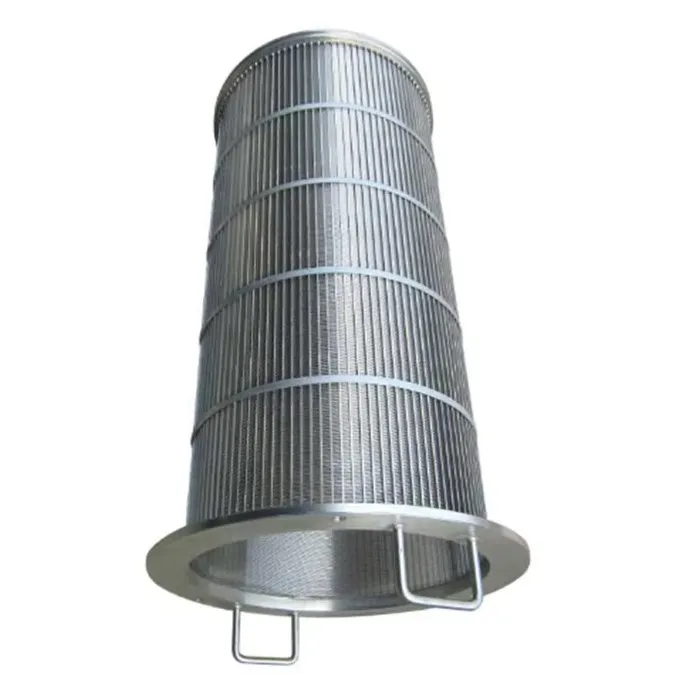
Wedge wire screens are made of a series of parallel support rods and wedge-shaped cross-section wires welded together, forming long and narrow slot openings. Unlike traditional woven mesh screens, the openings of Wedge wire screens are wedge-shaped — narrow at the top and wide at the bottom. This design prevents particles passing through the upper narrow slot from getting stuck in the middle, either falling through directly or remaining on the screen surface, providing excellent anti-clogging capability.
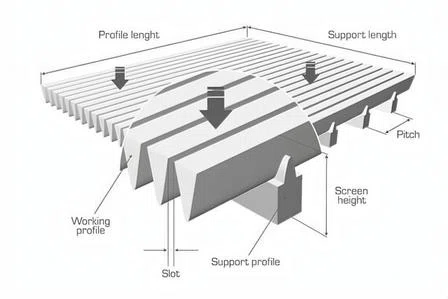
The main technical advantages of Wedge wire screens include:
-
No woven intersections: Smooth surface without edges, hydraulically advantageous flow profile, almost no turbulence
-
Wedge slot design: Excellent anti-clogging performance
-
High strength: Welded structure capable of withstanding high pressure and heavy loads
2.2 Application Scenarios in Iron Ore Processing
Wedge wire screens are mainly applied in the following stages of Iron ore processing:
(1)Fine Dewatering and Dry Stacking
In the dry stacking process, the high-frequency dewatering screen is critical equipment. As the core component of the dewatering screen, the wedge wire screen’s slot width can be precisely controlled according to process requirements, ranging from approximately 0.05 mm to several millimeters. For Iron ore tailings dewatering, finer slot widths are generally required to ensure dewatering effectiveness.
(2)Ore Screening and Classification
In the Iron ore crushing and screening process, Wedge wire screens are used for material classification and screening. Their anti-clogging characteristics make them particularly suitable for processing wet and sticky materials, which is especially important in Brazil’s rainy tropical climate conditions.
(3)Tailings Filtration
In the tailings filtration stage, Wedge wire screens are used for solid-liquid separation, ensuring stable filtration precision. Their wear life is several times longer than standard woven mesh screens, reducing replacement frequency and downtime.
III. Specific Application Analysis of Wedge Wire Screens at Vale
3.1 Screening Demand of the Capanema Project
The Capanema mine adopts natural moisture beneficiation, producing no tailings and requiring no tailings dam. This process characteristic determines that its screening equipment demand differs from traditional wet beneficiation.
According to Wood Mackenzie data, the Capanema project adds approximately 14 million tonnes/year of capacity, with ore transported via an 11 km conveyor to the Timbopeba plant for processing. This means screening equipment needs to adapt to conveyor transfer and subsequent processing requirements.
3.2 Demand Estimation for Wedge Wire Screens in Dry Stacking
According to industry data, in the dry stacking process, underflow treatment of high-frequency dewatering screens is a critical stage. Taking the practice of the Pau Branco mine as an example, magnetic separation tailings (>45μm) of Iron ore can be dewatered by high-frequency screening, while slime (<45μm) requires filtration by horizontal filter presses.
The application of Wedge wire screens in high-frequency dewatering screens needs to meet the following technical parameters:
-
Processing capacity: Determined according to mine production scale
-
Moisture content after dewatering: Generally required below 16%
-
Wear life: Needs to adapt to the high abrasiveness of Iron ore
3.3 Competitive Advantages of Wedge Wire Screens
Compared with traditional screening solutions, Wedge wire screens have obvious advantages in Iron ore processing:
Wear resistance advantage: According to patent data, screen panels with improved wedge wire profiles showed 60% less wear than hard chrome plated panels during a 7-week test period. This improved wedge wire cross-section design (truncated diamond profile) provides a larger wear surface, extending service life.
Anti-clogging advantage: The V-shaped slot design of Wedge wire screens prevents particles from getting stuck in the gaps, ensuring consistent permeability during long-term operation. This is particularly important for processing Brazil’s wet Iron ore.
Comprehensive cost advantage: Although the initial investment of Wedge wire screens may be higher than polyurethane panels, their longer service life and less downtime for replacement make their comprehensive cost of use more competitive.
IV. Market Opportunities and Challenges
4.1 Demand Growth Drivers
Vale’s copper business expansion plan has created clear market space for Wedge wire screens. The company plans to increase annual copper production to approximately 700,000 tonnes by 2035, with planned capital expenditure of US$3.5 billion in copper projects in the Carajás region alone during 2026-2030.
At the same time, continued growth in the Iron ore business also drives demand for screening equipment. The Capanema project is expected to reach full capacity in the second quarter of 2026, and the S11D project achieved a record production of 86 million tonnes in 2025.
4.2 Supplier Qualification Requirements
Entering Vale’s supply chain requires meeting strict qualification requirements:
-
Product quality stability and consistency
-
Customization capability adapted to Brazilian ore characteristics
-
Timely spare parts supply and technical support
-
Compliance with Vale’s ESG standards
4.3 Localization Trend
Brazil already has local wedge wire screen suppliers, such as Bariontec, which focuses on providing customized wedge wire filters for mining. Vale may tend to prefer local suppliers in procurement to reduce costs and shorten delivery times.
V. Conclusion and Outlook
Vale’s dry stacking strategy and Iron ore production growth have created clear market opportunities for Wedge wire screens in Brazilian mining. With their excellent anti-clogging performance, wear resistance, and long service life, Wedge wire screens have significant technical advantages in Iron ore dewatering, screening, and tailings treatment.
As Vale continues to promote tailings filtration and dry stacking solutions, and new projects such as Capanema ramp up production, demand for Wedge wire screens is expected to grow steadily. For screening equipment suppliers, meeting Vale’s technical standards, providing customized products adapted to Brazilian ore characteristics, and establishing localized service capabilities will be key factors for entering this market.
In the future, with the continuous improvement of safety and environmental requirements in Brazilian mining, Wedge wire screens, as an efficient and reliable screening solution, have promising application prospects.
Please login to write a comment after