 English
 Español
 Français
 日本語
 한국어
 Deutsch
 Português
 Русский
 中文 (中国)

📖 Table of Contents
- 2. Five Core Advantages of Wedge Wire Screens
- 1. Self-cleaning & Anti-clogging, High Screening Efficiency
- 2. Fully Welded Structure, High Strength & No Deformation
- 3. Precise Slot Size & Stable Filtration Performance
- 4. High Open Area & Strong Flow Capacity
- 5. Long Service Life & Low Operation and Maintenance Costs
- 3. Common Types and Application Scenarios of Wedge Wire Screens
Wedge wire screen, also widely known as Johnson screen, V-wire screen, or trapezoidal wire slotted screen in the industry, is a high-performance filter material that replaces ordinary woven wire mesh and perforated screen plates in industrial filtration and dewatering applications. Featuring a unique narrow-top and wide-bottom trapezoidal slot, all-welded integrated structure and self-cleaning anti-clogging performance, it is extensively applied in coal washing, sewage treatment, petrochemical, food and pharmaceutical processing, aquaculture and other industries. It serves as the core component for high-precision solid-liquid separation, material classification and sand control filtration in modern industrial systems.
Many enterprises often encounter common problems with traditional screens, including easy clogging, low structural strength, deformation, short service life and unstable filtration accuracy. Wedge wire screens perfectly solve these pain points and have become the preferred screen product for industrial bidding, engineering supporting and equipment renovation projects.
1. Structural Working Principle of Wedge Wire Screens
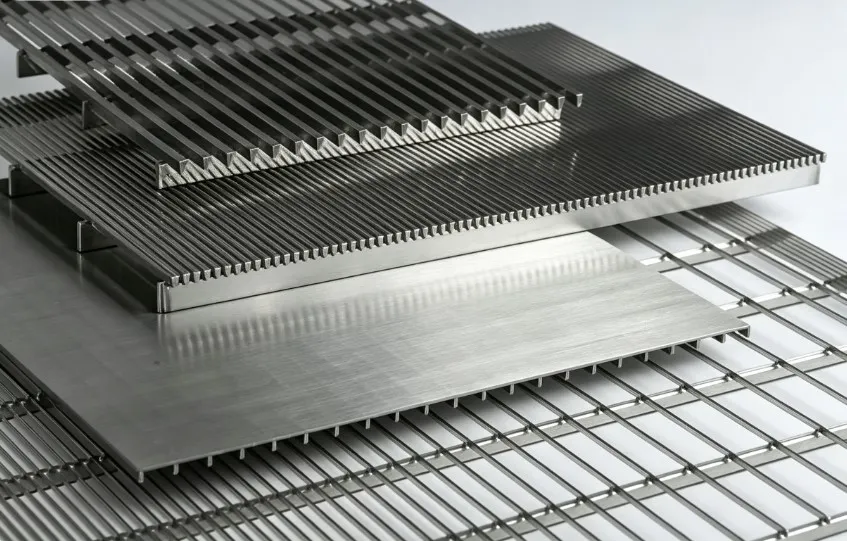
Different from the cross-woven structure of ordinary wire mesh, a wedge wire screen is fully welded by trapezoidal profile surface wires and transverse support rods through automatic resistance welding. The integrated forming process leaves no splicing gaps or loose parts, delivering excellent overall structural rigidity and stability.
Its most competitive advantage lies in the exclusive graduated trapezoidal slot design: the slot opening is narrow on the screen surface and wider at the bottom. This structural feature prevents particles and impurities from being trapped in the gaps, realizing a natural self-cleaning function. It effectively eliminates frequent equipment shutdowns caused by mesh clogging and fouling, a common bottleneck of traditional filter screens.
Common raw materials include 304 stainless steel, 316L stainless steel, carbon steel and galvanized steel. Among them, 316L stainless steel wedge wire screens feature superior resistance to corrosion, acid, alkali and seawater erosion. Ideal for chemical, sewage and marine working conditions, their service life is 3 to 5 times longer than that of ordinary screens.
2. Five Core Advantages of Wedge Wire Screens
Compared with conventional woven wire mesh, perforated plates and plastic screens, wedge wire screens offer lower comprehensive operating costs and more stable performance. Their core strengths are summarized as follows:
1. Self-cleaning & Anti-clogging, High Screening Efficiency
The gradient trapezoidal slot ensures smooth material penetration without particle trapping or scale accumulation. It greatly reduces maintenance downtime caused by clogging and adapts to high-flow filtration and screening scenarios with high impurity concentrations.
2. Fully Welded Structure, High Strength & No Deformation
Each wedge wire is firmly fused with the support rods as a whole. The integrated structure boasts excellent load-bearing capacity, compression resistance and impact resistance. It can withstand high-pressure water flow and heavy material impact, maintaining stable performance without bending, cracking or deformation during long-term operation.
3. Precise Slot Size & Stable Filtration Performance
Slot openings can be precisely customized from 0.02mm to tens of millimeters with uniform and error-free gaps. It guarantees consistent separation accuracy, fully meeting high-standard working requirements for precision filtration, material grading, oil well sand control and fine dewatering.
4. High Open Area & Strong Flow Capacity
The optimized wire layout provides a larger effective permeable area with low fluid resistance. Its filtration, dewatering and drainage efficiency is significantly higher than traditional screens, effectively improving the overall operating efficiency of filtering equipment.
5. Long Service Life & Low Operation and Maintenance Costs
High-quality stainless steel materials feature outstanding wear resistance, corrosion resistance and wide temperature adaptability (-40℃ to 500℃). The screen operates stably with low failure rates and long replacement cycles, reducing comprehensive operation and maintenance costs by more than 30%.
3. Common Types and Application Scenarios of Wedge Wire Screens
Classified by shape and structural design, wedge wire screens are divided into four mainstream types, covering almost all industrial screening and filtration demands:
1. Flat Wedge Wire Screen Panel
Designed with a rectangular flat structure with customizable slot sizes and frame specifications. It is widely used for ore grading, coal dewatering, sewage treatment equipment, vibrating screen surfaces and filter tank bottom plates in mining and industrial fields.
2. Wedge Wire Screen Cylinder (Johnson Filter Tube)
Fabricated by rolling and welding wedge wires into a cylindrical shape, it features good airtightness and uniform filtration. It is the core filter component for water well screen pipes, oil well sand control, pipeline filters and industrial internal filter elements.
Please login to write a comment after