 English
 Español
 Français
 日本語
 한국어
 Deutsch
 Português
 Русский
 中文 (中国)

📖 Table of Contents
- 1. Distinct Manufacturing & Structural Design
- Wedge Wire Screen (Johnson Screen / V-wire Screen)
- Conventional Wire Mesh (Woven Wire Mesh / Welded Mesh)
- 2. Core Performance Gap: Anti-Clogging & Flow Capacity
- 3. Mechanical Strength & Pressure Resistance
- 4. Service Life & Long-Term Operation Cost
- 5. Precision Consistency of Filtering Slot
- 6. Suitable Application Scenarios
- Conclusion
What is the difference between wedge wire and wire mesh
For industrial filtration, dewatering, solid-liquid separation, mineral screening and water treatment projects, wedge wire screens and traditional wire mesh are two mainstream filter media widely adopted globally. Many purchasing engineers and plant managers struggle to tell their core differences and select the right product to cut maintenance cost and boost production efficiency. Today we break down wedge wire vs wire mesh from manufacturing craft, structural performance, anti-clog property, service life, total cost and applicable scenarios.
1. Distinct Manufacturing & Structural Design
Wedge Wire Screen (Johnson Screen / V-wire Screen)
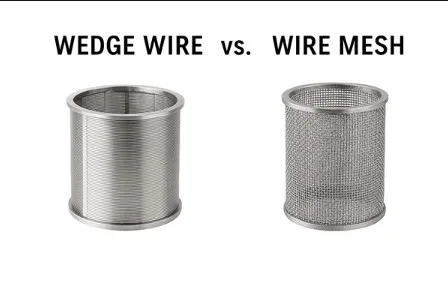
Wedge wire is also called profile wire screen. It is produced by continuously welding V-shaped trapezoidal profile wires onto parallel support rods one by one under precise CNC welding equipment.
- Surface structure: Smooth continuous long slots, no crisscross wire intersections
- Welding feature: Full fusion welding between profile wire and support rod, integral rigid structure
- Customization: Slot gap adjustable from 0.02mm to dozens of millimeters; shapes include flat panel, curved sieve bend, cylindrical filter tube, water cap and cone screen
- Material: SUS304, SUS316L, duplex stainless steel, carbon steel with galvanized treatment
Conventional Wire Mesh (Woven Wire Mesh / Welded Mesh)
Wire mesh is formed by weaving round metal wires in crisscross grids or spot-welding intersecting wires at every crossing point.
- Surface structure: Grid holes formed by overlapping round wires, countless cross contact points
- Woven mesh: Flexible structure, holes easy to deform under extrusion
- Welded wire mesh: Fixed cross spots but thin round wire leads to weak bearing capacity
- Limitation: Minimum mesh aperture limited by wire diameter, hard to achieve ultra-fine uniform filtering gaps
2. Core Performance Gap: Anti-Clogging & Flow Capacity
This is the most obvious advantage of wedge wire over wire mesh.
- Wedge wire: V-shaped cross-section forms outward-widening continuous slots. When liquid and solid pass through, particles slide off the smooth slope instead of being stuck inside slots. The open area reaches 30%–50%, delivering larger flow rate and lower pressure drop during continuous operation. It is recognized as self-cleaning screening media with minimal particle bridging.
- Wire mesh: Grid holes have sharp inner corners and stacked wire crossing points. Solid particles easily lodge at intersections, causing frequent blockage, rising pressure loss and unstable system flow. Fine woven mesh needs daily high-pressure washing to maintain throughput.
3. Mechanical Strength & Pressure Resistance
Industrial working conditions often involve high water pressure, heavy material impact and abrasive media, making structural strength critical.
- Wedge wire: Thick trapezoidal profile wire plus dense support rod welding structure bears 150–400 psi collapse pressure, slight deformation even under long-term high-load operation. It resists abrasion from sand, ore slurry and chemical particles, no rupture risk.
- Wire mesh: Thin round wire leads to poor compression resistance. Once pressure exceeds 70–100 psi, mesh grid stretches, deforms or cracks, directly damaging filtering precision and triggering equipment shutdowns. Woven mesh is flexible and cannot bear heavy stacking load.
4. Service Life & Long-Term Operation Cost
Many buyers only compare initial purchase price while ignoring follow-up replacement and downtime loss.
- Wedge wire screen: Under continuous industrial corrosive/abrasive environments, service life reaches 5–10 years. Stable slot size avoids frequent replacement; less cleaning frequency cuts labor and water cost. Despite higher upfront price, total operation expenditure is much lower within 2–3 years of use.
- Wire mesh: Woven mesh wears fast with abrasive materials, usually replaced every 3–12 months; welded mesh lasts 1–2 years at most. Frequent shutdown for screen replacement causes production loss, and unstable filtering effect may lead to unqualified final products.
5. Precision Consistency of Filtering Slot
- Wedge wire: CNC automatic welding controls slot tolerance within ±0.005mm, uniform gaps across the whole screen surface, stable particle interception effect for precision separation.
- Wire mesh: Weaving tension or spot welding deviation creates uneven hole sizes. After long-time extrusion, grid aperture expands randomly, failing to meet strict precision filtration standards in chemical, pharmaceutical and food industries.
6. Suitable Application Scenarios
Choose Wedge Wire If You Have These Demands
- Water treatment: Well screen, resin trap, wastewater dewatering, sewage filter nozzles
- Mineral & mining: Coal dewatering, ore grading, slurry separation sieve bend
- Chemical & petrochemical: Catalyst recovery, high-pressure reaction kettle filter tubes
- Food & beverage: Juice filtration, grain washing, sugar industry separation
- Environmental protection: Sludge dewatering, solid-liquid separator internals
- Requirements: High flow, anti-clog, long service life, high pressure, precise micron filtering
Choose Wire Mesh Only For Light-Duty Simple Screening
- Low-pressure simple filtration with low solid content
- Temporary low-load separation with frequent screen replacement acceptable
- Low-precision rough screening with no strict demand on flow stability
Conclusion
Wire mesh owns lower one-time purchase cost for light, simple filtering tasks. But for heavy-duty, continuous industrial production requiring stable flow, anti-blocking and long service cycle, wedge wire screen is the cost-effective long-term solution with comprehensive performance edges.
Our factory provides customized wedge wire screens of all shapes, materials and slot sizes for global industrial clients. We support technical drawing optimization, sample production and one-stop filtration solution consultation. Contact our engineering team to get tailored wedge wire specifications and quotation matching your working conditions.
Please login to write a comment after