 English
 Español
 Français
 日本語
 한국어
 Deutsch
 Português
 Русский
 中文 (中国)

- Introduction
- 1. What the Five-Layer Sintered Mesh Is
- 2. Performance Characteristics in Seawater Duty
- 3. The Corrosion Question: What 316L Does Not Guarantee
- 4. System-Level Considerations: The Filter Is Not Just the Media
- 5. Filtration Rating as a System Decision
- 6. Compliance and Certification
- 7. Comparison with Alternative Media
- 8. Conclusions and Recommendations for Specification
Introduction
Seawater filtration is a critical unit operation on board ships, particularly in ballast water management systems (BWMS), seawater cooling circuits, and desalination pre-treatment trains. Among the filter media deployed in these duty conditions, 316L stainless steel five-layer sintered mesh has become one of the most widely specified materials, combining fine absolute filtration with the mechanical robustness and backwashability demanded by marine service. This article reviews the structure, material rationale, performance characteristics, and application constraints of 316L five-layer sintered mesh in shipboard seawater filtration, drawing on manufacturer specifications, independent corrosion research, and reported operational experience. It also identifies the technical questions that remain insufficiently documented and should be addressed when specifying this material for a particular vessel or BWMS design.
1. What the Five-Layer Sintered Mesh Is
1.1 Structure
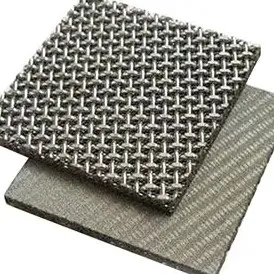
Five-layer sintered mesh is produced by stacking five woven stainless steel wire cloths of different mesh counts, pressing them together, and vacuum-sintering the assembly so that the layers bond at their contact points into a single rigid, porous sheet. The standard layer configuration is:
| Layer | Function | Typical specification |
|---|---|---|
| Protective layer (outer) | Shields the filtration layer from external impact and coarse debris | Coarser mesh |
| Filtration control layer | Defines the absolute filtration rating | Finest mesh, e.g. 316L |
| Dispersion layer | Distributes flow evenly across the filtration layer | Intermediate mesh |
| Support layer | Prevents deformation under differential pressure | Medium-coarse mesh |
| Reinforcement/skeleton layer | Provides overall rigidity and pressure resistance | Coarsest mesh, e.g. 304 or 316L |
Published specifications give a standard five-layer thickness of approximately 1.7 mm, with product ranges from about 1.0 to 2.0 mm; filtration ratings are commonly quoted from 1 μm to 200–300 μm; maximum compressive strength is cited at up to 3000 kPa; and the material is rated for service from −200 °C to 600–650 °C. Porosity is typically in the 28–50 % range, and manufacturers state that filtration performance recovers by more than 90 % after cleaning and regeneration.
The sintering step is what distinguishes this product from a simple stack of woven screens. Bonding at layer contact points produces a monolithic structure with a fixed, stable pore geometry: the mesh cannot delaminate, the pore size does not shift under flow, and the sheet can be cut, pleated, welded, and rolled into cartridges without the layers separating.
1.2 Why 316L
Type 316L is an austenitic stainless steel with 2–3 % molybdenum, which raises its resistance to chloride-induced pitting and crevice corrosion relative to 304/304L. In marine and high-chloride environments this is the minimum grade normally considered, and it is the grade most commonly specified for the filtration control layer of sintered mesh used in seawater duty. Manufacturers also offer 904L, 2205, 2507, and 32750 (super duplex) as alternatives for more aggressive service, noting that highly corrosive seawater sometimes requires super duplex stainless steel for the filtration layer, at higher cost and with greater demands on the sintering process.
2. Performance Characteristics in Seawater Duty
Manufacturer literature consistently identifies the following advantages for shipboard seawater applications:
-
High strength and pressure resistance. The support and reinforcement layers carry the differential pressure, allowing the fine filtration layer to remain thin and therefore to offer low clean pressure drop while withstanding backwash pressure surges.
-
Stable absolute filtration. Because the pore structure is fixed by sintering, the rated removal efficiency does not drift with time or cleaning cycles, unlike single-layer woven mesh, which tends to bulge, collapse, or develop leaks after repeated cleaning.
-
Backwashability and regeneration. The rigid, smooth surface releases captured solids readily; the material supports water/air backwashing, ultrasonic cleaning, and chemical cleaning, with performance recovery cited above 90 %.
-
Formability. The sheet can be cut, pleated, rolled, and welded into cartridges, candles, and disc assemblies, which is essential for packaging into the compact pressure vessels used on ships.
-
Thermal and chemical tolerance. The rating to 600 °C and resistance to acids and alkalis allow steam and chemical cleaning regimes that would damage polymeric media.
In ballast water service, the filtration stage is typically designed to remove organisms and suspended solids larger than roughly 20–50 μm before the disinfection stage (electrolysis, UV, or chemical injection). A 30 μm rating is commonly quoted in Chinese-manufactured ballast water filter cartridges, while other suppliers quote 20–100 μm depending on the configuration; these figures should be treated as nominal and confirmed against the absolute rating required by the specific BWMS type-approval.
3. The Corrosion Question: What 316L Does Not Guarantee
The most important technical caveat concerns corrosion performance, and it is one that manufacturer marketing material tends to omit. Independent research by the 725th Research Institute of China Shipbuilding Industry Corporation, published in Liaoning Chemical Industry, examined the pitting corrosion behaviour of 316L multi-layer mesh, 316L skeleton mesh, and 316L finished components in natural seawater. The study found that pitting resistance ranked 316L skeleton mesh > 316L finished component > 316L multi-layer mesh — that is, the multi-layer mesh was the least resistant of the three. The study further reported that in the finished component, the skeleton mesh acted as the anode and accelerated corrosion, while the multi-layer mesh was protected.
The practical implications for specification and operation are significant:
-
Sintered multi-layer structures can introduce galvanic effects. Layers of different mesh count and, in some products, different alloys (e.g. a 316L filtration layer over a 304 reinforcement layer) are in intimate electrical contact. In seawater, differences in composition, surface condition, and aeration between layers can drive galvanic coupling. The finding that the multi-layer mesh was the least resistant element suggests that the fine filtration layer — the thinnest and most critical layer — may be the most vulnerable to pitting.
-
“316L” is not a sufficient specification. Alloy grade alone does not define seawater performance. Sintering atmosphere and temperature, surface finish, passivation treatment, and the alloy combination across layers all affect corrosion resistance. A purchaser should require the material certificate (e.g. EN 10204 3.1) for each layer and evidence of passivation.
-
For aggressive service, consider duplex grades. Where the vessel trades in warm, high-chloride waters or where long intervals between inspections are planned, 2205 or 2507 for the filtration layer may be the more defensible choice despite the higher cost.
It should be noted that the corrosion study examined small specimens under laboratory conditions; it establishes a mechanism and a caution rather than a service-life prediction. Vessel-specific assessment should consider actual seawater chemistry, temperature, flow velocity, and the frequency of backwashing.
4. System-Level Considerations: The Filter Is Not Just the Media
Operational experience reported by port state control inspectors illustrates that the reliability of a seawater filter assembly is often determined by components other than the filter medium. In one documented case, a 44,038 GT Liberian-flagged bulk carrier fitted with a ballast water management system (automatic backwashing filter plus electrolysis, installed 2022) repeatedly raised “DP high alarm” — a high differential pressure alarm. Investigation found cracks in the copper sleeve of the backwashing filter’s rotating shaft, which prevented the motor from rotating smoothly and the filter mesh from being cleaned across its full surface, leading to progressive plugging and excessive differential pressure.
The lesson for an application article is twofold. First, the backwash mechanism — shaft, bearings, drive motor, seals, and control logic — is a demonstrated weak point, and filter media selection cannot compensate for a poorly designed or poorly maintained cleaning system. Second, when evaluating reported filter performance, it is necessary to distinguish failures attributable to the medium (pitting, mechanical damage, loss of pore integrity) from failures attributable to the housing, drive, instrumentation, or operating procedure. Published data on this breakdown are scarce and would be valuable: specifically, the proportion of filter-related casualties caused by the medium itself versus the balance of plant.
5. Filtration Rating as a System Decision
The choice of 30 μm (or 20 μm, or 50 μm) should not be presented as an optimum in isolation. It is a compromise among three factors: the removal efficiency required by the downstream process, the solids load and nature of the water in the vessel’s trading pattern, and the acceptable backwash frequency and pressure drop.
Engineering studies of ballast water filtration report that 1 μm and 5 μm screens can meet IMO D-2 biological removal expectations (on the order of 90–95 % and 80–90 % respectively) but carry high plugging risk and frequent maintenance, whereas a 10 μm screen achieved only about 70–80 % removal in heavily contaminated port waters and would not meet the standard on its own. A 2022 analysis in China Water Transport of ballast water pre-treatment technology notes that physical filtration demands high mesh accuracy and identifies 20–35 μm as the practical selection range for the pre-treatment stage.
Three points follow for the application discussion:
-
Absolute versus nominal rating. A “30 μm” five-layer sintered mesh, with a pore structure fixed by sintering, can be specified and verified as an absolute rating (e.g. by bubble-point test), whereas woven mesh ratings are frequently nominal. The article should state which convention is being used and require a bubble-point or glass-bead challenge test report.
-
The filter is a pre-treatment stage. In most BWMS designs the filter precedes electrolysis, UV, or chemical disinfection, and overall D-2 compliance depends on the combined train. Filter rating should therefore be justified by the type-approval testing of the complete system, not by the filter in isolation.
-
Water quality drives the choice. A vessel trading in turbid estuarine waters needs a coarser rating or a larger filter area to control backwash frequency; a vessel trading in clean oceanic waters can afford a finer rating. A single number cannot be universal.
6. Compliance and Certification
For shipboard installation, the filter medium sits inside equipment that must be type-approved. The relevant frameworks are the IMO G8/G11 guidelines for ballast water management systems and, for US waters, 46 CFR 162.060. Filter elements are expected to be supported by data on pore size distribution and porosity, and type-approval certificates are typically valid for five years. In China, marine auxiliary equipment including ballast water pre-treatment filters can be certified by CCS.
At the time of writing, publicly available evidence of type approval specifically covering 316L five-layer sintered mesh as a filter medium is limited; certification is normally held by the filter or BWMS manufacturer for the assembly, not by the mesh supplier for the material. An application article should therefore state explicitly that certification status must be confirmed with the specific supplier and that the material certificate (EN 10204 3.1) for each layer should be supplied with the product. Claiming certification without a certificate number and scope would be inappropriate.
7. Comparison with Alternative Media
A credible application article should position sintered mesh against alternatives. The comparison dimensions that matter in seawater duty are:
| Comparison | Dimension to compare | Available evidence |
|---|---|---|
| 316L vs 2205/2507 sintered mesh | Critical pitting temperature, pitting potential, cost | Manufacturer grade offerings; independent CPT data still needed |
| Five-layer sintered mesh vs single-layer woven mesh | Dirt-holding capacity (g/m²), flux recovery after backwash (%), collapse pressure (kPa) | Manufacturer claims of superior rigidity and >90 % recovery; independent comparative data scarce |
| Sintered mesh vs wedge-wire screen | Minimum filtration rating, open area, backwash efficiency | Qualitative only in current sources |
Published, like-for-like comparative test data are thin. Where numbers are quoted they come from suppliers, and the article should label them as such. The strongest defensible statements at present are qualitative: sintered mesh offers a finer absolute rating and more stable pore structure than wedge-wire, and greater rigidity and regeneration capacity than single-layer woven mesh.
8. Conclusions and Recommendations for Specification
316L five-layer sintered mesh is a well-established filter medium for shipboard seawater service, offering stable absolute filtration in the 1–200 μm range, high pressure resistance (up to about 3000 kPa), good backwashability with reported recovery above 90 %, and the formability needed for compact cartridge construction. Its limitations are equally important to state: 316L multi-layer structures have shown lower pitting resistance than solid 316L components in natural seawater, galvanic effects between layers are possible, and the reliability of a seawater filter installation often depends more on the backwash mechanism than on the medium itself.
For a specification or procurement decision, the following should be required:
-
Material certificates (EN 10204 3.1) for every layer, with the alloy of each layer stated — do not accept “316L” as a blanket description if the reinforcement layer is 304.
-
An absolute filtration rating confirmed by bubble-point or challenge test, not a nominal figure.
-
Evidence of passivation and sintering quality control, and, for aggressive service, consideration of 2205 or 2507 for the filtration layer.
-
Type-approval status of the complete filter assembly under IMO G8/G11 and, where applicable, USCG and CCS, confirmed by certificate number and scope.
-
Backwash system verification — drive, shaft, bearings, and control logic — as part of acceptance testing, together with a baseline differential pressure record to allow trend monitoring in service.
The principal evidence gaps that would strengthen future application guidance are: independent, like-for-like corrosion and flux-recovery data for sintered mesh in natural seawater; service statistics separating medium failures from balance-of-plant failures; and published comparative performance against duplex sintered mesh and wedge-wire alternatives.
Please login to write a comment after