 English
 Español
 Français
 日本語
 한국어
 Deutsch
 Português
 Русский
 中文 (中国)

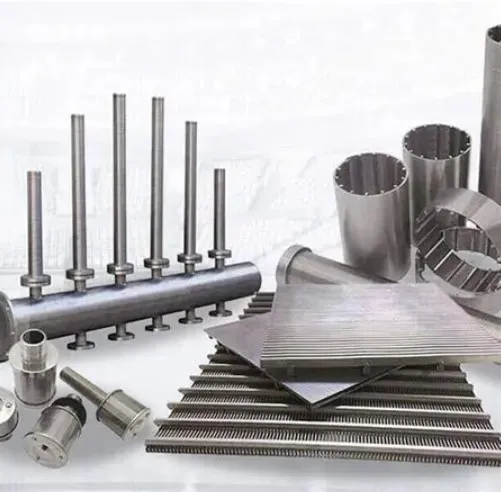
Johnson wedge wire screens are among the most durable separation media available, with typical service lives exceeding 20,000 operating hours and, in well-run installations, six to eight years of useful service. That longevity, however, is not automatic. It depends on a maintenance regime that goes beyond occasional hosing-down: quantified inspection thresholds, contaminant-specific cleaning parameters, and a verification step that confirms the screen is actually clean rather than merely looking clean. This article sets out a practical, evidence-based programme for maintaining and cleaning Johnson wedge wire screens, from daily rinsing through to the repair-or-replace decision.
1. Why the V-Profile Changes the Maintenance Equation
The defining feature of a Johnson screen is its V-shaped profile wire. The wide end faces the feed, and the gap narrows toward the drainage side, so particles are presented with a constantly converging slot rather than a straight-walled one. In practice this produces a self-cleaning effect: solids tend to slide off the surface during operation and backwash rather than wedging into the slot. Comparative testing illustrates the difference. In a 5,000-hour simulated slurry trial, wedge wire screens retained 92% of their open area, while slotted tubes fell to 74%. Backwash efficiency is correspondingly higher — above 95% for wedge wire versus 60–70% for slotted tube — and five-year total operating costs run 35–40% lower. Maintenance frequency reflects this: every three to six months for wedge wire, versus monthly or more for slotted alternatives.
Two installation details protect that advantage. First, the wide end of the V must face the direction of material flow; reversing it defeats the wedge effect and accelerates plugging. Second, slot width should be selected at 0.7–0.9 times the target separation particle diameter, leaving a margin for wear before the slot opens beyond specification.
2. Daily and Shift-Level Maintenance
The single most important routine action is a high-pressure rinse in the direction of the slots at the end of each shift. Rinsing across the slots can drive particles deeper into the gap; rinsing along them flushes them out. This is particularly important in coal preparation and dewatering duty, where fine solids accumulate quickly.
Daily inspection should cover five points: slot blockage or enlargement, uneven wear across the screen surface, abnormal vibration, visible cracks at welds, and a sudden rise in product moisture (a reliable early indicator of screen damage in dewatering applications). On vibrating assemblies, pay particular attention to weld condition at the edges, where vibration amplitude is highest and fatigue damage concentrates first.
For passive cylindrical intake screens — the fish-friendly fine-filtration type with no moving parts — normal operation relies on environmental cross-flow supplemented by periodic air-burst backwashing. Slot openings in this duty typically range from 0.5 to 10 mm, with through-slot velocity kept below 0.15 m/s. These units may be specified in 90/10 copper-nickel alloy or with coatings to resist marine biofouling, but they remain vulnerable to blockage during heavy debris loads or harmful algal blooms, so the air-burst cycle must be maintained rather than treated as optional.
3. Matching the Cleaning Method to the Contaminant
Most screen damage attributed to “cleaning” is actually damage caused by using the wrong cleaning method for the contaminant present. The table below sets out the appropriate approach for each foulant type.
| Contaminant | Recommended method | Key parameters / cautions |
|---|---|---|
| Loose particulate | High-pressure water rinse along slots; backwash | Verify by differential pressure after rinsing, not by appearance |
| Fibrous matting | Gentle brushing | Avoid pressing fibres into the slot |
| Grease / sticky organics | Approved detergent or alkaline treatment | Do not use strong alkaline cleaners on stainless without confirmation |
| Hard mineral scale | Approved descaling agent after identifying scale type | Do not select an acid by appearance alone |
| Biofilm | Physical cleaning plus validated treatment | Recurrence indicates a system-level issue |
For fine-slot screens in pharmaceutical and food duty, ultrasonic cleaning is a practical option, but the parameters matter. A frequency of 40 kHz is generally better suited to fine slots and thin wire, while 28 kHz suits coarser screens and heavier deposits. For oily contamination, an alkaline cleaning solution containing an emulsifier at 55–65 °C for 15–30 minutes is typical; for mineral scale, an acidic descaler at 40–50 °C for 10–20 minutes. Note that the cleaning vessel itself must be compatible: acid descalers should be used in 316 stainless containers, not 304.
Chemical cleaning of stainless steel screens carries a specific hazard that general guidance often omits: chloride-containing cleaners should be used with caution, and hydrochloric acid should not be the default descaler, because chloride ions create a pitting risk on stainless steel. “Avoid strongly corrosive agents” is too vague to be useful; “avoid chlorides, and do not default to HCl” is actionable.
Where an official manufacturer procedure is available, follow it. Johnson Screens’ own phosphate-based descaler for stainless well screens, for example, specifies that the treatment solution be maintained at pH below 3.0 to remain effective; if pH rises above 3.0, roughly 20% of the original acid volume should be added. Contact time is 12–48 hours depending on the degree of plugging. Manufacturer parameters of this kind should take precedence over generic advice.
4. Verifying That Cleaning Has Actually Worked
This is the step most maintenance routines skip, and it is the difference between a cleaning procedure and a cleaning programme. A screen should be judged by measurement, not by colour.
Three checks together constitute acceptance:
-
Differential pressure or flow test against a new element. Under constant flow, rising differential pressure means effective open area is being lost. As a working benchmark, a cleaned element that returns to at least 85–90% of its new-element performance can be regarded as acceptably clean; if differential pressure cannot be brought back close to the new-screen value, the element has reached end of life.
-
Bubble-point test to detect holes or weld damage that visual inspection would miss.
-
Visual inspection of welds, end caps and seals.
One counter-intuitive point deserves emphasis: a low differential pressure does not by itself prove the screen is intact. A damaged screen can pass more fluid while separating less. Differential pressure must therefore be read together with slot inspection and process results — product moisture, filtrate quality, or downstream solids carry-over — rather than in isolation.
For open installations, differential pressure is less convenient, and slot gauging becomes the primary check. A plug gauge should be used quarterly, with replacement recommended once wear exceeds 15% of nominal slot width.
5. Repair or Replace?
Wedge wire screens are not automatically “replace on failure” items. Where damage is localised — a few damaged profile wires, a small dent — and the rest of the screen is in good condition, single wires and small areas can be repaired by qualified welding. The decision rule is economic and dimensional: repair is worthwhile when the repair cost is below 40–50% of replacement cost. Replacement is indicated when surface damage exceeds 10–15% of total area, when ovality or deformation is present, or when corrosion pits are deep. Deformed or weld-cracked elements should not be returned to service.
The economics of getting this right are well documented. One coal mine that converted its screens to wedge wire reported annual maintenance savings of approximately US$18,800, a fall in unplanned shutdowns from an average of nine per year to one, and screen life extending from one to two months to twelve months. In sugar centrifugals, wedge wire baskets have run for at least 800 days in B-sugar duty and at least 1,000 days in C-sugar duty, with one Dubai refinery reporting over 1,200 days of service. These figures reflect correctly specified, correctly maintained screens — not screens that were simply left alone.
6. Monitoring, Materials and Storage
Monitoring frequency should be graded by duty. For continuous 24/7 operation, inspect monthly during the first year to establish a baseline, then move to quarterly. For batch or intermittent operation, inspect before each operating campaign.
Material selection interacts with both corrosion and cleaning. SS304 suits general industrial duty, SS316L is preferred for corrosive or aggressive environments, and duplex stainless is appropriate for high-wear coal processing. Where aggressive or corrosive conditions combine with regular chemical cleaning, 316L and duplex grades are the safer specification. Temperature capability reaches up to 600 °C depending on alloy, and filtration ratings span 20 µm to 3,000 µm — both worth confirming against the cleaning method, since high-temperature operation may rule out certain chemical treatments.
Storage matters more than it appears. Screens should be cleaned, dried, and stored in a ventilated, dry location, protected from dust, with no heavy objects resting on the outer wall, and away from moisture and corrosive gases. Contaminants left to dry on the screen harden, become harder to remove later, and can abrade the profile wires during subsequent handling.
7. A One-Page Maintenance Schedule
| Frequency | Action |
|---|---|
| Each shift | High-pressure rinse along slot direction; check for blockage, vibration, weld cracks, product moisture rise |
| Monthly (first year, continuous duty) | Full inspection; establish differential-pressure baseline |
| Quarterly | Plug-gauge slot measurement; replace at >15% wear; differential-pressure/flow comparison |
| Every 3–6 months | Scheduled cleaning per contaminant type; bubble-point test on critical elements |
| As required | Repair if cost <40–50% of replacement and damage <10–15% of area; otherwise replace |
| After each campaign / before storage | Clean, dry, inspect welds and seals, store ventilated and protected |
Conclusion
The maintenance of a Johnson wedge wire screen is not complicated, but it is specific. Rinse along the slots, not across them. Match the cleaning chemistry to the contaminant rather than to appearance. Control pH and avoid chlorides when cleaning stainless. Verify cleanliness by differential pressure, bubble point and slot gauge rather than by eye. Treat repair as a legitimate option within a defined cost and damage envelope. Screens maintained on this basis routinely deliver the six-to-eight-year service life and the 92% open-area retention that the V-profile makes possible; screens maintained by habit alone rarely do.
Please login to write a comment after