 English
 Español
 Français
 日本語
 한국어
 Deutsch
 Português
 Русский
 中文 (中国)

- 1. What Is a Centrifuge Wedge Wire Basket?
- 2. Construction & Material Specifications
- 3. Working Principle
- 4. Key Specifications & Sizing Parameters
- 5. Applications Across Industries
- 5.1 Mining & Coal Industry
- 5.2 Chemical Processing
- 5.3 Food & Beverage Industry
- 5.4 Additional Industries
- 6. Why Choose Wedge Wire Over Traditional Screens?
- 7. Selection Guide: Key Considerations
- Step 1: Define Application Requirements
- Step 2: Choose Material Grade
- Step 3: Select Slot Width
- Step 4: Determine Basket Configuration
- Step 5: Verify Dynamic Balance
- 8. Maintenance & Troubleshooting
- 9. Summary
1. What Is a Centrifuge Wedge Wire Basket?
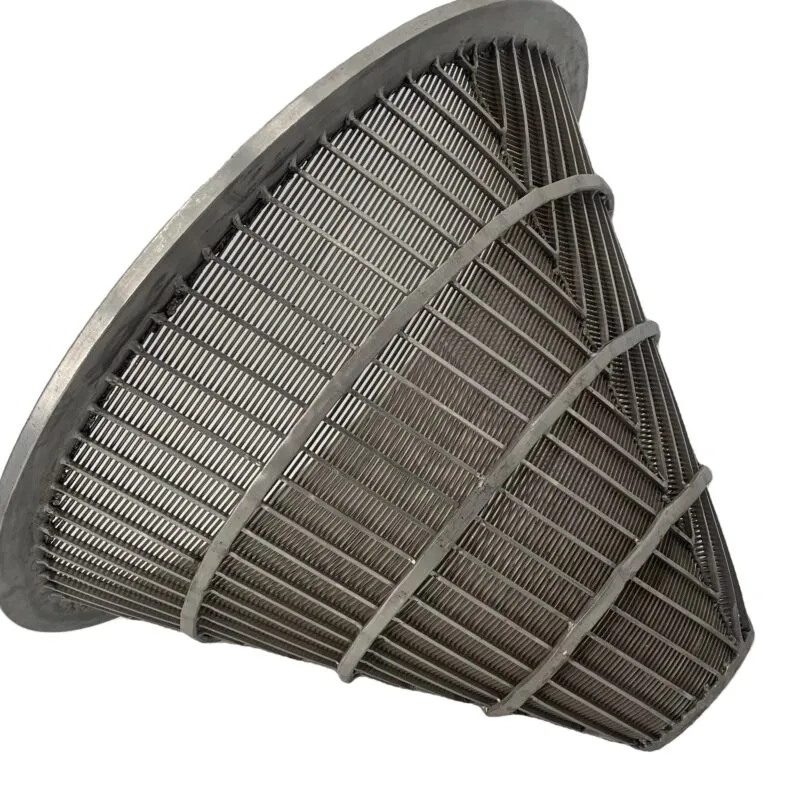
A centrifuge wedge wire basket—also known as a centrifuge screen basket or Johnson screen basket—is the core filtration component in centrifugal solid-liquid separation equipment . Constructed by resistance welding stainless steel V-shaped (wedge) profile wires onto support rods, the basket forms a robust, self-supporting structure with continuous slot apertures .
The defining feature of this design is the narrow-top, wide-bottom slot geometry, which provides exceptional anti-clogging performance: particles that enter the slot can pass through easily without becoming wedged . The basket typically features flanges at the top or bottom for bolt connection to the centrifuge machine .
Available in conical, cylindrical, and tapered configurations, these baskets are tailored to different centrifuge types (vibratory, pusher, or scroll discharge) and are precision-machined to tight tolerances for vibration-free operation at high rotational speeds .
2. Construction & Material Specifications
2.1 Structural Components
The wedge wire basket comprises :
-
Top and bottom flanges – for machine connection
-
Conical/cylindrical screen body – formed by wedge wire panels
-
Reinforcing rings and ribs – provide structural strength
-
Wedge wires – V-shaped stainless steel wires arranged along the cone generatrix
-
Support rods – backing structure welded to the wedge wires
The screen body is fabricated from several sector-shaped panels welded together on dedicated fixtures, ensuring precise geometry .
2.2 Material Selection Guide
Material selection is critical for basket performance and longevity. The following table summarizes key material specifications :
| Material | UNS Designation | PREN* | Chloride Tolerance | Max Temp |
|---|---|---|---|---|
| SS 304 | S30400 / 1.4301 | 18–20 | ≤ 200 ppm | ≤ 400°C |
| SS 304L | S30403 / 1.4307 | 18–20 | ≤ 200 ppm | ≤ 400°C |
| SS 316 | S31600 / 1.4401 | 24–26 | ≤ 1000 ppm | ≤ 450°C |
| SS 316L | S31603 / 1.4404 | 24–26 | ≤ 1000 ppm | ≤ 450°C |
| SS 316Ti | S31635 / 1.4571 | 24–26 | ≤ 1000 ppm | ≤ 550°C |
| Duplex | S32205 / 1.4462 | 33–38 | Brackish/seawater (limited) | ≤ 300°C |
| Super Duplex | S32750 / 1.4410 | ≥ 40 | Seawater compatible | ≤ 300°C |
*PREN = Pitting Resistance Equivalent Number (higher = better corrosion resistance)
Selection Guidance:
-
SS 304/304L: General purpose, non-corrosive environments, food contact (FDA compliant)
-
SS 316/316L: Chemical processing, moderate corrosion, chloride-containing streams
-
SS 316Ti: High-temperature applications (up to 550°C)
-
Duplex/Super Duplex: Severe corrosion (seawater, acidic media, high chlorides)
2.3 Manufacturing Tolerances
Precision manufacturing ensures consistent performance and balanced operation :
| Slot Range | Tolerance |
|---|---|
| 0.02 – 0.10 mm | ± 0.005 mm |
| 0.10 – 0.50 mm | ± 0.01 mm |
| 0.50 – 2.00 mm | ± 0.03 mm |
| 2.00 – 10.0 mm | ± 0.10 mm |
-
Diameter tolerance: ± 0.5 mm (≤ 500 mm) / ± 1.0 mm (> 500 mm)
-
Length tolerance: ± 2.0 mm per meter
-
Ovality: ≤ 0.5% of outer diameter for cylindrical screens
3. Working Principle
3.1 Centrifugal Separation Mechanism
The basket operates as the rotating element in a centrifuge. Feed slurry enters the rotating basket, and high centrifugal force drives liquid through the wedge wire slots while solids are retained on the screen surface .
Key design principles:
-
Slots aligned with solids motion direction: Accelerates cake transport and maximizes liquid drainage
-
Wedge-shaped slots: The narrow top prevents particles from passing; the widening profile prevents clogging
-
High open area: Up to 25–30% greater than traditional perforated screens, significantly improving throughput
3.2 Self-Cleaning Advantage
The V-shaped wire design provides inherent self-cleaning: the slot narrows from the feed side (top) to the discharge side (bottom), ensuring that any particle capable of entering the slot can pass through completely without becoming trapped .
4. Key Specifications & Sizing Parameters
4.1 Dimensions
Typical size ranges available from manufacturers :
| Parameter | Range |
|---|---|
| Basket Diameter | 300 – 2,500 mm |
| Basket Height | 90 – 1,000 mm |
| Slot Width | 0.04 – 10.0 mm (common: 0.3 – 1.0 mm) |
| Cone Angle | 10°, 22°, or custom |
Common industry-standard models include :
-
HSG Series: HSG1000, 1100, 1200, 1300, 1500
-
VM Series: VM-1200, 1400, 1500
-
TLL Series: TLL-700, 900, 1000, 1150, 1200
-
FC Series: FC-1200
4.2 Service Life Expectancy
Under typical coal dewatering conditions, basket service life is 3–4 months (approximately 30,000 tons of processed coal) . In less abrasive applications (food, chemical), service life can extend to 12–18 months .
5. Applications Across Industries
5.1 Mining & Coal Industry
Primary Application: Dewatering and de-sliming of coal fines, mineral concentrates, and tailings.
Key Benefits:
-
Reduces product moisture by 1–2% compared to alternative screens
-
Handles 0–13 mm feed materials in vibrating or scroll centrifuges
-
Substantially reduces wear on downstream pumps and equipment
-
Wide range of models for different capacity requirements (HSG, VM, TLL series)
Typical Feed: Coarse coal, fine coal, potassium salts, ores, mineral slurries
5.2 Chemical Processing
Primary Application: Separation of crystals, polymers, catalysts, and chemical intermediates.
Key Benefits:
-
Corrosion-resistant material options (316L, Duplex) handle aggressive chemicals
-
Precise slot control ensures consistent product purity
-
High open area maximizes production throughput
Typical Applications: Potassium salts, sulfuric acid, copper sulfate, nickel sulfate, chlorides, borax, soda ash, rubber additives, dyes, plastic raw materials, fertilizers, resins
5.3 Food & Beverage Industry
Primary Application: Dewatering of starch, sugar crystals, juice clarification, and extraction processes.
Key Benefits:
-
FDA-compliant 304/316L materials
-
Smooth surface prevents product damage
-
Reduced crystal degradation—yields more sugar per ton compared to electroformed or laser-cut screens
Typical Applications:
-
Sugar processing: Sugar crystal dewatering and syrup clarification
-
Starch processing: Starch dewatering and purification
-
Beverage: Juice clarification, coffee/tea extraction
-
Brewing: Malt processing, beer/wort dewatering
Industry Note: The continuous one-piece basket construction eliminates multi-section assembly, simplifying installation and reducing startup failures .
5.4 Additional Industries
| Industry | Application |
|---|---|
| Pharmaceutical | API isolation, bioprocessing, vaccine production |
| Pulp & Paper | Fiber recovery from white water |
| Wastewater Treatment | Sludge dewatering, effluent clarification |
| Sugar Refining | Crystallizer discharge, molasses separation |
6. Why Choose Wedge Wire Over Traditional Screens?
| Feature | Wedge Wire Basket | Traditional Perforated/Woven Screen |
|---|---|---|
| Open Area | Up to 25–30% higher | Standard |
| Anti-Clogging | Self-cleaning V-slot design | Prone to blinding |
| Structural Strength | Self-supporting—no backup screen needed | Requires support structure |
| Wear Resistance | Slot width minimally affected by surface wear | Performance degrades with wear |
| Dynamic Balance | Precision G6.3 balancing standard | Variable |
| Service Life | 3–18 months depending on application | Typically shorter |
7. Selection Guide: Key Considerations
Step 1: Define Application Requirements
-
What material is being processed? (Abrasive? Corrosive? Food-grade?)
-
What is the target separation size? (Determines slot width)
-
What is the required throughput? (Determines basket diameter and height)
Step 2: Choose Material Grade
-
Food applications: SS 304 or 316L with FDA compliance
-
Chemical/corrosive: SS 316L, Duplex, or Super Duplex based on chloride/pH
-
High temperature: SS 316Ti (up to 550°C)
-
Mining/abrasive: Wear-resistant grades (may include surface hardening)
Step 3: Select Slot Width
-
Smaller slots = finer separation, but lower throughput
-
Common slot widths: 0.3–1.0 mm for most dewatering applications
-
Ultra-fine separation: slots as narrow as 0.04 mm
Step 4: Determine Basket Configuration
-
Conical: Most common, suitable for screw/scroll centrifuges
-
Cylindrical: For pusher-type centrifuges
-
Tapered: Hybrid designs for specific applications
Step 5: Verify Dynamic Balance
Ensure the basket is dynamically balanced (e.g., ISO G6.3 standard) for vibration-free high-speed operation .
8. Maintenance & Troubleshooting
8.1 Expected Service Life
-
Coal dewatering: 3–4 months (≈30,000 tons)
-
Chemical/food applications: 12–18 months
8.2 Common Issues & Solutions
| Issue | Cause | Solution |
|---|---|---|
| Reduced throughput | Slot blinding or wear | Inspect slots; clean or replace if worn |
| Excessive vibration | Loss of dynamic balance | Rebalance or replace basket |
| Product moisture increase | Worn slots reducing separation efficiency | Replace basket; verify slot tolerance |
| Premature failure | Material grade unsuitable for application | Review material selection (corrosion/abrasion resistance) |
8.3 Rotating the Basket (Wear Management)
Many conical baskets allow 180° rotation when the feed end wears, using the opposite end to extend service life.
9. Summary
The centrifuge wedge wire basket is a critical component enabling efficient solid-liquid separation across the food, mining, and chemical industries. Its V-shaped wedge wire construction delivers:
-
Superior open area — up to 25–30% higher throughput than perforated screens
-
Self-cleaning slots — minimizes clogging and downtime
-
Exceptional durability — 3–18 months service life with proper material selection
-
Precision separation — slot tolerances as tight as ±0.005 mm
-
Industry versatility — from sugar crystallizers to coal dewatering to chemical catalysts
Key selection priorities:
-
Match material grade to corrosive/abrasive conditions
-
Select slot width based on target separation size
-
Verify dynamic balance for high-speed operation
-
Consider total cost of ownership (not just purchase price)
Please login to write a comment after