 English
 Español
 Français
 日本語
 한국어
 Deutsch
 Português
 Русский
 中文 (中国)

- 1. Core Golden Rule for Slot Size Selection
- 2. Key Factors Affecting Slot‑size Decision
- 2.1 Particle characteristics
- 2.2 Working flow & back‑washing requirement
- 2.3 Medium corrosiveness & abrasion
- 2.4 Future operation tolerance
- 3. Practical Reference by Industry
- 4. Common Mistakes to Avoid
- 5. What to provide when you inquire for quotation
- Conclusion
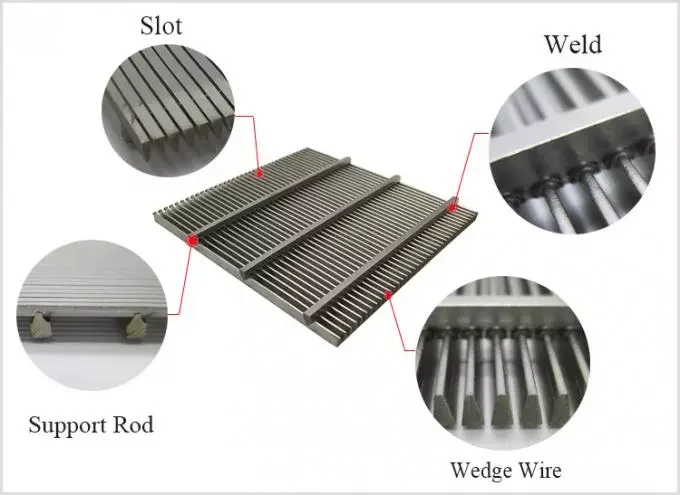
Johnson screen filter, also known as wedge‑wire filter, relies on trapezoidal wedge‑shaped slots to separate solid particles from liquid. Among all technical parameters including material, diameter and length, slot size is the No.1 factor that directly decides whether the filter works as expected.
Many buyers focus only on material and price but ignore slot‑size matching. Too large a slot allows unwanted solid particles to pass through and contaminate downstream equipment. Too small a slot raises flow resistance, causes rapid blockage and reduces processing capacity. Therefore, slot size must be determined according to real‑world working conditions rather than blind subjective estimations.
1. Core Golden Rule for Slot Size Selection
The slot opening must be smaller than the target particle size you need to retain.
General practical guideline: the selected slot size should be 70%‑80% of the minimum particle size to be trapped.
Example: If your system needs to hold back particles ≥1.0 mm, your ideal slot range is 0.7‑0.8 mm.
This safety margin avoids particle bypass caused by particle shape deviation, system pressure fluctuation and particle extrusion. Do not set slot size equal to particle size, otherwise irregular‑shaped particles may squeeze through gaps.
2. Key Factors Affecting Slot‑size Decision
2.1 Particle characteristics
- Particle size distribution: Check your particle size test report. Base calculation on the minimum particle you want to intercept, not average particle size.
- Particle shape: Round spherical particles pass gaps more easily; flaky, sharp‑angled particles are more likely to jam inside slots. For flaky solids, take a smaller safety margin.
- Solid content: High‑concentration slurry recommends relatively larger qualified slot, to reduce overall clogging risk.
2.2 Working flow & back‑washing requirement
Johnson screen is widely used with back‑washing / self‑cleaning systems.
- Frequent back‑washing scenario: avoid extremely tiny slots (<0.1 mm), fine slots are harder to clean and residual solids may stick in gaps.
- High flow demand: within interception requirement, choose the largest acceptable slot size to get higher open area and lower flow resistance.
2.3 Medium corrosiveness & abrasion
Under heavy abrasion conditions such as mineral pulp, the slot will slowly widen after long‑term wear. You need to reserve wear allowance when selecting initial slot size. For mining dewatering service, do not use slot size right at your critical interception threshold.
2.4 Future operation tolerance
Consider possible fluctuation of incoming particle size in actual production. Production feed particle size is not always stable, keep reasonable safety tolerance for unstable raw material.
3. Practical Reference by Industry
- Mining industry (tailings dewatering, centrifuge basket, sieve bend) Common slot range: 0.25 mm‑2 mm. Prioritize anti‑wear safety margin for abrasive mineral slurry.
- Water treatment (self‑cleaning filter, well water intake screen) Common slot range: 0.15 mm‑1 mm. Main goal is to block sand and organic debris.
- Petrochemical & oil well sand control Common slot range: 0.05 mm‑0.5 mm. Strict particle interception requirement, follow formation sand‑size analysis data.
- Food & beverage / chemical catalyst recovery Common slot range:0.08 mm‑0.6 mm. Need to balance interception accuracy and easy cleaning performance.
Note: All above ranges are for reference only. Actual slot shall be confirmed by your particle test data.
4. Common Mistakes to Avoid
- Select slot size according to experience only, without particle‑size data.
- Set slot size exactly equal to target particle size, without safety margin.
- Pursue ultra‑fine slot blindly when high flow volume is required, resulting in heavy clogging and insufficient throughput.
- Ignore slot widening risk caused by long‑term abrasion in mining slurry service.
5. What to provide when you inquire for quotation
To help us recommend proper slot size for your Johnson screen filter, please supply below information:
- Minimum particle size that needs to be retained
- Particle size distribution report if available
- Medium type: mineral slurry / water / chemical liquid; solid content
- Working flow rate, whether back‑washing system is equipped
- Medium abrasion and corrosion condition
Conclusion
Slot‑size selection for Johnson screen filter is not a simple number‑choosing task. It balances interception accuracy, flow capacity, anti‑clogging performance and service life. Always take actual particle condition as core basis and reserve proper safety tolerance. Correct slot selection maximizes filter performance and reduces maintenance cost for your whole system.
Please login to write a comment after