 English
 Español
 Français
 日本語
 한국어
 Deutsch
 Português
 Русский
 中文 (中国)

1. Introduction
The Johnson Screen, also known as wedge wire screen or Vee-Wire® screen, is a filtering element widely used in the mining industry for solid-liquid separation processes. Its characteristic construction — wires with a “V” profile welded onto support rods — creates slots with a geometry that widens toward the interior, giving the screen unique self-cleaning properties and high particle separation efficiency.
In the mining context, Johnson Screens are primarily employed in two critical applications: Pulp dewatering and solids classification. This article presents the operating principles, technical advantages, and selection parameters of this technology, based on manufacturer technical literature and specialized references.
2. Operating Principles
2.1 Geometry and Working Principle
The Johnson Screen is manufactured with trapezoidal (V-shaped) profile wires, arranged parallel to each other with precise spacing, and welded onto support rods that provide structural strength and rigidity.
The slot principle is based on the following geometric characteristics:
-
The slot is narrowest at the screen surface and gradually widens toward the base;
-
Particles larger than the slot opening are retained on the surface without becoming lodged;
-
Liquid and smaller particles pass freely through.
This design, described as “V-shaped grooves that expand inward,” minimizes clogging by solid particles and creates a continuous self-cleaning effect. In static screening applications such as DSM (Dutch State Mines) curved screens, the orientation of the wires perpendicular to the flow direction is essential for maximizing solids retention efficiency.
2.2 Technical Parameters
Johnson Screens are manufactured with adjustable technical specifications to meet different operational requirements:
| Parameter | Typical Range | Remarks |
|---|---|---|
| Slot opening | 20 microns to 3,000 microns | Defines separation precision; tolerance of ±5 microns |
| Effective open area | 20% to 50% | Higher than conventional screens, lower flow resistance |
| Material | SS304, SS304L, SS316, SS316L, SS321, Duplex, Hastelloy | Selected according to pulp corrosivity |
| Curvature angle | 45°, 60°, 90°, 120°, 150°, 160°, 270°, 300° | Defines specific application |
| Dimensions | Width up to 6,000 mm; customizable length | Adaptable to different equipment |
Slot dimensional accuracy is controlled to a tolerance of ±5 microns, enabling high-precision separation in critical applications.
3. Applications in Mining
3.1 Pulp Dewatering
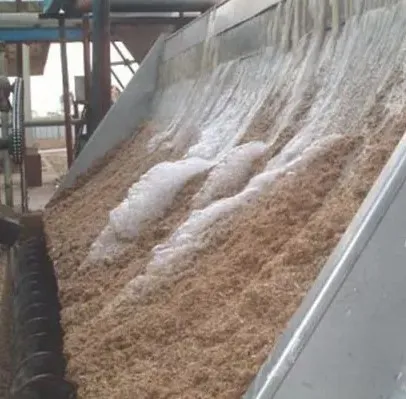
Dewatering is an essential process in mining to reduce the moisture content of mineral concentrates and tailings. Johnson Screens are widely used in curved and inclined screens for this purpose.
Dewatering mechanism:
The pulp is fed onto the curved screen surface. Centrifugal force and gravity direct the liquid through the slots, while retained solids are conveyed along the surface for discharge. The curved geometry provides greater dewatering efficiency due to the forces exerted by particles in flow over the curvature.
Observed advantages:
-
Greater flow capacity: The 20% to 50% open area significantly reduces flow resistance, allowing higher throughput compared to flat panel screens.
-
Retention efficiency: Precise slots effectively retain solid particles while allowing water and fine particles to pass through.
-
Self-cleaning: The V-design reduces clogging, minimizing downtime for maintenance.
-
Durability: The welded stainless steel construction (especially alloys such as SUS316L for acidic environments) provides resistance to abrasion and corrosion.
-
Low maintenance: Quick and straightforward replacement procedures maintain productivity.
3.2 Solids Classification
Classification, or screening, involves separating particles by size. DSM curved screens with Johnson Screens are used for fine material classification (desliming) and dense media recovery in coal and iron ore preparation plants.
Classification mechanism:
The pulp is continuously fed (by gravity or pressure) onto the curved screen surface. Particles larger than the slot opening are retained and slide along the surface, while smaller particles and liquid pass through the slots.
Design features for efficient classification:
-
Optimized slot patterns: Minimize blinding and plugging issues, resulting in more consistent screening performance;
-
Variable slot widths: Allow adjustment according to mineral type and particle size distribution;
-
High-strength materials: Withstand the abrasive nature of minerals, extending service life.
4. Advantages Over Conventional Screens
Compared to perforated plates or woven wire screens, Johnson Screens offer significant structural and operational advantages:
| Feature | Johnson Screen (Wedge Wire) | Conventional Screen |
|---|---|---|
| Slot precision | ±5 μm, highly consistent | Larger tolerance (±0.1 mm or more) |
| Self-cleaning | V-profile prevents particle lodging | Particles tend to clog openings |
| Slot wear pattern | Uniform enlargement, predictable | Irregular enlargement, localized deformation |
| Structural strength | Welded at every intersection, high rigidity | Susceptible to vibration-induced deformation |
| Service life | Extended, especially in abrasive environments | Shorter, prone to wire breakage |
| Open area | 20%-50%, high flow capacity | Generally lower |
5. Selection Considerations
Proper selection of a Johnson Screen for mining applications should consider:
-
Slot opening: Sized according to target particle size. The ±5 micron tolerance allows fine adjustment.
-
Manufacturing material: For acidic pulps (pH 4-6), 316L stainless steel is recommended; for neutral conditions, 304 may suffice.
-
Curvature angle: Dewatering and classification applications use angles such as 45°, 60°, or 120°, depending on feed pressure and desired throughput.
-
Dimensions: Adaptable to vibrating or static screens, with customizable width and length.
6. Maintenance and Service Life
To ensure performance and longevity:
-
Periodic inspection: Check slot width with feeler gauges;
-
Regular cleaning: High-pressure water jet in the slot direction reduces particle buildup;
-
Scheduled replacement: When slot wear exceeds 15% of nominal opening, replacement is recommended.
The robust construction and use of stainless steels provide extended service life and reduced maintenance costs, justifying the higher initial investment.
7. Conclusion
The Johnson Screen, with its innovative V-profile design, has become a fundamental technology for dewatering and solids classification operations in the mining industry. Its ability to offer high open area, separation precision with ±5 micron tolerance, self-cleaning, and durability in abrasive and corrosive environments makes it a superior solution for maximizing production efficiency and reducing operational costs.
Proper selection of technical parameters — slot opening, manufacturing material, curvature angle, and dimensions — together with appropriate maintenance practices, is essential to extract the maximum benefit from this technology in mineral processing operations.
Please login to write a comment after