 English
 Español
 Français
 日本語
 한국어
 Deutsch
 Português
 Русский
 中文 (中国)

- 1. Introduction
- 2. Operating Principles
- 3. Applications in the Paper Industry
- 3.1 Fiber Recovery
- 3.1.1 Brown Stock Washing
- 3.1.2 Fiber Recovery in Closed-Loop Systems
- 3.1.3 Pressure Screens
- 3.1.4 DSM Curved Screens (Sieve Bends)
- 3.2 Liquor Filtration
- 4. Advantages Over Conventional Screens
- 5. Material Selection
- 6. Economic Benefits
- 7. Maintenance and Service Life
- 8. Conclusion
1. Introduction
The pulp and Paper industry faces continuous challenges in the efficient management of its solid-liquid separation processes. Fiber recovery and Liquor filtration — both black liquor from brown stock washing and white liquor from chemical recovery systems — are critical operations that directly impact plant profitability and environmental sustainability.
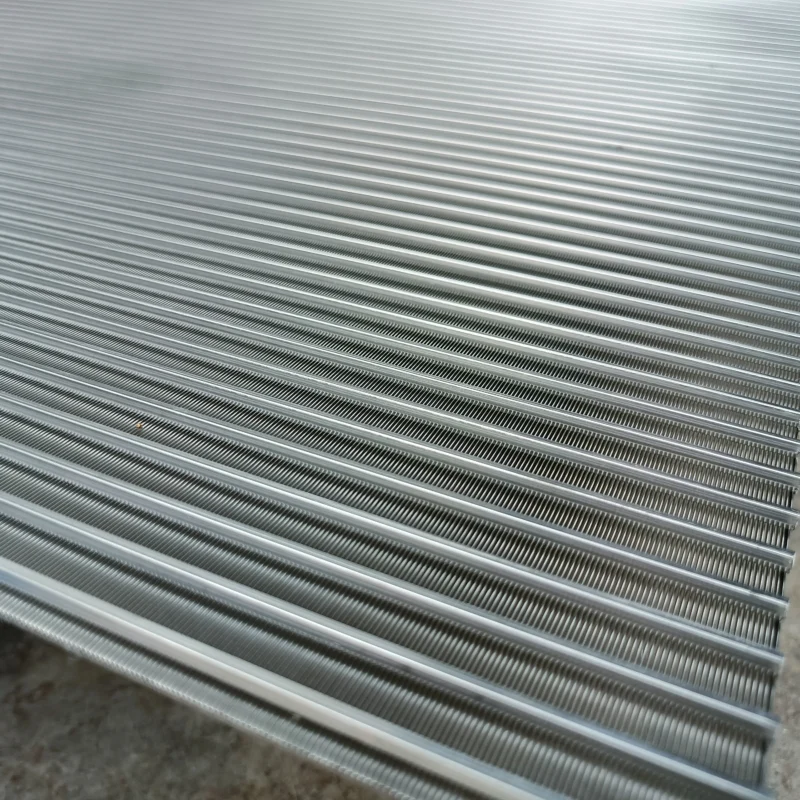
The wedge wire screen, also known as Vee-Wire® screen, has become established as a superior technological solution for these applications. Its distinctive design — trapezoidal (V-shaped) profile wires welded onto a support structure — creates slots with a geometry that widens toward the interior, conferring unique self-cleaning properties, high separation precision, and exceptional durability in aggressive environments.
This article presents the operating principles, main applications, performance data, and selection guidelines for wedge wire screens in Fiber recovery and Liquor filtration in the Paper industry, based on technical literature and data from manufacturers and industrial operations.
2. Operating Principles
2.1 Geometry and Working Principle
The wedge wire screen is manufactured with trapezoidal profile wires, arranged parallel to each other with precise spacing, and welded onto support rods or rings that provide structural strength.
The working principle is based on three fundamental geometric characteristics:
-
Narrowest slot at the surface: The opening at the screen face is the smallest dimension, defining the cut size for separation.
-
Widening toward the interior: The slot gradually expands toward the base, creating a channel that does not trap particles.
-
Sharp cutting edge: The upper edge of the V-shaped wire acts as a blade that “cuts” the boundary layer of the flow, facilitating the passage of liquid and smaller particles.
This geometry, described as “V-shaped grooves that expand inward,” minimizes clogging by fibers and solid particles, and creates a continuous self-cleaning effect — fibers retained on the surface are easily removed by the feed flow or by backwashing cycles, without the need for frequent mechanical intervention.
2.2 Shear Separation Mechanism
One of the most important characteristics of the wedge wire screen — particularly relevant for Fiber recovery in DSM (Dutch State Mines) curved screens — is the surface shear separation mechanism.
Unlike a conventional screen that functions as a “depth filter,” the curved screen with wedge wire operates on the run-down shear principle:
-
The pulp flows by gravity over the curved screen surface.
-
The sharp edge of each V-shaped wire “scrapes” a liquid layer with a thickness equivalent to approximately half the slot opening, which passes through the screen as filtrate.
-
Solid particles — including cellulose fibers — that are larger than the thickness of the sheared layer continue their path along the screen surface and are discharged at the lower end.
-
This mechanism allows the screen to separate particles significantly smaller than the slot opening itself.
Fundamental relationship — Cut Point:
The effective cut point (d50) of a DSM curved screen with wedge wire can be approximated by the relationship:
d50 ≈ 0.5 × s
where:
-
d50 = median separation diameter (particle with 50% probability of being retained)
-
s = nominal slot opening
For example, a screen with a 0.25 mm (250 µm) slot will have an effective cut point of approximately 125 µm, meaning that fibers as fine as 125 µm can be recovered, even though the physical slot opening is twice that value.
2.3 Technical Parameters
Wedge wire screens for the Paper industry are manufactured with adjustable technical specifications:
| Parameter | Typical Range | Remarks |
|---|---|---|
| Slot opening | 0.05 mm to 2.0 mm | Typical: 0.10 – 0.40 mm for pressure screens; 0.25 – 1.0 mm for curved screens |
| Dimensional precision | ± 5 µm | Tight tolerance for consistent separation |
| Effective open area | 20% to 50% | Superior to perforated screens, lower pressure drop |
| Materials | SS304, SS304L, SS316, SS316L, Duplex | Selected according to liquor corrosivity and temperature |
| Operating temperature | Ambient to 90°C | Limited by material corrosion resistance |
| Profile wire diameter | 1.5 mm to 4.0 mm | Defines mechanical strength and service life |
3. Applications in the Paper Industry
Wedge wire screens find applications at every stage of the papermaking process, from raw material preparation to wastewater treatment.
3.1 Fiber Recovery
Fiber recovery is one of the most critical and economically significant applications of wedge wire screens in the Paper industry.
3.1.1 Brown Stock Washing
In the chemical pulping process (kraft), brown pulp is washed to remove black liquor and dissolved solids. Wedge wire screens are used to separate fibers from black liquor, enabling:
-
Recovery of fibers that would otherwise be lost in the effluent.
-
Recycling of black liquor to the evaporation and chemical recovery system with lower suspended solids content.
-
Reduction of solids loading on evaporators, preventing scaling.
3.1.2 Fiber Recovery in Closed-Loop Systems
In modern closed-loop water systems, fibers lost at various process stages are captured by wedge wire screens and returned to the process. Major sources of recovered fibers include:
-
White water from the paper machine: Water drained from the fourdrinier table contains fine fibers and mineral fillers. Wedge wire screens recover these fibers for reuse in sheet formation.
-
Felt and fabric wash effluents: Wash waters contain fibers that can be recovered before effluent treatment.
-
Condensate and cooling waters: Any incidental fiber losses are captured by safety screens.
3.1.3 Pressure Screens
Pressure screen baskets represent one of the most sophisticated applications of wedge wire screens. In this equipment, pulp is fed under pressure against the inner surface of the cylindrical basket:
-
Accepted fibers (of suitable size) pass through the screen slots and proceed to subsequent stages.
-
Rejects — including longer fibers, knots, bark, and other contaminants — are retained inside the basket and discarded or sent to refining.
-
The V-slot design ensures that fibers do not become lodged in the openings, maintaining stable flow capacity over time.
Typical slot openings for pressure screen baskets range from 0.10 mm to 0.40 mm, depending on pulp type (mechanical, chemical, or recycled) and desired final quality.
3.1.4 DSM Curved Screens (Sieve Bends)
DSM curved screens are static equipment that use gravity as the driving force. They are widely used for Fiber recovery at various points in the mill:
-
Pre-filtration before biological effluent treatment: Removes fibers that would cause clogging in downstream equipment.
-
Fiber recovery in gas scrubbing systems: Captures fibers entrained in gas streams.
-
Fine fiber concentration: In some configurations, the curved screen can concentrate the fibrous suspension.
Typical construction uses curvature angles of 45° to 120°, with 60° being the most common for fiber applications. Screen widths range from 300 mm to 1,500 mm, with flow rates that can exceed 300 m³/h for a single unit.
3.2 Liquor Filtration
Filtration of liquors — both black and white — is essential for chemical recovery efficiency and final product quality.
3.2.1 Black Liquor Filtration
Black liquor, resulting from brown stock washing, contains dissolved solids (lignin, cooking chemicals) and suspended solids (fine fibers, sand particles). Wedge wire screens are used in:
-
Safety filters before evaporators: Remove particles that would cause scaling and efficiency reduction in evaporators.
-
Liquor recovery systems: Capture fibers that, if they reached the recovery boiler, would form deposits on tubes and compromise operation.
Typical slots for this application range from 0.25 mm to 1.0 mm, depending on suspended solids loading and the need for downstream equipment protection.
3.2.2 White Liquor Filtration
White liquor — used in chemical cooking — must have low suspended solids content to ensure pulp quality. Wedge wire screens are employed in:
-
Green liquor filters: Before the causticizing process, remove coarse particles.
-
Final white liquor filters: Ensure purity of liquor sent to the digester.
Due to the alkaline and corrosive nature of white liquor (pH > 12), recommended materials for these applications are SS316L stainless steel or duplex alloys, which offer corrosion resistance at high temperatures and in alkaline environments.
3.2.3 Process Water Clarification
Clarified water is essential for various operations in the paper mill:
-
Felt washing systems: Low-solids water prevents felt clogging.
-
Pump sealing systems: Clean water extends mechanical seal life.
-
Cooling water: Prevents scaling in heat exchangers.
Wedge wire screens are used as pre-filters or polishing filters in these systems, with openings from 20 µm to 100 µm, removing fine particles and residual fibers.
4. Advantages Over Conventional Screens
Wedge wire screens offer significant advantages compared to perforated plates and woven wire screens:
| Feature | Wedge Wire Screen | Perforated Plate | Woven Wire Screen |
|---|---|---|---|
| Slot precision | ± 5 µm, consistent | ± 0.1 mm or more | Variable, depends on tension |
| Self-cleaning | V-profile prevents fiber lodging | Fibers lodge in circular holes | Fibers entangle in mesh |
| Pressure drop | Low (higher open area) | Moderate to high | High (limited open area) |
| Abrasion resistance | High (thick profile) | Moderate | Low (thin wires) |
| Service life | Extended | Moderate | Short in abrasive environments |
| Maintenance cost | Low | Moderate | High (frequent replacement) |
| Flow capacity | High | Moderate | Limited |
5. Material Selection
The choice of wedge wire screen material is critical to ensure performance and service life in each specific application.
| Material | Typical Applications | Advantages | Limitations |
|---|---|---|---|
| SS304 | White water, Fiber recovery systems, mildly corrosive environments | Low cost, good general resistance | Susceptible to chloride and acid corrosion |
| SS304L | Pulp preparation equipment, white water systems | Better weldability than 304 | Similar to 304 in chemical resistance |
| SS316 | Green liquor, partially clarified white liquor | Good resistance to acids and chlorides | Lower resistance at high temperatures than 316L |
| SS316L | Black liquor, final white liquor, chloride-containing environments, temperature > 60°C | Excellent resistance to general and pitting corrosion | Higher cost |
| Duplex Alloys | Severe environments (high temperature + high corrosivity) | High resistance to stress corrosion cracking | Significantly higher cost |
Additional recommendations:
-
316L stainless steel for chloride-containing or acidic environments (such as bleaching).
-
Resistance welding (full fusion point) to minimize crevice corrosion risks, especially in attachment welds.
6. Economic Benefits
6.1 Increased Fiber Recovery
Every kilogram of fiber recovered and returned to the process represents direct savings in raw material purchases (wood, chips, or purchased pulp). In a medium-sized mill, installing wedge wire screens for Fiber recovery can represent annual savings of hundreds of tons of fiber, with investment payback in just a few months.
6.2 Reduced Water and Energy Consumption
Cleaner pulp — with lower suspended solids content — enables:
-
Water recirculation: Reduced fresh water intake and effluent volume to be treated.
-
Lower energy consumption: Pumps and agitators operate with lower load due to reduced viscosity and solids presence.
-
Fewer wash cycles: Downstream equipment (evaporators, heat exchangers, felts) requires less frequent cleaning.
6.3 Reduced Maintenance
The self-cleaning design of wedge wire screens reduces the frequency of shutdowns for mechanical cleaning. In a DSM curved screen application at an Indian paper mill, manual cleaning frequency was reduced to just once per day, with feed flow between 279 and 331 m³/h and solids concentration of 0.23% to 0.34%.
The welded stainless steel construction, with a weld at every intersection of the wires with support rods, eliminates fatigue points and extends equipment service life, reducing replacement costs.
7. Maintenance and Service Life
Despite the robustness of the design, proper maintenance practices are essential to maximize wedge wire screen service life.
7.1 Regular Inspections
Recommended practices:
-
Weekly visual inspection: Check weld integrity, especially at edges where vibration is most intense.
-
Quarterly slot measurement: Use feeler gauges to monitor wear. Replacement should be scheduled when wear exceeds 15% to 20% of nominal opening.
-
Pressure drop monitoring: A sudden increase indicates possible clogging or excessive wear.
7.2 Cleaning
-
Continuous cleaning: The screen geometry itself promotes self-cleaning, but in applications with high fiber loading, the following are recommended:
-
Periodic backwashing: Reverse flow of clean water or compressed air.
-
Scheduled chemical cleaning: For removal of organic or inorganic deposits, using products compatible with the screen material and safe for the process.
-
7.3 Factors Affecting Service Life
| Factor | Impact | Mitigation |
|---|---|---|
| Abrasion by silica/sand | Premature wear of edges | Select thicker profile; pre-remove sand |
| Corrosion by chlorides/acids | Material loss, slot widening | Use SS316L or duplex alloys |
| Vibration fatigue | Cracks in welds | Ensure adequate structural support; reduce vibration amplitude |
| Fiber clogging | Pressure increase, capacity loss | Adjust opening for specific fiber; install wash system |
8. Conclusion
The wedge wire screen is a well-established and essential technology for the pulp and Paper industry, offering superior solutions for Fiber recovery and Liquor filtration. Its unique characteristics — dimensional precision of ±5 microns, self-cleaning geometry, high open area, and durability in chemically aggressive environments — ensure:
-
Higher fiber yield, directly impacting plant profitability.
-
Reduced water and energy consumption, contributing to operational sustainability.
-
Lower maintenance costs, with extended equipment service life.
Correct selection of technical parameters — slot opening, manufacturing material, geometry, and dimensions — is fundamental to extracting maximum benefit from this technology. When properly specified and maintained, the wedge wire screen translates not only into operational efficiency but into measurable financial returns that fully justify the investment.
Please login to write a comment after