 English
 Español
 Français
 日本語
 한국어
 Deutsch
 Português
 Русский
 中文 (中国)

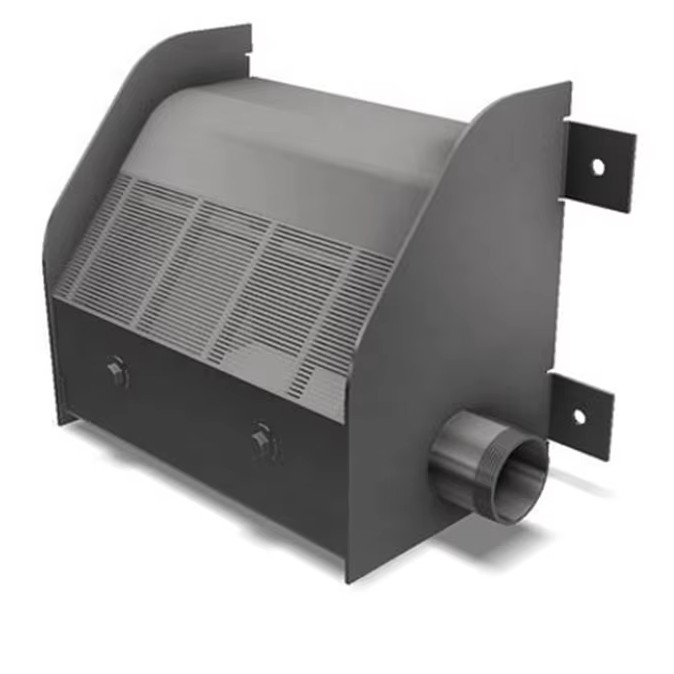
1. Working Principle
The screen consists of a curved panel of wedge wires, each tilted downstream by approximately 3°–10° (optimal around 5°). Water is accelerated over an ogee-shaped acceleration plate and delivered tangentially to the screen surface at 2–3 m/s. Because of the Coanda effect, the flow attaches to the convex surface. The leading edge of each wedge wire slightly protrudes into the flow and “shears” the upper layer of water; water passes through the slots while debris remains on the surface and is conveyed downstream.
The key to low head loss is keeping the screen “dry” — that is, controlling the water level in the collection chamber so that the screen surface is not submerged. If the screen is submerged, it behaves like a conventional submerged screen and clogs rapidly.
2. Low Head Loss Mechanism
Low head loss is achieved through three factors:
Gravity-driven acceleration – no external power is required; the available head accelerates the flow.
Tangential delivery – the ogee profile minimizes turbulence and energy loss at the transition.
Self-cleaning shear flow – debris is continuously removed, preventing the build-up that would otherwise increase head loss.
Quantitative head loss data [待补充]: Typical head loss ranges from [待补充] m at design flow, compared with [待补充] m for conventional trash racks and [待补充] m for sand filters under the same conditions.
3. Key Performance Data
Parameter Typical Range
Slot width 0.2–2 mm (commonly 0.5–1.0 mm)
Surface velocity 2–3 m/s
Wedge wire tilt 3°–10° (optimal ~5°)
Debris exclusion (>1 mm) ~100%
Debris exclusion (>0.5 mm) ~90%
Fish exclusion (>12.5 mm) near 100%
Maintenance interval days to quarterly
Screen panel life ~3 years in high-bedload conditions
Capacity table [待补充]: Unit-width flow (L/s/m) as a function of slot width (0.5, 1.0, 1.5, 2.0 mm) and screen inclination (30°, 45°, 60°).
Graded exclusion efficiency [待补充]: Exclusion efficiency (%) versus particle size (0.1–5 mm) for different slot widths.
4. Comparison with Tyrolean Intake
Aspect Coanda Screen Tyrolean Intake
Bar shape Curved Straight
Bar orientation Perpendicular to flow Parallel to flow
Shear generation Yes (additional shear) Limited
Self-cleaning Strong Moderate
Fish passage Favorable Less favorable
Head loss Lower [待补充] Higher [待补充]
Field studies indicate that maximum intake performance for sediment-laden flow occurs at a screen slope of about 30%, while for clear water it occurs near 0% slope — an important design trade-off.
5. Design and Selection Guidance
A practical design sequence:
Determine design flow and sediment concentration.
Select slot width based on target particle size.
Choose screen inclination and acceleration plate angle.
Size screen length and width using unit-width capacity.
Verify that the collection chamber level keeps the screen dry.
Provide a purge/backwash system for low-flow periods.
Common design errors include: insufficient drop height (leading to low velocity and clogging), submerged screen operation, and undersized screen area for peak flows.
6. Limitations
Not fully self-cleaning at low flow; debris can accumulate.
High bedload causes gradual wear of wedge wire leading edges.
Algae film can reduce capacity over time; brushing is required.
Design is sensitive to acceleration plate angle, drop height, and curvature.
7. Conclusion
The wedge wire Coanda screen is a robust, low-head-loss filtration solution for low-head intake retrofits and small hydropower. Its performance is well documented in principle, but broader adoption depends on more transparent head loss data, standardized capacity tables, independent long-term efficiency verification, and clearer economic analysis.
Please login to write a comment after