 English
 Español
 Français
 日本語
 한국어
 Deutsch
 Português
 Русский
 中文 (中国)

- 1 Introduction
- 2 Particle Size Characteristics of Brazilian Iron Ore Tailings and Dewatering Challenges
- 3 Technical Principles of Wedge Wire Flat Screens
- 3.1 V-Shaped Wire Structure and Self-Cleaning Mechanism
- 3.2 Self-Supporting Flat Panel Structure and TIG Welding Advantages
- 3.3 Material and Specification Customization Flexibility
- 4 Industrial Cases and Quantitative Data
- 5 Positioning of Wedge Wire Flat Screens in Brazil’s Tailings Dewatering System
- 5.1 Classified Dewatering, Not Whole-Fraction Replacement
- 5.2 Technical Choice Among Banana Screens and High-Frequency Screens
- 6 Regulatory Drivers and Compliance Logic
- 7 Conclusions
1 Introduction
Brazil is the world’s second-largest iron ore producer, with output of approximately 412 million tonnes in 2014, of which 90% is fine product. In iron ore beneficiation, approximately 400 kg of tailings is generated per tonne of concentrate; in 2014 alone, about 275.5 million tonnes of tailings were discharged into tailings dams. For a long time, upstream dam construction was the mainstream tailings disposal method in Brazil, favored for its cost advantages in the water-rich, topographically suitable Quadrilátero Ferrífero region.
However, the 2015 Fundão dam failure in Mariana and the 2019 Córrego do Feijão dam failure in Brumadinho (272 deaths) fundamentally changed this landscape. The Brazilian National Mining Agency (ANM) subsequently issued a series of regulatory resolutions banning upstream dam construction and mandating the “de-characterization” (descaracterização) of existing dams. Resolution ANM No. 220/2025, issued in 2025, further strengthened safety level classification, automated monitoring, and emergency system requirements, while explicitly incorporating “de-characterized dams” into a dedicated chapter.
Under this regulatory pressure, dewatered dry stacking has become the de facto standard for iron ore tailings disposal in Brazil. The choice of dewatering technology route depends on the tailings’ particle size characteristics, moisture targets, water recovery requirements, and full lifecycle costs.
2 Particle Size Characteristics of Brazilian Iron Ore Tailings and Dewatering Challenges
2.1 Bimodal Particle Size Distribution
The particle size distribution of Brazilian iron ore tailings exhibits a pronounced bimodal character, which is the core premise for understanding dewatering technology selection. Iron ore grades in the Quadrilátero Ferrífero region are relatively low (31–45% Fe), necessitating grinding and classification in beneficiation. Typical beneficiation flowsheets generate two tailings streams:
-
Coarse tailings: from magnetic separation or gravity separation, typically 150–45 μm
-
Fine/ultra-fine tailings (slimes): from flotation or desliming, below 45 μm, with the -10 μm fraction accounting for 20–30 wt%
Borehole sampling analysis at the Mineração Usiminas tailings dam shows that 25% of particles are below 10 μm and 15% are above 297 μm; Fe content is 44.3%, SiO₂ content is 30.9%, and the main minerals are hematite and quartz. This wide particle size distribution means that no single dewatering technology can efficiently handle all size fractions.
2.2 Particle Size Constraints on Dewatering Performance
Research at the Pau Branco mine provides key comparative data: the slimes at this mine are coarser than those at other mines in the Quadrilátero Ferrífero region—50% of particles are retained on a 10 μm sieve aperture, compared with only 30% at other mines. This particle size difference directly explains the gap in dewatering efficiency: Pau Branco achieves 15% final moisture, while other mines achieve 20%; unit filtration rate is 128 kg/h·m² versus 100 kg/h·m² at other mines.
Core conclusion: The finer the particles, the more difficult the dewatering. This is precisely the fundamental reason for adopting a “classified dewatering” strategy in Brazilian practice—coarse fractions are dewatered by screening, fine fractions by filter pressing, rather than attempting to treat all size fractions with a single technology.
3 Technical Principles of Wedge Wire Flat Screens
3.1 V-Shaped Wire Structure and Self-Cleaning Mechanism
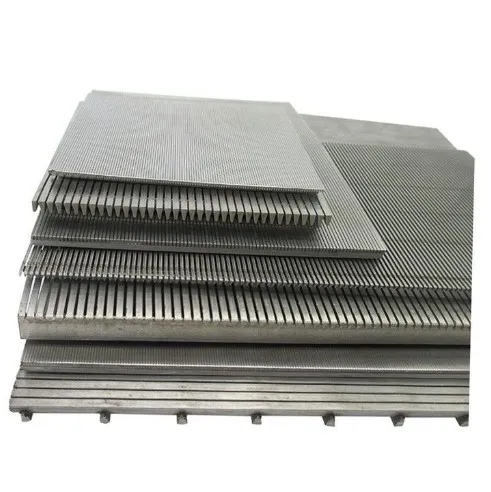
The core of the wedge wire flat screen lies in its unique V-shaped (wedge-shaped) wire design. Unlike traditional woven mesh or perforated plates, wedge wire uses a triangular cross-section, causing the slot to gradually widen in the direction of material flow—the narrow end faces the feed, the wide end faces the discharge. This geometric feature gives the wedge wire panel a natural anti-clogging advantage: once a particle passes the narrow end, it can smoothly exit through the wide end without lodging in the slot.
Technical comparison research by Elgin Separation Solutions notes that wedge wire panels provide “2-point particle contact” rather than the “multi-point contact” of woven mesh, significantly reducing the probability of particle entrapment. Wedge wire panels possess backwash and self-cleaning capability, with convenient routine maintenance.
3.2 Self-Supporting Flat Panel Structure and TIG Welding Advantages
Another core advantage of wedge wire flat screens lies in their structural self-support. The panel consists of V-shaped surface wires welded transversely onto a row of support rods; the welded cage structure itself is the load-bearing member, capable of spanning openings without additional intermediate support. This characteristic is particularly critical in vibrating dewatering screen applications—the panel must withstand the dual loads of high-frequency vibration and material impact.
The choice of welding process directly affects flat screen life. Elgin’s research explicitly states: TIG-welded flat screens are significantly stronger than resistance-welded ones. Resistance-welded screen cylinders, when cut and flattened into panels, subject the welds to additional stress, reducing final product strength; TIG welding is performed directly in the flat orientation, producing deeper, stronger bonds particularly suited to the demanding conditions of flat vibrating screens.
3.3 Material and Specification Customization Flexibility
Wedge wire flat screens can be customized to the specific conditions of Brazilian iron ore. Common materials include 304, 304L, 316, 316L, 321, 430 stainless steel, and duplex steels and other special alloys. Wedge wire widths range from 0.35 mm to 5 mm, and slot sizes start from 0.05 mm, covering standard specifications of 0.10, 0.15, 0.20, 0.25, 0.30 up to 3.00 mm, with precision tolerances controllable to within ±5 microns. This means that for the 45–150 μm coarse fraction dewatering needs of Brazilian iron ore tailings, a 0.15 mm (150 μm) slot wedge wire flat screen can achieve precise classification cuts.
4 Industrial Cases and Quantitative Data
4.1 Pau Branco Mine: Techno-Economic Benchmark
The Pau Branco mine (Quadrilátero Ferrífero region) study is the most complete industrial-scale case in Brazilian iron ore tailings dewatering. Its flowsheet design clearly demonstrates the positioning of wedge wire flat screens within a classified dewatering system:
-
Industrial tailings are first classified in a 45 μm cyclone
-
Coarse fraction (>45 μm, 100 tph) → high-frequency dewatering screen (wedge wire flat screen) → 15% moisture
-
Fine fraction (<45 μm, 200 tph) → thickener → horizontal filter press → 15% moisture
Key pilot parameters for the dewatering screen:
-
Screen aperture: 0.15 mm
-
Effective screening area: 3 m²
-
Feed conditions: 25 tph slurry, 30% solids
-
Final moisture: 15%
The economic evaluation data are particularly critical:
| Parameter | Filter Press (fine) | Dewatering Screen (coarse) | Whole Tailings |
|---|---|---|---|
| Capacity (tph) | 200 | 100 | 300 |
| CAPEX (M USD) | 4.0 | 1.2 | 5.2 |
| Unit investment (M USD/tph) | 0.02 | 0.01 | 0.02 |
The unit capacity investment of the wedge wire flat screen in coarse dewatering is only half that of the filter press. Compared with the conventional tailings dam option: maintaining existing dam capacity would require 10 raises, with total CAPEX of approximately 35 M USD—7 times that of the dewatering option (5.2 M USD).
4.2 Vale Timbopeba Mine: Mobile Pilot Test
Vale conducted a cyclone–vibrating screen combination pilot test on flotation tailings at the Timbopeba mine. The entire system (cyclone, vibrating screen, variable-frequency centrifugal pump, flow meter, pressure gauge) was installed in a container mounted on a truck, allowing mobility between Vale’s various mine sites. The pilot results were described as “promising” (promissores), demonstrating the practical possibility of this concept for flotation tailings dewatering.
The significance of this case lies in the modularity and mobility of the wedge wire flat screen system, making it suitable as a shared testing platform between mine sites and reducing equipment validation costs for individual operations.
5 Positioning of Wedge Wire Flat Screens in Brazil’s Tailings Dewatering System
5.1 Classified Dewatering, Not Whole-Fraction Replacement
The positioning of wedge wire flat screens in Brazilian iron ore tailings dewatering is classified dewatering: handling cyclone-classified coarse tailings (>45 μm), forming a particle size division of labor with filter presses rather than replacing them.
The reason lies in the physical boundary of the wedge wire flat screen: a 0.15 mm aperture means it cannot retain fine tailings dominated by -45 μm. In the Pau Branco flowsheet, the filter press accounts for 4.0 M USD (77%) of total investment, while the dewatering screen accounts for only 1.2 M USD (23%). The “efficiency” of the wedge wire flat screen is partial and classified, not a global replacement.
5.2 Technical Choice Among Banana Screens and High-Frequency Screens
In Brazilian practice, wedge wire flat screens are typically used as the screen media of dewatering screens, mounted on the frames of high-frequency vibrating screens or banana screens. Multotec’s dewatering screen product line explicitly offers “wedge wire and polyurethane dewatering panels for inclined screens,” with slot precision down to 0.5 mm. GKD’s Polywedge panels combine polyurethane coating with wedge wire, with aperture ranges of 0.15–10 mm, suitable for coal and iron ore dewatering applications.
Core considerations for choosing wedge wire flat screens over perforated plates or woven mesh:
-
Open area: The open area of a wedge wire panel is determined by the formula
%OA = s ÷ (s + w) × 100, and high open area can be achieved by optimizing wire width and slot width -
Anti-clogging: The V-shaped wire structure significantly outperforms woven mesh in muddy tailings
-
Wear life: Stainless steel alloys (304/316/duplex) offer longer life under the abrasive conditions of iron ore
6 Regulatory Drivers and Compliance Logic
The substantive impact of ANM Resolution No. 220/2025 is that it has transformed “tailings must be disposed of in low-moisture form” from a technical option into a compliance prerequisite. Key provisions include:
-
De-characterization (descaracterização): a dedicated chapter regulating dam de-characterization procedures
-
Safety level replacing emergency level: the new classification system emphasizes proactive safety management
-
ZAS restrictions: although the restriction on personnel activity within the ZAS under Article 7, Paragraph 1 of Resolution No. 220/2025 was postponed to 26 December 2029 by ANM Resolution No. 245/2026, the long-term direction is clear
These regulatory changes create a clear compliance logic: without dewatering, there is no compliant disposal method. Under this logic, the economic advantage of wedge wire flat screens translates into a compliance cost advantage—processing coarse fractions at the lowest cost while meeting moisture requirements.
7 Conclusions
7.1 Core Conclusions
-
The positioning of wedge wire flat screens in Brazilian iron ore tailings dewatering is “classified dewatering”: handling cyclone-classified coarse tailings (>45 μm), forming a particle size division of labor with filter presses.
-
Technical feasibility has been validated by industrial cases: Pau Branco pilot tests show that a 0.15 mm aperture dewatering screen can reduce magnetite tailings moisture to 15%, meeting dry stacking requirements (20–25% upper limit).
-
The V-shaped wire structure is the core of anti-clogging: wedge wire gradually widens in the direction of material flow and, combined with a self-cleaning mechanism, significantly outperforms woven mesh and perforated plates in muddy tailings.
-
Strength advantage of TIG-welded flat screens: for the demanding conditions of vibrating dewatering screens, the structural strength of TIG-welded flat panels is significantly superior to resistance-welded and subsequently flattened products.
-
Economic advantage is clear but limited: dewatering screen unit investment is approximately 0.01 M USD/tph, half that of filter presses. However, this advantage applies only to coarse fractions and cannot cover whole-fraction tailings.
7.2 Future Research Directions
Optimization boundary of feed concentration: the lower limit and optimal concentration range for wedge wire flat screen feed lack systematic research. Pau Branco uses 30% solids, but the actual concentration fluctuation range of cyclone underflow and its effect on screening efficiency have not been reported.
Coupling effects of chemical pretreatment: whether vibrational shear destroys floc structure and causes dewatering efficiency regression requires experimental verification.
Potential of fine-fraction dewatering screens: with the development of screen materials and vibration technology, is there potential to further lower the applicable particle size lower limit of wedge wire flat screens from 45 μm?
Full lifecycle cost model: existing CAPEX data date from 2016, lacking updated equipment prices, energy consumption data, and wear part life data. Establishing a full lifecycle model incorporating CAPEX, OPEX, water recovery benefits, and risk costs is the prerequisite for scientific technology selection.
Please login to write a comment after