 English
 Español
 Français
 日本語
 한국어
 Deutsch
 Português
 Русский
 中文 (中国)

Introduction
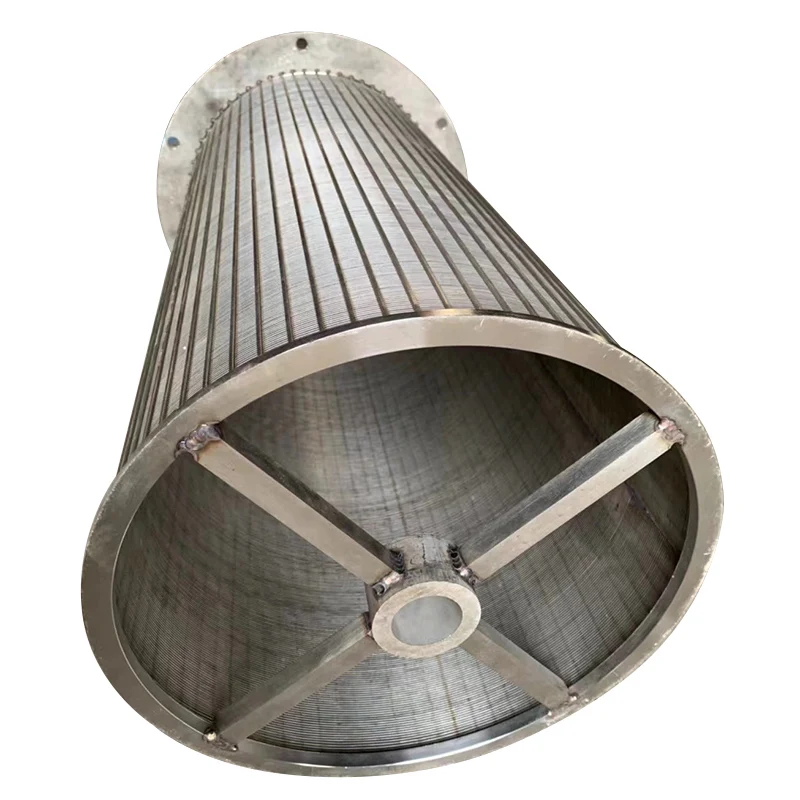
The Stainless steel rotary drum filter screen, also known as the wedge wire drum screen, is a surface filtration device widely used in municipal and industrial wastewater treatment. Its core component is a rotating cylindrical drum made of wedge-shaped wire (V-shaped profile wire) resistance-welded onto support rods. Wastewater passes through the screen surface, solids larger than the slot opening are retained, and the continuous rotation carries the captured material to a discharge mechanism. Compared with perforated plates and woven mesh, wedge wire drums offer higher open area, superior mechanical strength, and a self-cleaning geometry that reduces maintenance frequency.
This article consolidates published specifications, performance models, and application-specific design considerations to serve as an engineering reference for selection and process design.
1. Definition and Core Geometry
Wedge wire construction. The screen surface consists of a V-shaped profile wire wound helically around longitudinal support rods and resistance-welded at each intersection. The V-shape creates an opening that widens inward: particles contact the wire at only two points, which prevents wedging and allows easy backwash release. This is the geometric basis of the self-cleaning effect.
Open area calculation. The percentage of open area (%OA) is the primary determinant of hydraulic capacity:
%OA = slot width ÷ (slot width + wire crown width) × 100
For example, a #60 wedge wire screen with a 0.006-inch slot and 0.0035-inch crown width yields approximately 63% open area. Higher open area means lower head loss and higher throughput per unit of screen surface.
Typical specification ranges are summarized below.
| Parameter | Typical Range | Notes |
|---|---|---|
| Slot opening | 0.1–6.0 mm | Below 150 μm requires special manufacturing |
| Drum diameter | 300–3000 mm | Larger diameter compensates for finer slots |
| Drum length | 500–6000 mm | Determines residence time and submerged area |
| Flow capacity | 10–5000 m³/h | Depends on configuration and slot size |
| Material | SS 304 / 316 / 316L / duplex | 316L preferred for corrosive or marine service |
| Rotation speed | 1–10 RPM | Controlled by variable-frequency drive |
| Open area | up to ~63% | Depends on slot and crown width ratio |
Manufacturing limit for fine slots. Traditional resistance-welding equipment cannot reliably produce slots below 150 μm because the welding gun carriage experiences friction and self-weight deflection along the support rods, causing Z-axis deviation over the 500–600 mm span. European Patent EP0738531B1 describes an improved apparatus incorporating a wedge wire holder with a bird-beak front end, enabling reliable manufacture of slots in the 1–150 μm range. This matters because sub-150 μm drums can separate fine particles without filter cloth or coagulants, potentially replacing coagulation-sedimentation or cloth filtration stages.
2. Working Principle and Performance Models
Internal vs. external feed. In internal-feed configuration, wastewater enters the inside of the drum and flows outward through the screen; retained solids are conveyed by a screw or spiral to the discharge end. In external-feed configuration, wastewater flows around the outside of the drum and passes inward; solids are retained on the outer surface, lifted by rotation, and scraped off at the top into an integrated screw conveyor.
| Configuration | Feed Direction | Solids Removal | Typical Use |
|---|---|---|---|
| Internal feed | Inside → outside | Screw conveyor | Municipal primary treatment |
| External feed | Outside → inside | Scraper + screw | High hydraulic load, industrial |
Separation size prediction. Research from the University of Queensland provides a predictive model for wedge wire screen d50 (the particle size at which 50% is retained):
log₁₀d₅₀ = 0.722·log₁₀SW + 0.023·WUS + 0.00678·PD
where SW is slot width, WUS is bottom water flow rate, and PD is pulp density. This model demonstrates that separation size is not determined by slot width alone; water flow and slurry conditions also play significant roles.
Hydraulic loading rate reference values for selection estimates are given below.
| Screen Type | Hydraulic Loading Rate (m³/h·m²) |
|---|---|
| Static dewatering screen | 30–60 |
| Trough / tank screen | 20–45 |
| Vibrating screen | 40–80 |
Drum screens typically fall in the trough/tank range unless supplemented by vibration or spray assistance.
Capture efficiency. Published removal efficiencies range from 85% to 99% depending on target pollutant and slot size. A Japanese study using a 100 μm wedge wire drum screen reported the following results.
| Parameter | Value |
|---|---|
| Slot opening | 100 μm |
| Average SS removal | 30% |
| Average BOD removal | 22% |
| Separated sludge moisture | 86.5–92.5% |
| Maintenance-free operation | 6 months, no clogging |
| Cleaning method | Two brushes |
3. Key Design Trade-offs
Slot size vs. open area vs. throughput. This is the central trade-off in drum screen selection. Reducing slot size improves capture of fine particles but reduces open area, which lowers unit-area throughput. Compensating requires either a larger submerged screen area or a larger drum diameter. A drum designed for 6 mm slots cannot simply be re-specified with 0.5 mm slots and expected to pass the same flow; the entire hydraulic design must be recalculated.
The relationship can be illustrated as follows.
| Slot Width (mm) | Relative Open Area | Relative Throughput | Capture Fineness |
|---|---|---|---|
| 6.0 | High | High | Coarse |
| 2.0 | Medium | Medium | Medium |
| 0.5 | Low | Low | Fine |
| 0.1 | Very low | Very low | Very fine |
Submergence and self-buffering. Because the drum filters only its submerged circumference, the controlling design parameter is the hydraulic loading rate: flow divided by effective submerged open area. As retained solids build a mat on the screen, water level rises, submerging more screen area and increasing capacity. This provides a degree of self-buffering—but only up to the top of the drum. Beyond that point, overflow or bypass occurs.
Continuous vs. intermittent operation. Under normal municipal wastewater conditions, wedge wire drum screens can operate for extended periods without clogging. However, during algal blooms, grease discharges, or fibrous material surges, clogging can occur rapidly. Selection must consider worst-case conditions (peak flow, contaminant surges), not averages.
4. Application-Specific Design Logic
Municipal and industrial wastewater. The design objective is suspended solids removal and sludge concentration. Typical slot sizes range from 0.5 mm to 6 mm. Internal-feed configurations with screw conveyors are common for primary treatment. External-feed configurations with scrapers suit applications requiring higher hydraulic loads. Aeration or spray bars maintain screen permeability.
| Application | Typical Slot Size | Flow per Unit Width |
|---|---|---|
| Municipal primary sewage | 0.060 in (1.5 mm) | 150–1280 US gpm |
| Municipal primary sewage | 0.100 in (2.5 mm) | 190–1600 US gpm |
| Poultry feather | 0.060 in (1.5 mm) | 60–560 US gpm |
| Meat processing | 0.020 in (0.5 mm) | 50–480 US gpm |
| Meat processing | 0.040 in (1.0 mm) | 55–520 US gpm |
| Vegetable/fruit | 0.010 in (0.25 mm) | 80–750 US gpm |
| Brewery | 0.030 in (0.75 mm) | 75–720 US gpm |
Seawater intake and marine life protection. Here the design objective shifts from “remove solids” to “remove solids without harming marine organisms.” This is a fundamentally different design logic. Key requirements include: low through-slot velocity (recommended ≤0.15 m/s), gentle lift-hold-wash path, and avoidance of organisms being crushed against the screen surface.
Supporting data:
| Parameter | Value |
|---|---|
| Annual marine kills from intake structures (California, 2010) | 2.1 billion fish, shrimp, crabs |
| Annual losses, single coal unit (33,941.5 m³/h) | 1.42×10⁷ eggs; 2.616×10⁸ larvae; 1.4985×10⁶ shrimp |
| Recommended through-slot velocity | ≤0.15 m/s |
| Example slot width | 3.0 mm |
| Through-slot velocity (example) | 0.4 fps |
| River sweeping velocity (example) | 2.9 fps average |
| Sweep-to-through ratio | ~7:1 |
In this application, the ratio of sweeping velocity to through-slot velocity is critical: higher ratios allow inertial passage of organisms past the screen without entrainment. Wedge wire screens also present a relatively small “hydraulic influence zone,” allowing fish larvae to escape with a single short burst swim.
Chinese standards gap. Current Chinese standards (DL/T 458, DL/T 1257) do not specify requirements for preventing marine organism impingement mortality. This represents a significant technical gap compared to U.S. and European practice.
5. Operational Boundaries and Failure Modes
Normal self-cleaning regime. Under design conditions, the V-shaped slot geometry, continuous rotation, and spray/brush cleaning maintain stable head loss. A 100 μm drum with two brushes operated for six months without maintenance in Japanese testing.
Failure triggers and screen life are summarized below.
| Factor | Effect |
|---|---|
| Flow above design hydraulic loading | Rapid clogging |
| Grease / oil coating | Blinds slots, blocks flow |
| Algal bloom | Sudden high organic load |
| Fibrous material | Wraps rods, bridges slots |
| High loading rate (123 L/s) | Screen life ~4 hours (early design) |
| Reduced speed and loading | Screen life ~346 hours |
| Further improvement | >1 year reported |
Algal bloom contingency. During algal blooms, fine-slot screens (2–3 mm) require continuous operation including standby units, to prevent sudden debris surges from exceeding screen capacity. Additional spray nozzles and auxiliary lifting frames may be required.
6. Summary
The Stainless steel rotary drum filter screen with wedge wire construction is a mature technology with well-characterized geometry, predictable separation behavior, and broad application in municipal and industrial wastewater treatment. Its design logic, however, is not uniform across applications: municipal wastewater prioritizes solids capture and sludge concentration, while seawater intake prioritizes ecological protection and organism survival. Sub-150 μm slots expand its capability into fine-particle separation without chemical aids, but manufacturing constraints limit availability. Selection must be based on worst-case hydraulic and contaminant conditions, not average values, and must account for the specific failure modes of each application.
Please login to write a comment after