 English
 Español
 Français
 日本語
 한국어
 Deutsch
 Português
 Русский
 中文 (中国)

- Introduction
- How it works
- Open area and velocity calculation
- Applications
- Key technical parameters
- Material selection
- Surface treatment and sanitary design
- CIP/SIP compatibility
- Advantages over conventional solutions
- Comparison with conventional solutions
- Maintenance and lifecycle management
- Compliance and standards
- Selection and best practices
- Conclusion
Introduction
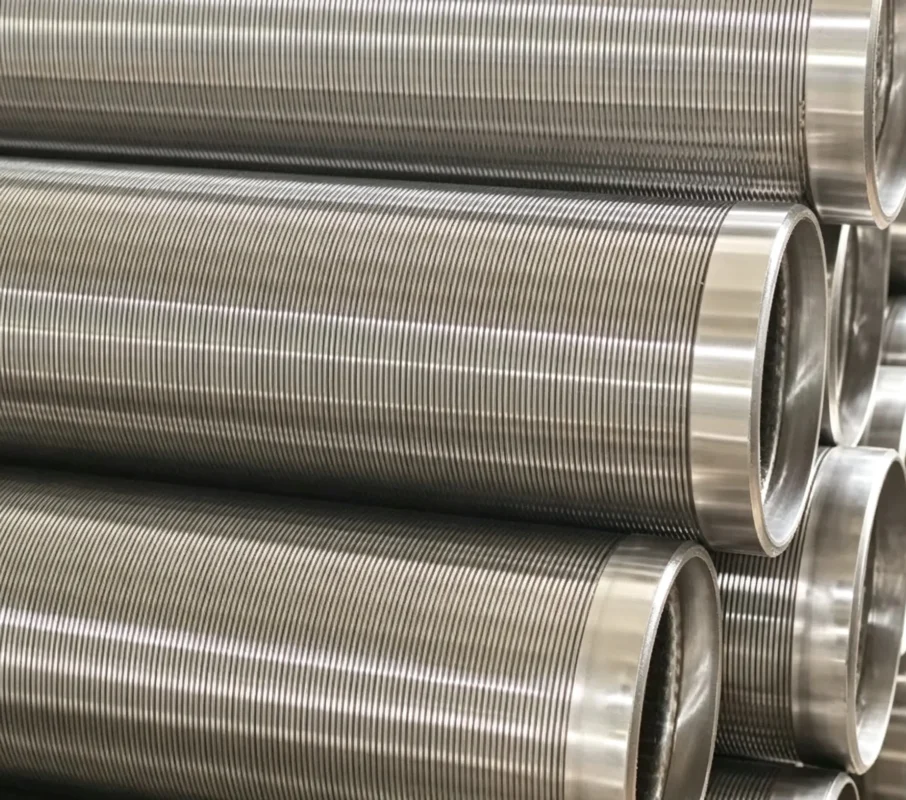
The food and beverage industry requires filtration processes that combine efficiency, hygiene and durability. Unlike other sectors, here the product contact is direct, sanitary requirements are strict and frequent cleaning is mandatory. In this context, the wedge wire filter basket, also known as a profile wire screen or V-wire basket, has become a mature technical solution for several stages of the process.
How it works
A wedge wire basket is made of trapezoidal profile wires welded onto support rods. This design creates continuous openings that widen from the inlet side to the outlet side. The result is a screen surface with a high open area, low pressure drop and strong resistance to clogging.
Unlike woven wire mesh, where particles can become trapped in the weave, wedge wire screens allow solids to touch only two points of the wire. This makes it easy for particles to be removed or carried away from the filtration zone, giving the basket a self-cleaning behavior. In addition, the continuous channel widens downstream, so particles are released during CIP and backwashing rather than becoming wedged.
Open area and velocity calculation
Open area is a central design parameter:
-
Open area = slot ÷ (slot + wire width) × 100%
-
The effective open area is reduced at each wire-support rod intersection, typically 3 to 8% below the nominal value.
The effective approach velocity is calculated as:
-
v = Q ÷ (A × %OA)
where Q is the volumetric flow rate (m³/h), A is the wetted screen area (m²) and %OA is the open area as a decimal.
The practical selection rule is to choose a slot slightly smaller than the smallest particle to be retained, then confirm that the approach velocity is gentle enough not to drive solids into the slot.
Applications
1. Brewing and distillery
Wedge wire false bottoms are the ideal structure for the mash tun. The V-shaped profile keeps solids in place while allowing efficient filtration and flow. Standard slots are 0.028 in. (approx. 0.71 mm) and 0.030 in. (approx. 0.76 mm). The screen is resistant to clogging and easy to clean, serving operations from microbreweries to large commercial plants.
2. Dairy
Centrifuge baskets and rotary baskets are used for cured cheese drainage, whey separation and milk clarification. The smooth surface and continuous profile prevent the retention of proteins and fats, which are the main fouling agents in this sector.
3. Juices and beverages
Wedge wire baskets are applied in juice extraction, pulp separation and clarification. The high open area maintains flow even with a high content of suspended solids.
4. Starch and sugar
Curved screens are used in starch washing, fiber separation and protein recovery. Rotary screens are applied in dairy effluent treatment.
5. Edible oils
Wedge wire baskets are employed in the refining and filtration of vegetable oils, withstanding elevated temperatures and aggressive media.
6. Brine and acid lines
For brine, pickling and acid juice lines, SS 316L is the recommended choice, since SS 304L tends to pit over time in these environments.
7. High-viscosity media
The high free channel, low flow resistance and robust construction make the wedge wire basket suitable for viscous media, where conventional screens lose flow rate quickly.
8. Wastewater treatment
In food industry wastewater treatment, wedge wire screens replace perforated plates and woven mesh, offering greater mechanical strength, less clogging and longer service life.
Key technical parameters
-
Material: stainless steel AISI 304, 304L, 316L or duplex, depending on the aggressiveness of the medium.
-
Slot opening: from 0.02 mm to 10 mm; in the food and beverage industry, 0.05 mm to 2 mm is common.
-
Profile wire: 1 × 2 mm, 2 × 3 mm, 2 × 4 mm, 3 × 4 mm, among others.
-
Support rods: 2 × 3 mm, 4.2 × 6.5 mm, among others.
-
Shapes: cylindrical basket, conical, inclined, rotary drum, curved screen or flat panel.
-
Basket diameter: from 300 mm to 2,500 mm.
-
Length: from 500 mm to 6,000 mm.
-
Rotary drum speed: 1 to 10 RPM.
-
Working temperature: ambient up to 130 °C (CIP/SIP cycles).
-
Filtration direction: inside-out or outside-in.
Material selection
-
SS 304: general food processing, with minimal welding and chloride exposure.
-
SS 304L: standard welded food processing equipment.
-
SS 316L: baseline for salt, acid and chlorinated cleaning environments.
Surface treatment and sanitary design
For dairy, beverage and pharmaceutical applications, specify electropolishing with a surface roughness of Ra 0.8 µm or better. Electropolishing removes the disturbed metal layer and forms a chromium-rich passive surface that resists bacterial attachment and cleans faster than mechanically polished surfaces.
For less critical applications (grains, sugar, starch), standard pickling and passivation is sufficient.
Welds should be resistance welds, with no filler metal, no solder and no adhesive, resulting in a single homogeneous stainless steel piece with no crevices or dead zones. Horizontal surfaces where product can accumulate should be avoided, all internal angles should be rounded, and the equipment should be validated for complete CIP cleaning without disassembly.
CIP/SIP compatibility
Typical CIP/SIP cycles operate at ambient temperatures up to 130 °C, with alkaline, acid, peracid and steam chemicals. Material selection must consider the chemical nature and temperature.
Failure modes and mitigation:
-
Bacterial growth in slots: the continuous V-profile widens downstream, releasing particles during CIP and backwashing instead of wedging them.
-
CIP/SIP chemical attack: SS 316L is the baseline for alkaline, peracid and chlorinated cycles; the smooth surface reduces deposit buildup between cycles.
-
Protein and fat fouling: the continuous slot geometry and high open area maintain flow even in high-solids streams.
Advantages over conventional solutions
Self-cleaning: the wedge shape prevents particles from becoming embedded in the opening.
High flow rate: the continuous slot and high open area allow greater flow with lower pressure drop. Wedge wire open area can reach 65%, compared with 25 to 40% for perforated plates.
Durability: welded construction and corrosion-resistant materials extend service life. Typical service life in the food industry is 10 to 20 years, varying by material: SS304/304L 5 to 8 years, SS316L 8 to 15 years, duplex 15 to 25 years or more.
Reduced cleaning time: industrial case studies indicate a 40 to 60% reduction in cleaning time compared with woven wire mesh.
Total cost of ownership: in many applications, the long service life of wedge wire can reduce lifecycle cost by more than 50% compared with conventional screening solutions.
Comparison with conventional solutions
Versus woven wire mesh:
-
Wedge wire is self-supporting, with inherent rigidity due to wire cross-section, substructure and multi-point welding.
-
It is generally easier to clean, with a smoother surface and lower risk of damage during cleaning.
-
It is much stronger, but also heavier.
-
It generally has a higher initial cost.
Versus perforated plate:
-
Wedge wire offers greater open area and better clogging resistance.
-
It is indicated when perforated plate does not have enough open area or woven mesh cannot withstand the required differential pressure.
Maintenance and lifecycle management
Common failure mechanisms: abrasive erosion, chemical corrosion, vibration fatigue, thermal cycle stress and support rod deformation.
Recommended maintenance frequency:
-
Visual inspection: monthly
-
Pressure monitoring: weekly
-
Slot wear assessment: quarterly
-
Structural inspection: annually
Cleaning methods: CIP systems, high-pressure water jet, air burst cleaning and mechanical brushing where applicable.
Compliance and standards
For food and beverage contact applications, the basket should meet requirements such as:
-
FDA 21 CFR (food contact materials)
-
3-A Sanitary Standards
-
EHEDG (European Hygienic Engineering and Design Group)
-
EC 1935/2004 (food contact materials in the European Union)
-
EN 10204 3.1 (material certificate)
-
ISO 9001, AS9100c, NADCAP (manufacturing quality)
Selection and best practices
Basket selection should consider fluid viscosity and temperature, fiber and suspended solids content, pH and chloride presence, design flow rate and allowable pressure drop, CIP cleaning requirements, available space and equipment type (basket, drum, curved screen or flat panel).
It is recommended to evaluate the filtration direction (inside-out or outside-in) and the drive type. In rotary drums, the clearance between the screw conveyor and the screen — typically 0.3 mm to 2.0 mm — directly influences cake dryness and equipment capacity.
Conclusion
The wedge wire filter basket is a mature technical solution for the food and beverage industry. Its performance combines high flow rate, clogging resistance, durability, easy cleaning and sanitary compliance. To get the most benefit, it is essential to correctly specify material, slot opening, geometry, surface treatment and flow direction, and to follow applicable sanitary standards. Investing in a well-designed basket means fewer shutdowns, better product quality and lower operating costs over many years.
Please login to write a comment after