 English
 Español
 Français
 日本語
 한국어
 Deutsch
 Português
 Русский
 中文 (中国)

Introduction
The sugar-alcohol industry handles large volumes of juice, molasses, syrup and wastewater, often at elevated temperatures and with a significant load of fibers, fine bagasse, sand and other solids. Filtration efficiency directly affects sugar and ethanol quality, energy consumption and maintenance costs. The wedge wire filter basket, also known as a profile wire screen or V-wire basket, has become a robust solution for several stages of the process.
How it works
A wedge wire basket is made of trapezoidal profile wires welded onto support rods. This design creates continuous openings that widen from the inlet side to the outlet side. The result is a screen surface with a high open area, low pressure drop and strong resistance to clogging.
Unlike conventional wire mesh, where particles can become trapped in the weave, wedge wire screens allow solids to touch only two points of the wire. This makes it easy for particles to be removed or carried away from the filtration zone, giving the basket a self-cleaning behavior.
Applications in the sugar-alcohol industry
1. Cane juice filtration
Wedge wire baskets are used in juice clarification and pre-treatment, retaining fine bagasse, fibers and impurities before they reach evaporators and crystallizers. Early removal of these solids reduces scaling, improves heat transfer and lowers steam consumption.
2. Continuous centrifugals
Wedge wire filter baskets are used in high-speed centrifugals to separate sugar crystals from molasses. Case studies show that 90-micron screens maintain molasses purity comparable to traditional chrome-plated screens, but with a much longer service life: while the conventional screen wears out in one harvest, the wedge wire basket can last three to six harvests.
3. Mud and filter cake filtration
In carbonatation or sulfitation mud filtration, the basket must withstand alkaline environments and high temperatures. The V-shaped profile prevents deep clogging and facilitates cake discharge.
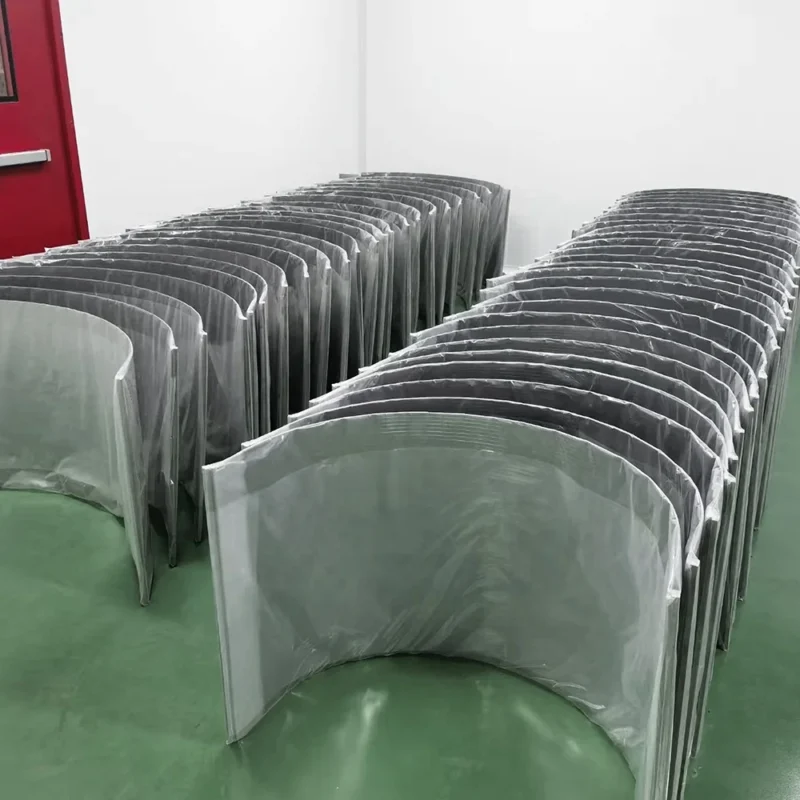
4. DSM screens and curved screens
DSM screens use gravity and centrifugal action to separate fibers and solids from juice, without moving parts or external power. This reduces energy consumption and maintenance, making them especially useful for pre-filtration and effluent treatment.
5. Filtration before evaporation and crystallization
Before concentrated syrup moves to crystallization, the basket removes grit and particles that could compromise crystal quality. Opening stability at high temperatures is a decisive factor.
6. Wastewater treatment
In vinasse and wastewater treatment, wedge wire screens replace perforated plates and wire mesh, offering greater mechanical strength, less clogging and longer service life.
Key technical parameters
-
Material: stainless steel AISI 304, 304L, 316L or duplex, depending on the aggressiveness of the medium.
-
Slot opening: from 0.02 mm to 10 mm; in the sugar-alcohol industry, 0.05 mm to 0.7 mm is common.
-
Profile wire: 1 × 2 mm, 2 × 3 mm, 3 × 4 mm, among others.
-
Support rods: 2 × 3 mm, 4.2 × 6.5 mm, among others.
-
Basket diameter: from 300 mm to 2,500 mm.
-
Length: from 500 mm to 6,000 mm.
-
Rotary drum speed: 1 to 10 RPM.
-
Working pressure: up to 14 bar in specific applications.
-
Filtration direction: inside-out or outside-in, depending on the design.
Advantages over conventional solutions
Self-cleaning: the wedge shape prevents particles from becoming embedded in the opening.
High flow rate: the continuous slot and high open area allow greater flow with lower pressure drop.
Durability: welded construction and corrosion-resistant materials extend service life, reducing downtime and replacement costs.
Energy efficiency: cleaner juice means lower pumping resistance, better heat transfer and less evaporator scaling. Every scale layer acts as thermal insulation and increases steam and electricity consumption.
Low maintenance: DSM screens and rotary baskets have few moving parts and require minimal supervision.
Compliance and standards
For food and beverage contact applications, the basket should meet requirements such as:
-
FDA 21 CFR (food contact materials)
-
3-A Sanitary Standards
-
EHEDG (European Hygienic Engineering and Design Group)
-
EN 10204 3.1 (material certificate)
Selection and best practices
Basket selection should consider:
-
Fluid viscosity and temperature
-
Fiber and suspended solids content
-
pH and chloride presence
-
Design flow rate and allowable pressure drop
-
CIP cleaning requirements
-
Available space and equipment type (basket, drum, curved screen or flat panel)
It is recommended to evaluate the filtration direction (inside-out or outside-in) and the drive type. In rotary drums, the clearance between the screw conveyor and the screen — typically 0.3 mm to 2.0 mm — directly influences cake dryness and equipment capacity.
Conclusion
The wedge wire filter basket is a mature technical solution for the sugar-alcohol industry. Its performance in juice, molasses, mud and wastewater filtration combines high flow rate, clogging resistance, durability and energy efficiency. To get the most benefit, it is essential to correctly specify material, slot opening, geometry and flow direction, and to follow applicable sanitary standards. Investing in a well-designed basket means fewer shutdowns, better product quality and lower operating costs across multiple harvests.
Please login to write a comment after